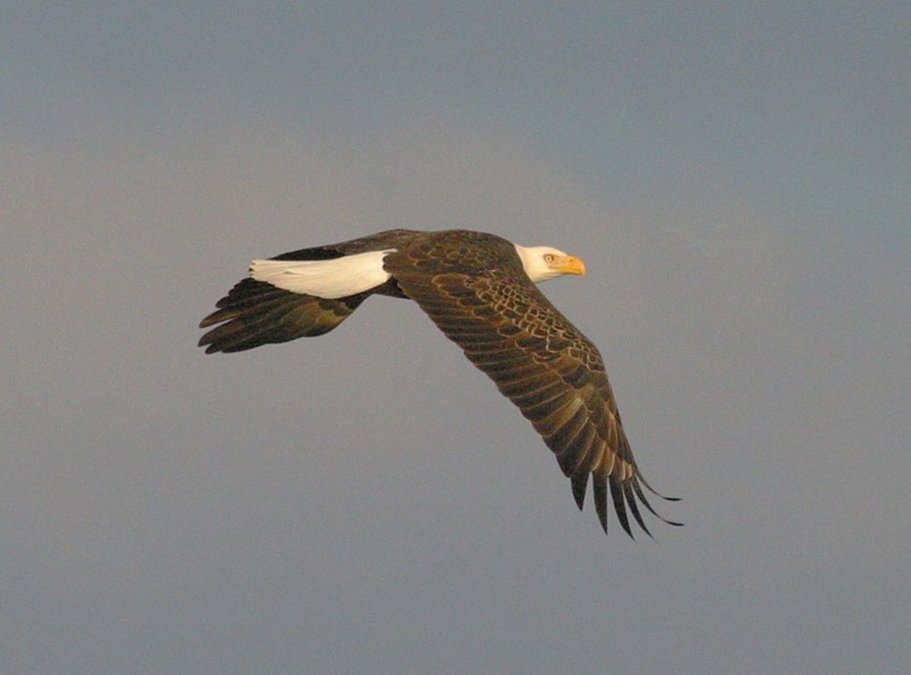
The 2026 survey of bald eagles nesting in Georgia may have covered less territory than usual, but the results point to a population that is still going strong.
According to a release from the state Department of Natural Resources, the survey rated nest success for bald eagles above average in all areas checked, said survey leader Dr. Bob Sargent.
Even though the survey sample size was smaller for the DNR surveys in even-numbered years, nearly half of all known eagle nests in the state were monitored, providing a reliable measure of productivity.
Of 113 occupied nest territories recorded, 101 were successful, fledging 170 eaglets (1.7 per nest) – an 89 percent success rate. The totals for nest success and fledging topped long-term averages.
Accounting for nests not checked, Sargent said the findings suggest Georgia again had over 200 nests, as it has since 2015, and the number of nesting eagles continued to increase in some areas, even if that trend has slowed over the last 10 years.
“This year’s results reflect a population that is having a strong year acquiring food resources and has clearly bounced back from the serious hit productivity took – especially on the coast – during the initial avian influenza outbreak in 2022,” Sargent said. “Unfortunately, we have evidence that the disease persists in Georgia and elsewhere across the U.S. But our survey shows that these magnificent birds are resilient.”
Following a steep decline in the eagle population in Georgia, the state went from no known successful nests during most of the 1970s to one in 1981, 55 by the turn of the century and more than 200 today.
Bald eagles have rebounded in Georgia and across the species’ range. Factors fueling the recovery include a U.S. ban on DDT use in 1972, habitat improvements after enactment of the federal Clean Water and Clean Air acts, protection through the Endangered Species Act, increased public awareness, restoration of local populations through release programs and forest regrowth.
DNR monitors eagle nesting by helicopter twice a year, splitting the state into five sections for surveys. Flights in January and February mark nests in use. Follow-ups in March and April help gauge how the nests fared.
The state’s six coastal counties are surveyed annually. During even-numbered years, nests are checked in northeast and central Georgia, as well as the north/northwest region of the state. Volunteers also monitor about 15-20 nests statewide each year, sharing their observations with DNR.
The 2026 survey covered the coastal counties and barrier islands, a swath of northeast Georgia framed by Athens, Dublin and Augusta-area reservoirs, and several reservoirs between Atlanta and Macon. Data on 16 nests that volunteers checked from the ground was also included.
Nest success rates ranged from 88 percent on the coast to 91 percent in central and northeast Georgia and 94 percent for the volunteer-monitored nests. The rates are notably higher than the long-term averages of 70-75 percent. But Sargent also cautioned that conducting the follow-up survey flight earlier than normal on the coast this year could have led to a slightly inflated nest success rate for that region.
The number of occupied nests surveyed on the coast has varied over about the last 10 years from the low 70s to the mid-80s, so the 75 recorded this year is average, he said. DNR typically documents 30-35 occupied nests in the central and northeast Georgia areas. This year’s results would have been consistent with that range if the entire follow-up survey could have been completed.
The public is encouraged to report eagle nests via https://georgiawildlife.com/bald-eagle, or by calling (478) 994-1438. Such reports typically lead to the discovery of 10-15 new nests a year.
DNR works with landowners to help protect bald eagle nests on private property. Although delisted from the Endangered Species Act in 2007, eagles are protected by the Bald and Golden Eagle Protection Act, the Migratory Bird Treaty Act, and state law. In Georgia, the species is classified as threatened.
The surveys of these birds are part of DNR Wildlife Conservation Section’s mission to conserve nongame wildlife – native animals not legally hunted or fished for – and native plants and natural habitats.
The conservation of bald eagles is supported in part by people who buy an eagle or monarch license plate or renew these or the older hummingbird designs. The tags cost only $25 more than a standard license plate and $19 of each purchase and $20 of each annual renewal goes to help conserve eagles and hundreds of other Georgia plant and animal species listed as species of conservation concern.