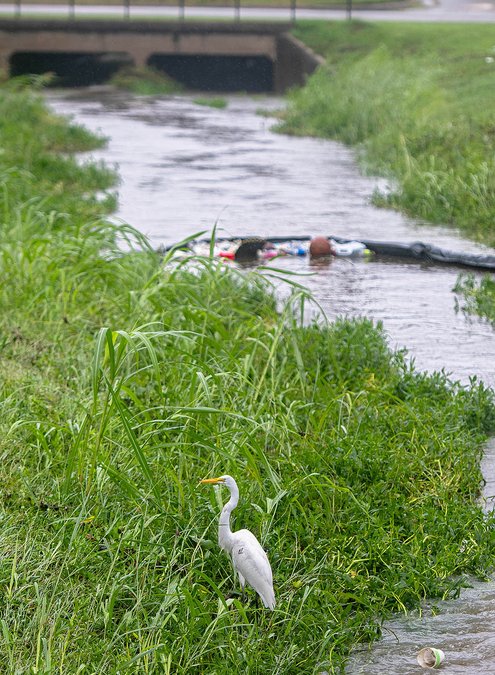
The city of Statesboro is set to move forward with a hydrologic and hydraulic study of the Little Lott’s Creek basin, by accepting federal and state grants Tuesday that will cover 85% of the estimated $945,000 cost.
“Hurricanes and storm events have caused significant flooding around Little Lott’s Creek and Bird’s Pond over the last three years. …,” city Public Works and Engineering Director Brad Deal stated in a June 26 memo. “Effective stormwater management of Little Lott’s Creek will improve water quality and help maintain a healthy environment for city residents and the broader community beyond the Statesboro city limits.”
The memo was included with a proposed grant acceptance resolution and related documents in the mayor and City Council’s agenda packets for the 9 a.m. Tuesday, July 7, regular council meeting.
A Hazard Mitigation Assistance Program grant through the Federal Emergency Management Agency, or FEMA, will fund the study as preliminary planning for flood mitigation projects along the basin, Deal reported. With FEMA authorizing the estimated cost of the study up to $945,000, the federal grant is for 75% of that amount, or $708,780. Further, the state will provide a 10% “match,” or $94,500, through the Georgia Emergency Management Agency, GEMA.
City’s cost share
That leaves the local share at 15% of the authorized cost, or $141,750. The source for this amount, identified in Deal’s memo and other documents, is the city’s stormwater fund. This money is collected from residents, businesses and other city service customers through the stormwater fee, billed monthly along with water, wastewater and trash collection fees.
The city government is expected to hire a consultant to perform to study.
“This study will address major flood risks, identify impacts on land use changes and proposed targeted mitigation strategies,” states the “scope of work” summary. It also says the study will focus on areas of the creek basin inside Statesboro and beyond to approximately one mile outside the city limits.
The tasks to be performed include data collection, including records of rainfall and streamflow, land cover, topography (using LiDAR) and soil data and FEMA floodplain maps and records of dam failures; wetland assessment; a Global Positioning System field survey; public outreach and input efforts; hydrologic and hydraulic modeling; model calibration; a budget report; and finally, a watershed stormwater plan document.
FEMA also approved $47,250 funding for “subrecipient management costs,” or expenses for city personnel managing the grant contract.
The expiration date for the grant is Aug. 27, 2030, and the city would have to apply for an extension at least 60 days before that if work is not completed.
Creek on Blue Mile
Meanwhile, a $15.5 million line of credit, a major portion of Statesboro’s long-promised state funding and financing for the Creek on the Blue Mile Project, also affecting Little Lotts Creek, has expired this year. As a result, the city is looking afresh at the timing of that multifaceted project, after receiving a state official’s advice that the line of credit will be available again in 2030.
The Creek on the Blue Mile was a locally conceived vision, combining flood control, economic development and recreational aims, that received state support. Back in 2018, the city was approved for a $15.56 million Georgia Environmental Finance Authority, low-interest (2.25%) line of credit and $5.5 million in direct state funding for the project. (Notice that GEFA, which was the source of the line of credit, is a different state-supported agency from GEMA, mentioned in regard to the new hydrology study funding).
While using about half of the state direct funding on a Creek on the Blue Mile feasibility study, planning and design, the city never borrowed against the GEFA line of credit. But now, in 2026, that line of credit has expired, City Manager Charles Penny reported during the June 16 council meeting.
“While the GEFA commissioner declined to extend the line of credit directly, the agency agreed in writing that the city has until 2030 to apply for those funds at the original 2.25% interest rate for a 30-year term,” states a summary of Penny’s comments in the June 16 meeting minutes.
Also, during a work session on June 16, council members heard a city staff update about the Creek on the Blue Mile overall funding sources. In regard to the line of credit, the slideshow summary stated that GEFA advised reapplying “when ready for construction” but before Jan. 1, 2030.
Another, more recent state funding source for a portion of the project, called an INODIC grant, also faced a deadline this year without being spent, and has been altered as a result. Improving Neighborhood Outcomes in Disproportionately Impacted Communities grants were created in 2022 from remaining federal pandemic-era funding to the state, and Statesboro was approved in 2023 for a $1.65 million grant.
That money was proposed for construction and installation of amenities on the proposed, terraced creek-side promenade. These features could have included brick pavers, lampposts, benches, trash receptacles and bicycle racks.
Memorial Park instead
However, the deadline for the funds to be spent was October 2026. Realizing the grant was going to expire before Creek on the Blue Mile construction began, city staff members applied for a “change in scope,” approved in May, for INODIC funding to instead be applied to the design of the renovation of Memorial Park, the park bounded by Max Lockwood Drive, South Zetterower Avenue and Fair Road. It also includes a portion of the creek to be landscaped.
During the June 16 meeting, the council awarded a $915,420 grant to EMC Engineering Services for the design of Memorial Park.