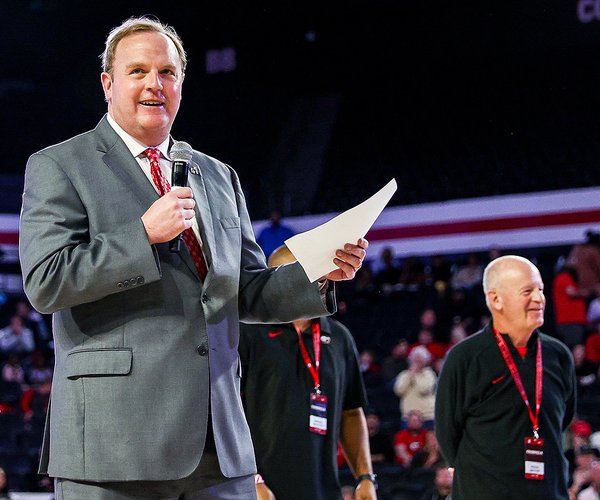
As the 2025–26 athletic and fiscal year comes to a close, Georgia Southern Director of Athletics Chris Davis reflects on his first two years at the helm and discusses what's ahead.
Q: As we conclude the 2025-2026 athletics season and now that you're two years in, how does a Chris Davis athletic department look in this modern age of college athletics?
CD: We still have to keep the main thing the main thing, which is taking care of our student-athletes, our coaches, our staff, our donors, fans and alumni, and representing Georgia Southern University at the highest.
I think that's something that sometimes gets lost in today's modern age. But that's still a critical part. I'm proud of a lot of things we do because, at the end of the day, we are people-focused. And if you think about it, our donors, our fans, and our alums: people. Our student-athletes are the epicenter of everything we do in athletics: our focus. Our coaches, who spend the most time with our athletes, are very important to our enterprise: our focus. Our staff, and everything they do to put on all our different games and events. All the care they put into meeting our fans, donors, and alumni, and into communicating: our focus. Representing an incredible institution like Georgia Southern and working with Dr. Marrero, an incredible president, and our cabinet-level leadership, and everyone at this institution: people. So at the end of the day, our focus is on people.
And then strategy. I think it's people-focused with strategy. We are very much looking at every ounce of strategy and getting more and more focused on what that means and looks like in this ever-changing landscape. From a strategy standpoint, you're seeing it across the board in everything we're doing.
It's not just facilities now; we're looking at how to build rosters. How is that really important in today's landscape? That's a piece. How do we support our coaches and staff individually while still recognizing it's a comprehensive enterprise? It's more of an individualistic approach because the way we approach helping one sport compete versus another is definitely different. The business aspect of college athletics in terms of planning and running budgets is more complex than it has ever been.
Q: There's a lot of talk in the business about revenue generation, fan experience and storytelling. How is the department pivoting to this style of external communications?
CD: It's definitely different because you need to give a lot of information, and that information is changing. There's a lot of information out there from a national perspective that people are reading on social media and other sources. Not that it's untrue, but what does it mean for Georgia Southern when there are a lot of people taking a stance on something when no one really knows what's actually going to happen? I'm very big on making sure we do keep the main thing the main thing. When we talk about facts, we can talk about facts. We stay in an area where we can change on a dime. Georgia Southern Athletics is striving every day to drive greater resources and we can pivot quickly because we have great people and the ability to execute a strategy.
Now, the key is what is best for Georgia Southern? And in the revenue generation category, we're looking at all kinds of different things for Georgia Southern. There's the Eagle Victory Plan and looking at how that rolls out, and the five different buckets we've talked about. Terry Harvin has done a lot of his own videos, which is important. Terry is an important part of our athletics foundation, and our foundation is a vital cornerstone to everything we do. Raising money is important; raising money in all those different buckets is important. Meeting people where they are and explaining what that means and how to do it, is important.
Storytelling is going to be at the top of our list this upcoming year, not just by me but by our entire athletic department. Georgia Southern is a brand, and the old adage is that athletics is the front porch. We have to go and get even deeper with our storytelling. That's something that we're challenging our entire team on. How can we become even deeper storytellers, and that's in every medium? That's the key.
Q: Fans hear terms like revenue sharing, NIL and roster management every day now. For Eagle Nation, what's the biggest misconception about how all of this impacts a program like Georgia Southern?
CD: First of all, the portal, NIL and revenue sharing are here, and they're here to stay. There are great things and not-so-great things about the portal as it affects our rosters. I understand when a fan or donor gets upset about a player leaving; it makes sense. The important part is this: from a portal standpoint, we need to focus on each individualized sport and what's important to how we build the rosters. We have tools that the coaches use to navigate their rosters so they know who they have, where their vacancies are and a management for the overall roster building.
We want to do everything we can to drive resources in the revenue sharing area because it helps us compete at a greater level. Our resources and matching fan expectations are what keep me up at night. I genuinely care that our student-athletes can compete at the highest level, and our coaches can do what they need to put the best team they can. Our fans, donors and alumni want us to have a winning product that they can be proud of. So, how can we get them there from the standpoint of getting more wins?
Q: Four Eagle teams made the postseason this year. Looking back, what accomplishments across the department make you the most proud?
CD: Degrees from this university matter from the standpoint that no one can take that away from you. From the student-athlete piece, we sometimes don't talk enough about it. We graduated a bunch of student-athletes this year. Ryan Gilbert and his team did a phenomenal job, and we finished with a record GPA of 3.264. It's really impressive when you think of nearly 400 student-athletes with that GPA.
Our fall sports were a lot of fun, and we had a lot of successful moments. Our men's soccer program was nationally ranked with a high RPI, and we had two players taken in the MLS rosters. How cool is that? They were homegrown by Coach Squires and his staff. We had an incredible gift from Bo Pitts that impacted the whole team, and you saw how that changed things. We matched people and revenue. We had the financial resources and the right people and created some really cool things.
Look at volleyball and what Chad Willis has done and continues to do with that program. I know he's chasing the Sun Belt championship. There has been a lot of magic in Hanner, and there's only more to come.
Football had a very impactful season because it had multiple chapters. The West Coast chapter was really tough, and then we had a tough time in October, but we came back and had a strong November that led into a strong bowl performance and win in Birmingham. Yes, we want November to be where we chase conference championships, and we can't shy away from that. It's really important. That's why we're focused on making that even better for next year. Coach Helton's roster building and staff building is vitally important. We took a deep look at everything we could to continue to up that support as a cornerstone of who we are at Georgia Southern, and we need to continue to do that.
Women's basketball had an incredible year, winning the Sun Belt regular season title, and then men's basketball had five wins in five days down in Pensacola at the conference tournament to really draw some national attention to the program.
Baseball is a sport that I think everyone is really upset about, including myself. I heard countless times from Coach Hennon in postgame interviews how he was taking the blame and realizing that we need to be better. We now have an unbelievable baseball facility we built together, and I mean that: together. That was Eagle Nation - donors, fan support, alumni support and institutional care of our entire team, led by Dr. Marrero. We need to make sure we put the baseball product together, so that's a huge focus going into this year.
Q: Has there been any talk about dropping or adding sports at the varsity level?
CD: At Georgia Southern, we've had zero conversations about removing any of our sports. There are some sports we keep an eye on from an addition standpoint, but nothing is currently moving that direction. Right now, we've got to focus on what we have. We have a great mix of sports that are all supported financially to be competitive. We need to continue to raise our financial strength to continue to meet the competitive challenges while communicating to our fans. Because once again, the people are our most vital asset. That includes the fanbase, the students, alumni, coaches and our staff. At the epicenter are our student-athletes. You either like, love it, or live it. We want them to live their sport, be the conduit of growth and let them compete at the highest level.
Q: The Steverson Baseball Facility was the latest big facilities project and is close to being done. What's on the radar for the future?
CD: From a facilities standpoint, over the course of years I have been at Georgia Southern, formerly as the COO and now as the AD, we've been able to do a lot of projects and that's exciting. It's $100M+ worth of projects and the focus on those projects was also a lot of different timelines in college athletics. I know that sounds crazy to think about because five, four or three years ago doesn't sound like a long time. But the amount of change that has happened in college athletics over that time is hard to believe. We will continue to enhance our athletic facilities, but we also need to enhance other aspects of our competitive edge, which is our people piece.
So are we going to continue to do facilities? Yes. What does that look like? I think the next projects we look at include Paulson Stadium. Can we do a Bishop Field House enhancement? That's a big thing. That's probably our focus. I would love to do some things in the press box and suites. Is there an additional video board in play? All those pieces are things that we're looking at.
We'd love to do some things at softball. Exploring how we make that whole stadium feel more stadium-esque as it relates to a potential fan deck in the right-center field as we have at baseball, and maybe a nice entrance to the stadium. We did a lot of different things with soccer and track, but we continue to keep an eye on them.
Q: Finally, when you think about the overall 'state of the union' for Georgia Southern Athletics right now, what would you say to fans, donors and alumni about where the department is headed and why they should be optimistic about the future?
CD: First of all, I want to thank Eagle Nation for their constant and consistent care for Georgia Southern Athletics and Georgia Southern University as a whole. We need to continue to focus on trying to grow those touchpoints. We're beacons of information; all of our staff is, and so are our coaches. So if there's a person you need us to reach out to that we haven't, please reach out to us and let us know.
You saw our Hall of Fame class, and the mix of that class, the various student-athletes that crushed their sports of play here at Georgia Southern that deserve and have earned their way into the Hall of Fame. We're about honoring because we are a school that is student-athlete-centric, coach-centric and also people-focused. The Hall of Fame class really shows that.
We must pull together and stay together. And when we have questions, and when we have concerns, we need to talk them out. I think it's really important that I'm always accessible.
Then, as it relates to winning, we stay in a constant state of challenging our department with how we can win more. When we closed out the athletic season a few weeks ago at our last meeting, I challenged all our staff to ask how can we keep the vibe and the accelerated piece of making sure we impact our community, we impact our APEX program, we impact our GPAs, we impact our student-athlete experience, we impact making sure we graduate. But how do we also impact winning?
And we are winning in so many areas. But we want to win more. So we are putting the focus on making sure our coaches and our student-athletes know how our athletic department, and our team of athletics support staff can help them win. Because at the end of the day, we want to be a championship ecosystem that is people-focused but is focused on winning championships and having a process to achieve those goals.