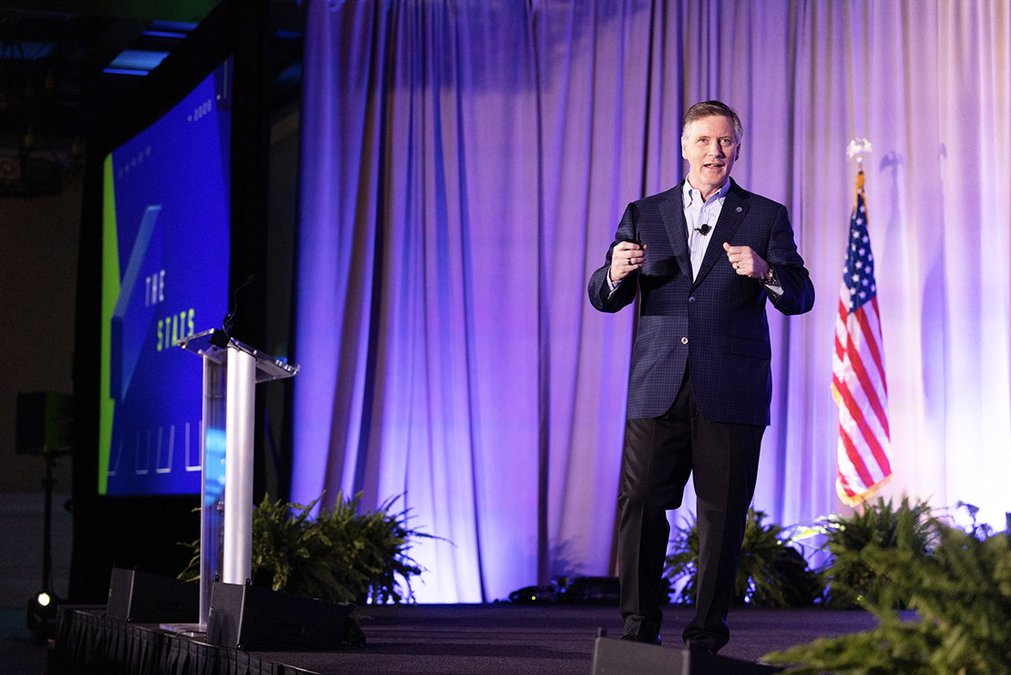
The Georgia Ports Authority recently held their 57th annual Georgia International Trade Conference bringing together customers, business partners and industry leaders to discuss the latest maritime and logistics developments.
Gov. Brian Kemp met with Georgia Ports customers and logistics partners during the conference.
In his opening remarks, Kemp said “Innovation and port investments by the Georgia Ports Authority are helping to keep our state No. 1 for business, while also positioning us as a true leader in global trade. Our ports are an economic engine for the entire state, and we’ll continue to find ways to further their success and reach.”
New findings from Georgia Tech researchers show using the Port of Savannah saves shippers more than $1,000 per container to Atlanta, Memphis and Nashville, compared to West Coast gateways, along with more predictable transit times.
Chris Gaffney, managing director of the Supply Chain and Logistics Institute at Georgia Tech said: “Our research shows … routing cargo through Savannah reduces congestion exposure, saves shippers money and delivers more consistent, predictable transit performance,” he said.
Aboout 80 percent of Savannah’s cargo moves inland by truck and 20 percent by rail. With the cost of diesel fuel, rail is increasingly attractive beyond 250 miles from the port.
“In today’s current global business environment, our customers require greater supply chain predictability and cost savings opportunities,” said Georgia Ports President and CEO Griff Lynch. “We have the capacity and connectivity to respond quickly to disruptions and market fluctuations around the world, enabling our customers to adjust supply chain speeds and routings to win and retain business.”
On average, 40 container ships a week go to the Port of Savannah, 42 double-stack trains a week then connect to inland markets, with the lowest rail loading time in the nation of 20 hours or less.
Georgia Ports 10-year plan will see five new big ship berths added, reflecting a 54 percent growth in container throughput with Ocean Terminal and Savannah Container Terminal. Rail service will be a major differentiator as a gateway port serving growth to inland consumer and manufacturing markets. The Mason Mega Rail facility had a record year in 2025, handling 591,000 containers.
Savannah Harbor deepening and widening feasibility study announced
On April 15, the Georgia Ports Authority submitted a Letter of Intent to Adam Telle, the Assistant Secretary of the Army for Civil Works to formally begin the study process to further deepen and widen the Savannah Harbor.
The U.S. Army Corps of Engineers encourages non-federal sponsors to undertake feasibility studies themselves in line with Section 203 of the Water Resources Development Act of 1986 as a way to accelerate dredging timelines and save taxpayer funds.
“We are excited to kick off this first step with the Army Corps of Engineers on the Savannah Harbor deepening and widening feasibility study,” Lynch said. “Our goal is to be the benchmark for Army Corps of Engineering deepening projects.”
Port officials said the shipping channel needs to be improved to better handle the largest ships currently coming into Savannah, and to prepare for even larger, more efficient vessels expected to serve the U.S. East Coast in the future.
The study will consider deepening the channel and adding passing lanes for two-way ship traffic. The U.S. Army Corps of Engineers will provide technical assistance and will retain final review and approval authority, including oversight of environmental and economic analyses.
GDOT infrastructure improvements
The Georgia Department of Transportation will begin construction on a cable replacement project for the Talmadge Bridge over the Savannah River. The bridge will remain operational during the project. The work will shorten the bridge’s cables, increasing air draft beneath the bridge from 185 feet to about 205 feet, allowing larger vessels to pass. Completion is expected in 2029.
In August 2026, GDOT will open the $126 million Brampton Road Connector, a four-lane highway providing a direct link between the Port of Savannah’s Garden City Terminal and the interstate system, removing at-grade rail crossings and truck traffic from local neighborhoods.
Separately, GDOT plans to widen Interstate 95 by one lane in each direction along a 22-mile stretch from Exit 90 to the South Carolina state line; the project is currently in preliminary design.
The department also plans to reconstruct and widen portions of Interstate 16 west of I-95 toward State Route 67 in Bulloch County. This $522 million project will expand I-16 to three lanes in both directions, with construction expected to begin in 2027.
“All the pieces are coming together in Savannah as the gateway of choice for the Southeast region,” Lynch finished. “With five container berths in the pipeline, along with a new Gainesville Inland Port and multiple GDOT infrastructure improvements, Georgia Ports is ready for the next 10 years with its $5 billion investment plan as the fastest growing port in the Southeast, serving 70% of the nation’s population east of the Mississippi River.”