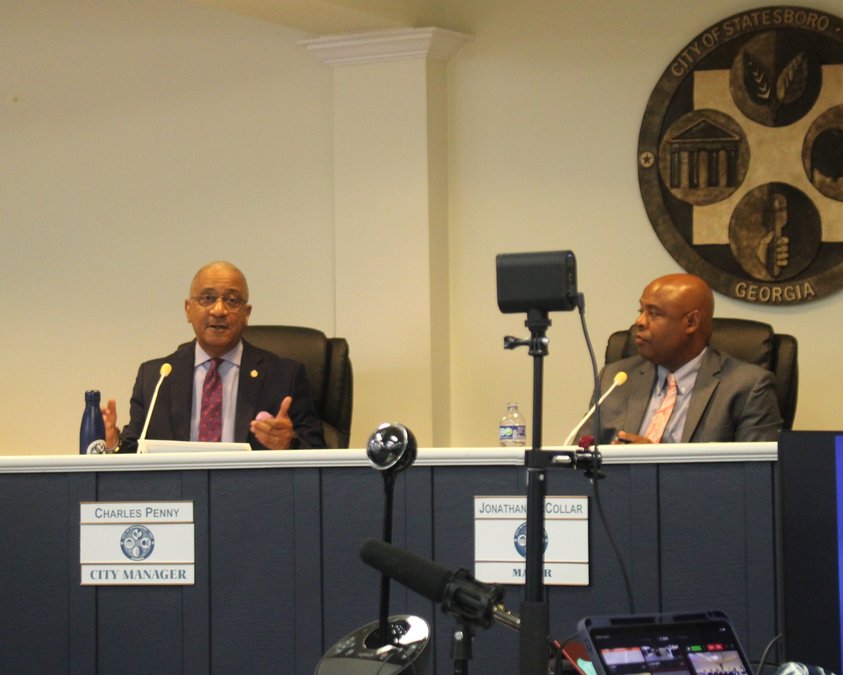
With the version of Statesboro’s proposed fiscal year 2027 city budget presented at last week’s budget hearing, city staff reduced the forecast property tax increase to a slightly less than 25% rate hike, down from a 44% increase suggested in May.
“And it might go down some more,” City Manager Charles Penny emphasized when asked about the millage rate numbers right after the Tuesday, June 2 council meeting, which included the hearing.
On a $225,000 market-value home with a standard homestead exemption, the newly suggested 2.129-mill increase would mean about $187 in additional tax. But the 3.835-mill rate increase he’d suggested during a May 12 meeting would have resulted in tax rise of about $337 on the same example property.
Reasons given for the downward revision include, foremost, the availability of about $1.4 million revenue from the new sales tax known as FLOST a year earlier than originally expected, and secondarily, more “real growth” in the value of the tax digest resulting from construction of new homes and businesses.
“This budget reflects a nominal tax base increase from new developments,” Penny said in his presentation to the council. “We think probably in this budget there’s about $700,000 in revenue from the new apartments, the new houses …, things like that. Those will help contribute to our budget this year.”
In the earlier version of the budget proposal, he and Finance Director Cindy West had used an estimate of 8% real growth in the city’s total digest value. But they have now increased that allowance to 10%. Penny said a potential estimate of real growth as high as 13% had been heard, but city officials are waiting for final digest values from the Bulloch County Board of Assessors staff.
Early FLOST effect
Meanwhile, the first six months’ revenue from the Floating Local Option Sales Tax, or FLOST, also known as a Property Tax Relief Sales Tax, is becoming available a full year earlier than expected. Authorized by a “yes” vote of 71.7% of Bulloch County voters in a November 2025 referendum, the FLOST became the ninth penny of sales tax here and has been collected since Jan. 1.
Under the 2024 Georgia law that authorized such a tax, the revenue was originally required to be collected for a full year before being available for proportional rollbacks of property tax rates by the county and the cities beginning July 1, 2027.
But in early May, Gov. Brian Kemp signed updated legislation that, in counties such as Bulloch that have collected a FLOST tax since Jan. 1, makes the first six months revenue available for counties and cities’ fiscal 2027 budgets, starting July 1, 2026.
The estimated $1.4 million FLOST cash collected from January through June can substitute for that amount of property tax in the currently proposed budget. But a full 12 months’ revenue from the sales tax, plus forecast growth and inflation, should make more than double that amount available for fiscal 2028.
Predicts 1-year reversal of hike
“Final conclusion, to balance the city’s budget for fiscal year 2027 will require a 2.129-mill increase,” Penny said. “This increase is due to the county’s decision to dissolve the fire district. This year’s FLOST is estimated to be about $1.4 million, which is a good thing. The increase will be offset next year (FY 2028) by the FLOST funds, which are estimated at $3.5 million.
“So basically, what we would recommend is a millage rate increase this year, but next year we should be able to roll that millage rate back to where we are today,” he concluded. “It’s a one-year impact in order to be able to fund the fire department.”
This follows the termination, effective July 1, 2025, of the longstanding intergovernmental agreement under which the Bulloch County government supplied a portion of the Statesboro Fire Department’s revenue, in exchange for the SFD’s providing primary response to areas outside the Statesboro city limits within five miles of its two stations.
In the city’s budget presentations, the loss of the fire tax district funding was estimated at $2,755,000. Meanwhile, a three-year federal Staffing for Adequate Fire and Emergency Response, or SAFER, grant totaling $2.1 million the city was awarded in 2023 to hire an additional 12 full-time firefighters expires in August. So, this is resulting in the loss of another $703,000 in annual funding.
With his latest presentation, Penny continued to defend the ongoing, sales-tax funded construction of SFD Station 3 and retention of the Fire Department’s full staffing with 69 career firefighters and four city-funded dispatchers despite the loss of the five-mile district.
“We need those 69 firefighters to serve the city of Statesboro,” he said.
Other than the offsetting funding sources and millage hike dial-back, the budget was little changed from the May presentation. Penny described it as a no-frills proposal, with no funding for any new hires in any department.
“This budget is balanced, and again, there’s no increase in personnel,” he said.
It will provide It a 2% upward adjustment in the city’s overall pay plan, which is less than a compensation consulting firm’s reported recommendation of 3.5%. It also continues “pay for performance” opportunities for city employees but will require a 15% increase in employee-paid insurance premiums.
No water, sewer, stormwater or other fee increases are proposed.
Overall, the city’s general fund expenses are budgeted at $32.67 million, up from $27.37 million in the curren fiscal year, and the fire fund at $8.64 million, up from $8.04 million, with the fire fund’s main revenue source being an almost $7.5 million transfer from the general fund.
All of the city’s budgets together project total expenditures of $90.15 million, up from $89.67 million in the current year, not including transfers between funds.
After Penny’s presentation, Mayor Jonathan McCollar called for public comments in the budget hearing, but nobody rose to speak or ask questions.
Councilmember John Riggs made a motion to move the budget forward as presented. Councilmember Tangie Johnson seconded, and the vote was 4-0. Council may now vote for final adoption of the budget during the 5:30 p.m. June 16 meeting.
But the tax millage will not be set with the budget. A series of tax increase hearings would be held later this summer, before the millage vote.
Millage rate background
For calendar year 2025, and as applied to the 2026 budget that expires June 30, the city’s property tax rate was 8.625 mills. At the end of the revised slideshow Penny presented for the formal budget hearing during the June 2 council meeting, he revealed a new suggested rate of 10.754 mills, which would be a 2.129-mill increase. In May he had presented the budget as requiring a 3.835-mill hike, mainly to make up for the lost funding sources for the Statesboro Fire Department.
A mill is 1/1,000th of a property’s value as assessed for taxes, and most real estate in Georgia is assessed at 40% of market value. So – not considering any exemptions – each 1 mill unit amounts to $90 tax on a home or other real estate with a market value of $225,000.
Therefore, with a 2.129-mill rate hike, the tax a $225,000 house with a standard $2,000 (in assessed value) homestead exemption would increase by $187.35. At 8.625 mills, the tax on the example how was $759. At 10.754 mills, the tax would be $946.35, or 24.6% higher.