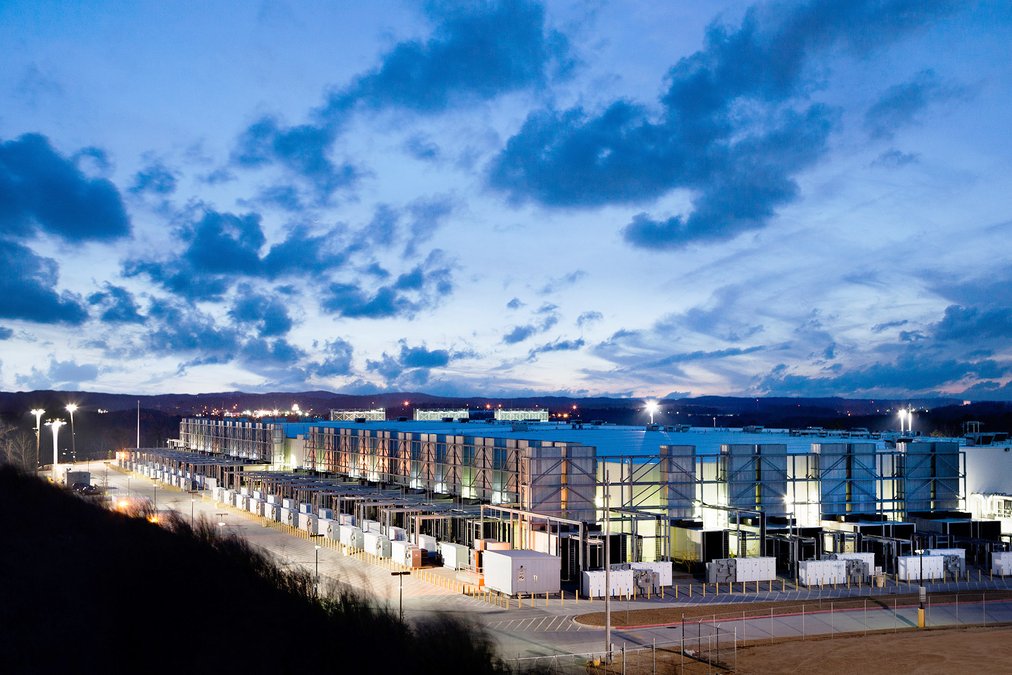
Bulloch County Planning and Development staff, following a May directive from the Board of Commissioners, now proposes to remove all possibly permissive references to data centers, as well as regulations allowing “crypto mining” from the county zoning ordinances.
Ironically, the currently proposed zoning text amendment will add a “data center” definition that wasn’t there before, but only to clarify what isn’t being allowed in various zones.
The proposed amendment is the last of 11 zoning items on the agenda for the Planning and Zoning Commission’s 5:30 p.m. meeting Tuesday, July 21, in the North Main Annex community room. After a hearing there, the appointed board is expected to vote on a recommendation for or against the change, after which it would go back to the elected Board of Commissioners, possibly during their 5:30 p.m. Aug. 4 session, for a vote.
Back in mid-February, the commissioners imposed a 90-day moratorium barring the creation of data centers in the county unincorporated area and setting May 5 as the date of a hearing on possible extension of the moratorium.
By May 5, Planning and Development Director James Pope and staff had drafted an ordinance that could have allowed data centers as conditional uses in certain zoning categories or by right in specific “overlay zoning” areas. This was posted to the Board of Commissioners’ page on Facebook.
‘Flat no,’ takes time
But after hearing from citizens and holding the May 5 hearing, commissioners not only voted to extend the moratorium to Dec. 31, as expected, but went further. Commissioner Toby Conner said at the time, “I don’t think we should even go on with the moratorium; I think we should just put the flat ‘no’ on this.”
After County Attorney Jeff Akins advised commissioners that an action not to allow zoning centers at all would require a Zoning Ordinance amendment through the usual process, Conner ultimately made the motion to extend the moratorium to year-end, and it passed 5-0.
But meanwhile, Commissioner Nick Newkirk offered a motion “to start the process” for a zoning amendment prohibiting data centers in Bulloch County outright. Conner seconded it, and that motion was also approved 5-0.
“That instructed staff to write the text amendment for that purpose, so that is what we’re bringing to the (Planning and Zoning) board now,” Pope said in a Friday interview.
During the May discussion, Akins and Pope had noted that provisions for “cryptocurrency mining,” enacted by the commissioners a few years ago, might be in conflict with a ban, and that consideration has also gone into the currently proposed amendment.
That brings us to this week.
Not in any zone
As summarized in the P&Z Board agenda, the amendment would add a definition for “Data Center,” and modify existing definitions for the General Business, Heavy Manufacturing and Light Manufacturing zoning classifications.
Here is the definition proposed to be added:
“Data center. A facility that houses computing and networking equipment, along with storage and management systems, to support the storage, processing, and distribution of digital data and applications,” it states, and then adds a description.
“A data center typically features high-performance servers, storage arrays, networking equipment, cooling systems, and power backup solutions to ensure uninterrupted operation,” the description states. “Server rooms or similar IT operations that are subordinate to a primary use are not included in this definition.”
That last sentence could be important to businesses that don’t exist to provide data processing for others but do have rooms filled with computer servers or other information technology equipment that supports their own work.
If the amendment is enacted, each of the separate definitions of three zoning classifications where data centers might previously been allowed will have a single sentence added at the end: “General Business does not include data centers.” … “Heavy Manufacturing does not include data centers.” … “Light Manufacturing does not include data centers.”
“The definition of a data center recognizing what a data center is, then the other sections of the text amendment essentially say a data center is not heavy industrial or manufacturing or general business,” Pope explained Friday.
Defined away
“In that way if anyone comes in and wants to do a data center in Bulloch County, our ordinance recognizes a data center use and points to the fact that it is not in the use chart, and the couple of uses that other jurisdictions have used as possible interpretations of where a data center may be able to go, we’re clearly specifying that, no, a data center is not these things,” he said. “So that, to us, makes it clear that a data center would not be able to locate in Bulloch County, in the unincorporated area, crypto-mining included.”
It has been four years since Bulloch County officials, led by a somewhat different panel of commissioners, went to some trouble to add regulations for cryptocurrency “mining” operations as conditional uses in Ag-5, Light Industrial and Heavy Industrial zones.
The summer of 2022 was when Excelsior EMC, the rural electric co-op based in Metter, proposed placing a commercial cryptocurrency mining operation – really a compact data center with racks of servers used to verify transactions made with encrypted digital currencies – at a site along Georgia Highway 119, near the 119 Spur, in southeast Bulloch County.
The local regulations were designed to address noise concerns for cooling fans of a 10-megawatt facility. Originally, it was proposed to occupy about one acre from a 5.5-acre power substation site owned by Georgia Transmission Corporation, which is owned in turn by electric membership co-ops across the state.
Despite receiving conditional-use approval for a modified site plan by a 5-1 vote of commissioners in early September 2022, that project never materialized. By that time, crypto-mining operations were receiving heavier state scrutiny, including from some area legislators.
No ‘crypto’ either
So the 2026 amendment would also remove the following definitions: Commercial Cryptocurrency Mining, Cryptocurrency, Cryptocurrency Data Center, Cryptocurrency Server Farm.
Finally, the amendment will modify “Section 1415: Commercial Cryptocurrency Mining Operation” to read only “Section 1415: Reserved.” In other words, that space will still be there, but awaiting something county officials might add in the future, if ever.
These references were removed with the thought of “cryptocurrency mining being a type of data center,” Pope explained.
“We don’t have one in place here, and I don’t anticipate us getting one, so I think it’s probably best just to wrap that up into data center use, and if we’re eliminating the possibilities of data centers being here, crypto-mining would be the same thing,” he said.
The county’s jurisdiction on this is limited to its unincorporated area, outside the cities and towns. Statesboro City Council, by a 3-1 vote on June 2, approved an ordinance that could allow data centers occupying up to 50 acres each in certain zones inside Statesboro’s city limits.