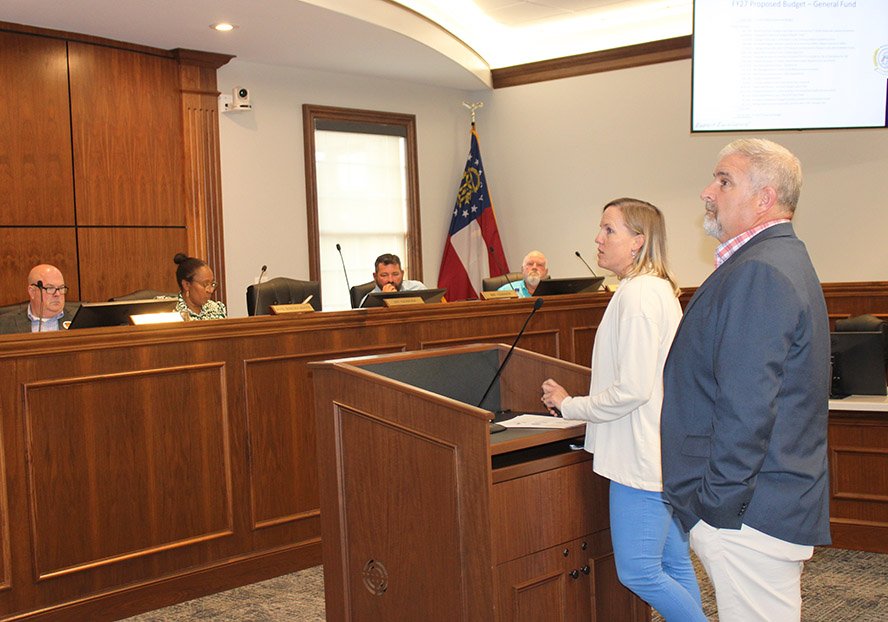
Bulloch County commissioners came into Tuesday evening’s special meeting with a budget projected to allow a partial rollback of their general government property tax rate from 11.35 mills to around 10 mills, but made two additions that could add back more than a third of a mill.
Those additions, both approved by less than unanimous votes of the commissioners, will staff and keep open seven solid waste collection centers than had been planned to close, at an expected added cost of around $850,000, and fund the hiring of six new Bulloch County Sheriff’s Office personnel, at a rough estimate of about $600,000.
Going into the meeting, which included the announced public hearing on the budget, County Manager Chris Eldridge told commissioners it was a last opportunity to make changes. Commissioners are slated to vote to adopt the budget next week for it to be in effect July 1.
“We have to have it finalized tonight because you can’t make changes that last night because then you’d have to readvertise,” he said.
With the $1.45 million in added spending, there should still be a rollback of the property tax millage rate, but a still more limited or “partial” one in terms of only partly reversing the effects that inflation in real estate values has on property taxes.
Any property tax rollback, along with an already proposed more than $4 million expected increase in spending, is being bankrolled by an estimated $6.4 million revenue from the first six months of the FLOST, or Floating Local Option Sales Tax. But the rollback was already expected to be “partial” because county staff hadn’t proposed a “full” rollback to offset the overall inflation in assessed values.
Few new hires
But the proposed budget presented by Eldridge and Chief Financial Officer Kristie King going into Tuesday’s 5:30 p.m. hearing was much reduced from April’s “wish list” budget.
As previously reported from a May work session, this version would have eliminated all of the 21 full-time and one part-time added general fund employee positions, estimated to cost $1.8 million, originally requested by department and agency chiefs. It still doesn’t supply any of the additional 17 full-time firefighter positions requested from the Rural Fire Fund, which has its own tax separate tax rate, currently 3 mills.
Collection centers
After Assistant County Manager Crystal Dawson and interim Solid Waste Director Rose Bonner unveiled a plan last month to reorganize the county’s solid waste collection center system, some related staffing changes were built into the budget. Originally, the plan called for closing 10 of the 22 current centers, staffing the remaining 12 centers, limiting their hours and days of operation and locking them at night, with all of this to take effect by Jan. 1, 2027.
That plan, reflected in the budget at the beginning of Tuesday’s meeting, called for eliminating eight of the 17 current positions in the Solid Waste Department but adding 12 positions at Bulloch County Correctional Institution for employees to be assigned to work at the collection centers.
FLOST effects
Meanwhile, the FLOST, also known as a Property Tax Relief Sales Tax, has been collected here as the “ninth penny” sales tax since Jan. 1, having been approved by a large majority of Bulloch County voters in a referendum last November. As originally authorized in state law, the FLOST would have been collected for a full year before being available for proportional rollbacks of property tax rates by the county and cities beginning July 1, 2027, the start of the 2028 fiscal year. But Gov. Brian Kemp signed amended legislation last month that makes the first six months revenue available for counties’ and cities’ fiscal 2027 budgets, starting July 1, 2026.
King estimated that six months of the 1% FLOST tax will bring the county about $6.4 million.
Technically, what she first suggested during the May 19 budget work session was a fractional 0.215-mill increase in the property tax millage followed immediately by a 1.511-mill rollback offset by the first six months of FLOST revenue.
That would have amounted to a roughly 1.3-mill net property tax rate reduction, and a new rate of about 10 mills. A mill is 1/1,000th of a property’s value as assessed for taxes, and most real estate in Georgia is assessed at 40% of market value. So – not considering any exemptions – 1 mill amounts to $100 tax on a home or other real estate with a market value of $250,000.
Citizen opposition
Tuesday’s hearing was lightly attended. Only three citizens spoke, but all three spoke for having no tax increase, and requested or demanded a greater reduction. Commissioners Chairman David Bennett repeatedly emphasized that a millage rollback was intended and noted that Bulloch County has adopted FLOST and related elements of a state law that also creates a homestead exemption with assessment increases limited to the national Consumer Price Index inflation rate.
One of the citizen speakers, Bulloch Action Coalition co-founder Cassandra Mikell, excoriated the commissioners for not limiting spending to provide a full rollback, which she said would have made the general fund property tax rate about 9.3 mills.
She referred to the state law known as the Taxpayers Bill of Rights, or “TaBOR.” In the absence of a full rollback, this law will still require the commissioners to hold a series of tax increase hearings later, before finally setting the millage rate. This is a separate process from adopting the budget.
“By law, will you have to have TaBOR hearings?” Mikell asked.
“My understanding of this is, by law, yes, we will have to have hearings,” Bennett said.
“So, that is a tax increase, David. That is a tax increase. By law, that is a tax increase. …,
Mikell said. “(FLOST) was meant to provide people with a savings in their tax rates.”
Noting that FLOST was providing about $6 million at this point and saying there had been a $2 million “deficit” she asserted that this left “about $4 million to play with” and that after a rollback to 9.3 mills the county would still “have a little left.”
“Y’all are increasing taxes. Don’t lie to the people!” Mikell said.
Board adds back
But in the past few weeks, commissioners had also been hearing complaints from citizens who objected to the plan to close so many of the waste collection centers, as well as from certain county officials.
Commissioner Timmy Rushing, who did not seek re-election this year and noted he has half a year more to serve, said he would rather see the county fund more needs now and avoid putting things off until a large tax increase becomes inevitable in a few years. He said there is about $22 million in state funding for infrastructure in the I-16 and U.S. 301 interchange area available that will be lost if the county doesn’t improve its law enforcement and fire department coverage.
The county has a $60 million sales tax-funded plan to expand the jail, Rushing noted, and suggested that Sheriff Noel Brown’s requested staff additions were part of a planned multi-year buildup. However, the six Sheriff’s Office positions sought this year, according to King, were for training and support, court services, the crime suppression unit and field operations. She had a $583,000 cost estimate.
An initial motion Rushing made to add back funding for the six Sheriff’s Office positions failed for lack of a second.
Meanwhile, Commissioner Ray Davis had suggested closing only the three unfenced garbage collection sites – those at Rocky Ford, Highway 80 West and Lake Collins – but staffing to operate the remaining 19 fenced solid waste centers. He proposed operating nine or 10 each day on alternating days through a six-day work week.
“Now let me be clear, that would be manning the stations three days a week, all 19, closing the three that are not fenced in,” he said. Dawson then provided the $850,000 cost estimate.
Commissioner Anthony Simmons seconded Davis’ motion, and it passed 4-1, with Rushing voting “no.”
A little later, after some further discussion, Simmons made a motion to fund the six added Sheriff’s Office positions, with a more generic $600,000 cost now stated, and Rushing seconded it. This passed 3-2, with Simmons, Rushing and Commissioner Ray Mosley voting “yes” and Davis and Commissioner Toby Conner voting “no.”
Commissioner Nick Newkirk was absent.
For fiscal year 2027, set to begin July 1, the budget proposal allows general fund spending of $76.25 million, up from $72 million in the fiscal 2026 budget. It includes pay adjustments for some positions toward the implementation of a new compensation plan, but no across-the-board or merit-based raises.