Statesboro City Council entered its new fiscal year Tuesday with a shorter-term renewal of the city's small business recruiter agreement with Georgia Southern University, a new agreement with Hyundai for two years free use of two Ioniq 5 electric vehicles, and negotiations for EMC Engineering to take over design work for the Creek on the Blue Mile.
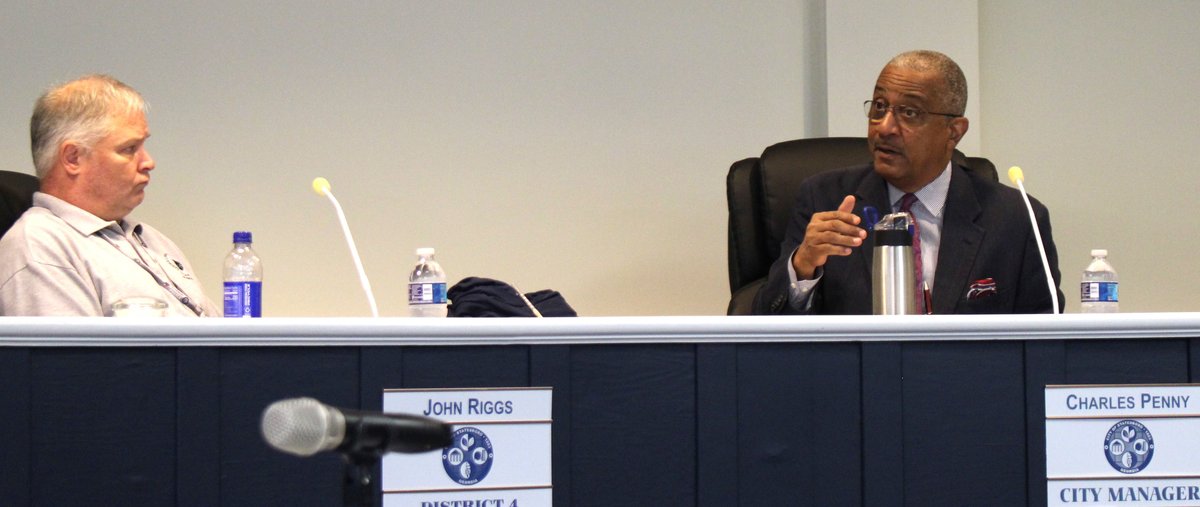
July 1 is always the first day of a new fiscal, or budget, year for the city, but the mayor and council don't always meet on that day. However, their first regular meeting of each month is held at 9 a.m. on the first Tuesday, so it worked out that way for July 1, 2025, officially the start of fiscal 2026. City Manager Charles Penny even said, "Happy new year," to the elected officials and public.
For the past three years, the city had maintained a Retail Development and Small Business Recruitment Agreement with the Georgia Southern University Research and Service Foundation. The city paid an amount that covered the salary, benefits and travel expenses of a "retail recruiter," and the university provided the recruiter, Alan Gross, with office space and support at its Business Innovation Group, or BIG, headquarters, which is downtown near City Hall. Under the agreement, Dominique Halaby, founding director of BIG and now Georgia Southern's associate provost for innovation and commercialization, also coordinates research projects for the recruiter and the city free of charge.
Gross and the city staff in May reported the retail recruitment effort's first major success, the announcement that a home furnishings chain will locate a store in the former, long-vacant Kmart building on Northside Drive.
Now, with Tuesday's approval by council, the recruiter agreement is being renewed, but for just one year, not three. The new agreement runs July 1, 2025–June 30, 2026.
"That three years has come and gone, and so in working with the university, also working with the Development Authority of Bulloch County, I don't recommend we do another three-year agreement," Penny told the council. "What I recommend is a one-year agreement with the university."
When they started the program, officials of these organizations "were really trying to figure out where the position needs to sit," he said, referring to the job of the small-business, or retail, recruiter. Working with the university helped get the program started, Penny said, but he added that Gross had worked closely with Benjy Thompson, CEO of the Development Authority of Bulloch County, or DABC, in answering questions from potential developers.
"But the small-business recruiter being located at the university also provided opportunities for the university to be able to count these efforts toward EDA grants," said Penny.
Federal grants, totaling over $3 million, through the Economic Development Administration, or EDA, a part of the U.S. Department of Commerce, were used beginning a decade ago to create the Business Innovation Group's "Fab Lab" and Innovation Incubator, and more recently for an expansion.
But city officials had met with Georgia Southern University President Kyle Marrero, Thompson and Halaby, and Penny said he believed it would be good now to tie the retail recruiter position "more closely with our industrial recruitment effort" at the DABC.
After the one-year renewal agreement expires, this group has agreed, "that position would transition to the Development Authority of Bulloch County," he said.
City Council voted 5-0 to approve the one-year extension on a motion from Councilmember John Riggs seconded by Councilmember Tangie Johnson.
This carries a $125,000 funding commitment by the city, and Penny said the university's support helps cover a total program cost of about $200,000. The $125,000 includes the recruiter's $74,880 salary, $28,859 in estimated fringe benefit costs, plus travel costs not-to exceed $4,019.87, leaving about $17,241 for "indirect costs."
The city is expected to supply the money in quarterly installments of $31,250.
Two free EVs
The city's cost for the two-year free loan of two Ioniq 5 electric vehicles from Hyundai Motor America is expected to be a lot less, stated as $1 for each vehicle. However, the city will need to install at least a couple of EV charging stations, possibly in its City Hall employee parking lot. The Ioniq 5, a small SUV, was the first model of EV to be manufactured at Hyundai Motor Group Metaplant America, in northern Bryan County but also described as the "Savannah" plant.
Two 2025 model year vehicles made at that plant are to be supplied to the city of Statesboro, the "agreement for restricted sale" actually states. The supposed $1 price each was stated in the agenda item cover memo and mentioned by Penny.
The Ioniqs will become part of the city fleet, to be driven by employees on work assignment.
The city received the offer in an email from Hyundai, Penny reported.
"If you think about it, Hyundai is 30 miles from City Hall; they're making new electric vehicles," he said. "This is a great opportunity for them to place these vehicles in our fleet, but it's marketing for them as well. But it provides a great opportunity for us to utilize two vehicles for a dollar a year."
Under the wording of the agreement in the council folder, the city cannot sell the vehicles or assign them to anyone else, but is expected to return them — or technically, sell them back "for the price of Zero Dollar(s)" — eventually to Hyundai. Meanwhile, the city is required to include the vehicles specifically in its insurance coverage, with at least $1 million per occurrence and $2 million aggregate general liability and $3 million combined business automobile liability coverage, with $1 million underinsured motorist coverage.
"We've consulted with our risk management folks, and we will present to them what we can do from an insurance standpoint, but we think it's a great opportunity for the city to take advantage of (an offer from) this world-known industry that's sitting right in our … front door." Penny said.
On a motion from Johnson, seconded by Ginny Hendley, council's vote to accept was 5-0.
New 'Creek' lead firm
Soon after that, the council also approved, 5-0, on a motion by Hendley seconded by Paulette Chavers, authorizing city staff to negotiate with EMC Engineering Services Inc. to perform engineering design work for the Creek on the Blue Mile project.
Previously, the city spent more than $2 million over five years with the design firm Freese and Nichols on the "creek" plan, which combines flood control, economic development and recreational aims. But Penny announced in December that the city was breaking with Freese and Nichols after federal funding became involved in the plans through the Georgia Department of Transportation, requirements for the federal process added to the design work, and Freese and Nichols and their subcontractors asked for about $4 million more.
The city then issued a new request for qualifications from engineering consulting firms for services for drainage improvements and the design of a multi-use trail and promenade for the Creek on the Blue Mile. EMC Engineering and Cranston engineering were the two firms that submitted proposal statements, which a city staff team evaluated, using a scoring system before recommending EMC.
EMC had already been involved in the planning, as a part of Freese and Nichols' earlier subcontractor team.
Georgia Environmental Finance Authority, or GEFA, direct funding was cited in a city memo as the funding source for the new design contract, whose price had not been determined. But Penny noted that the Georgia DOT is providing "bridge money" to replace two bridges and a culvert structure — on South Main Street, Fair Road and South Zetterower Avenue — along the path of the project.
The city's original funding sources for the overall creek project were $5.5 million in direct state funding and a $15.5 million line of credit, both through GEFA, announced by state officials back in 2018. More recently, the GDOT has been budgeted $6.48 million for the bridge construction and utility line relocation and $2.12 million as a grant for the walking path and promenade areas.