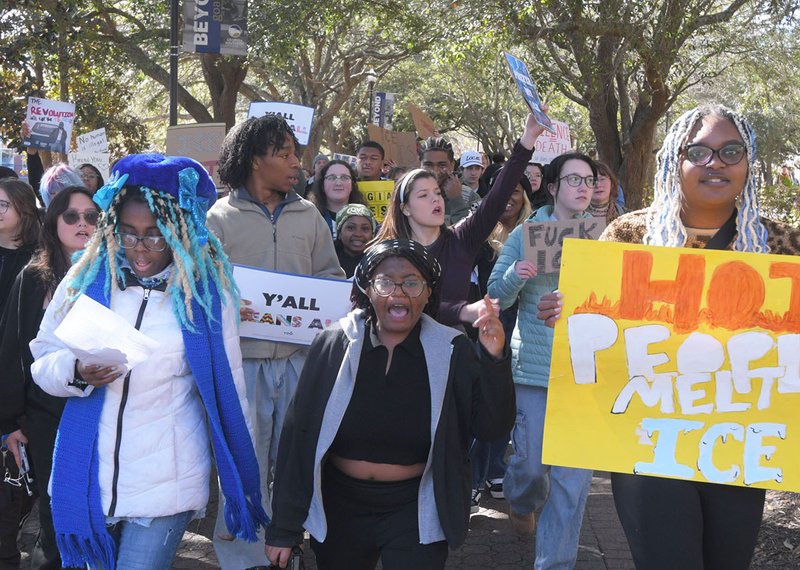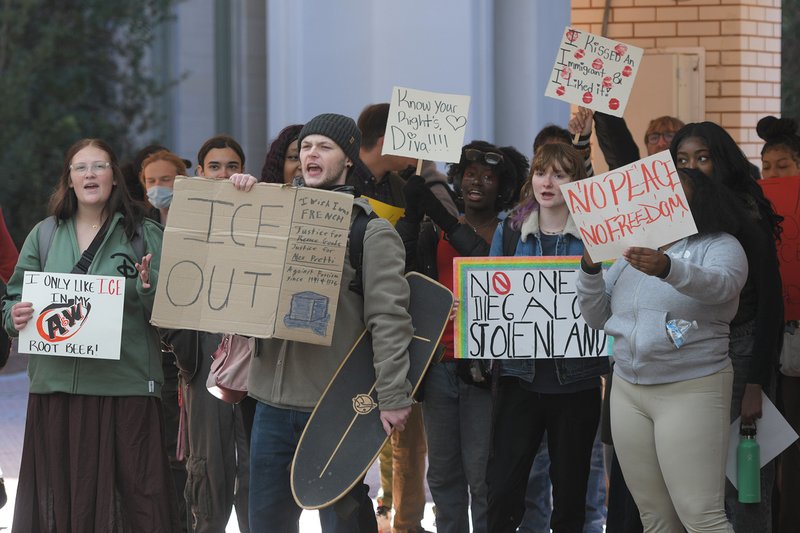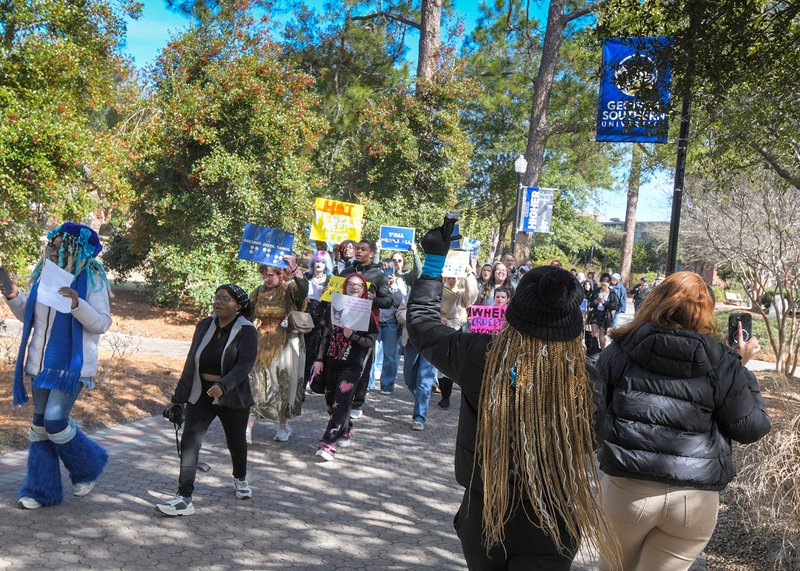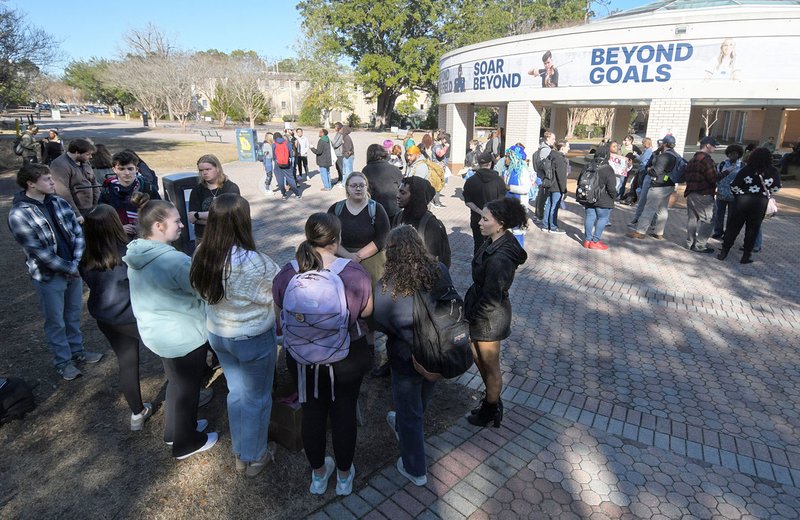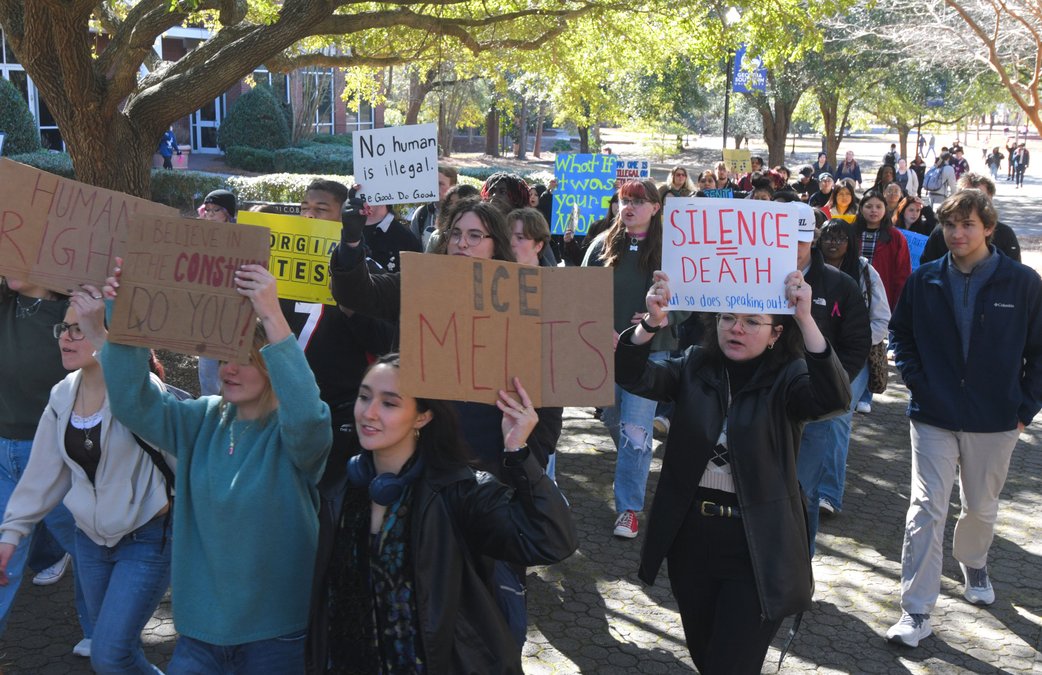
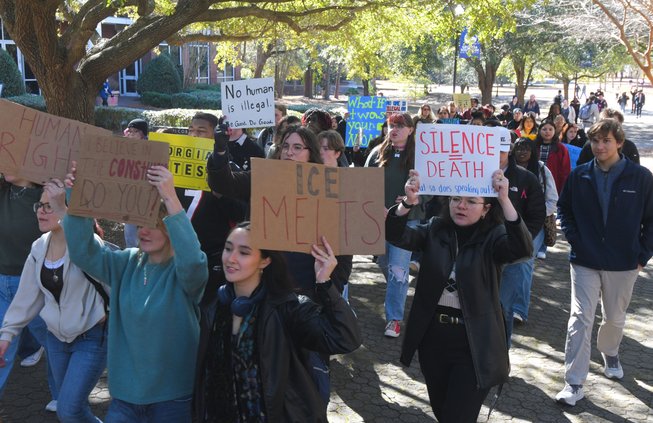
Students opposed to the operations of ICE and other agencies and to cruelty in the current federal crackdown on immigration held a three-hour rally beginning at noon Wednesday at the Russell Union Rotunda and along the central Pedestrium of Georgia Southern University’s Statesboro Campus.
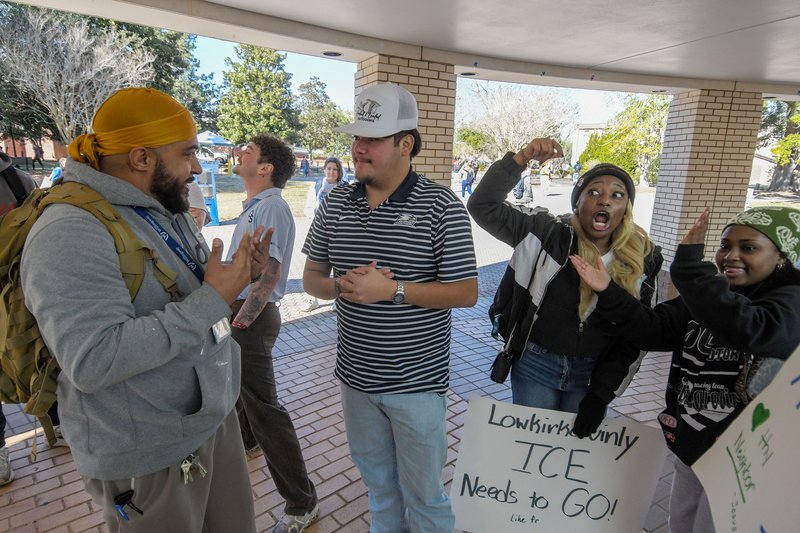
About halfway through the protest time, a smaller group of students set up a booth for the university chapter of Turning Point USA, the conservative nonprofit organization whose national co-founder Charlie Kirk was murdered in Utah last September. One student who identified as the son of a legal immigrant also approached the anti-ICE crowd and expressed support for that agency, whose full name is U.S. Immigration and Customs Enforcement. At Georgia Southern on Wednesday, these interactions didn’t lead to violence, but to discussions.
Two freshman students, Jalaia Ross, 19, from Columbus, Georgia, and Priscilla Allen, 18, from Dublin, Georgia, were the lead organizers of the demonstration based at the rotunda, a landmark, circular masonry structure with a skylighted cover above a stepped stage. A flier posted on social media had described the event as a “protest to stop ICE and demand justice and compassion for all people.” Its headline urged, “Stand together for basic human rights.”
“ICE is doing something very inhumane, in my opinion,” Ross said. “I think we’re all Americans, we’re all humans, so regardless of someone’s status they shouldn’t be ripped away from their families or what not. I think it’s just wrong, and I feel like students should do something, even if it’s just small, even if it’s just a protest.”
Allen was preparing to give a brief speech as the crowd gathered, and the Statesboro Herald reporter asked for a preview.
“The theme is going to be how in the past there have been leaders who have used their power not for good but against people who are less fortunate and how that same practice continues today in our towns and our cities, and how ICE has been tearing apart families and has been wreaking havoc across the nation,” Allen said. “And I just want to have a message of unity because ICE is attacking all people; it isn’t just immigrants; it isn’t just people of color. … So I want to emphasize togetherness with my speech.”
About 60 people, mostly students, had gathered before Allen stepped onto the rise of the rotunda to deliver her remarks. By the time the core group first strolled, or casually marched, down the Pedestrium – a landscaped free speech zone that crosses the heart of campus – and back again, the crowd had nearly doubled, to over 100 people.
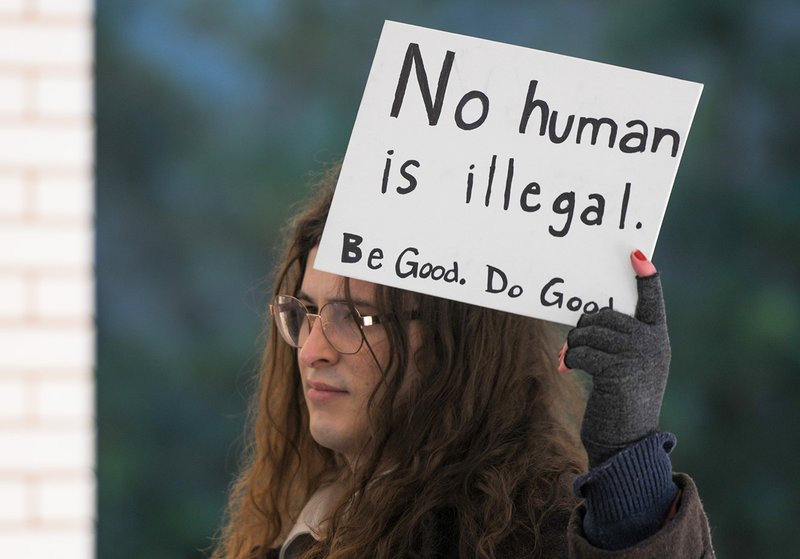
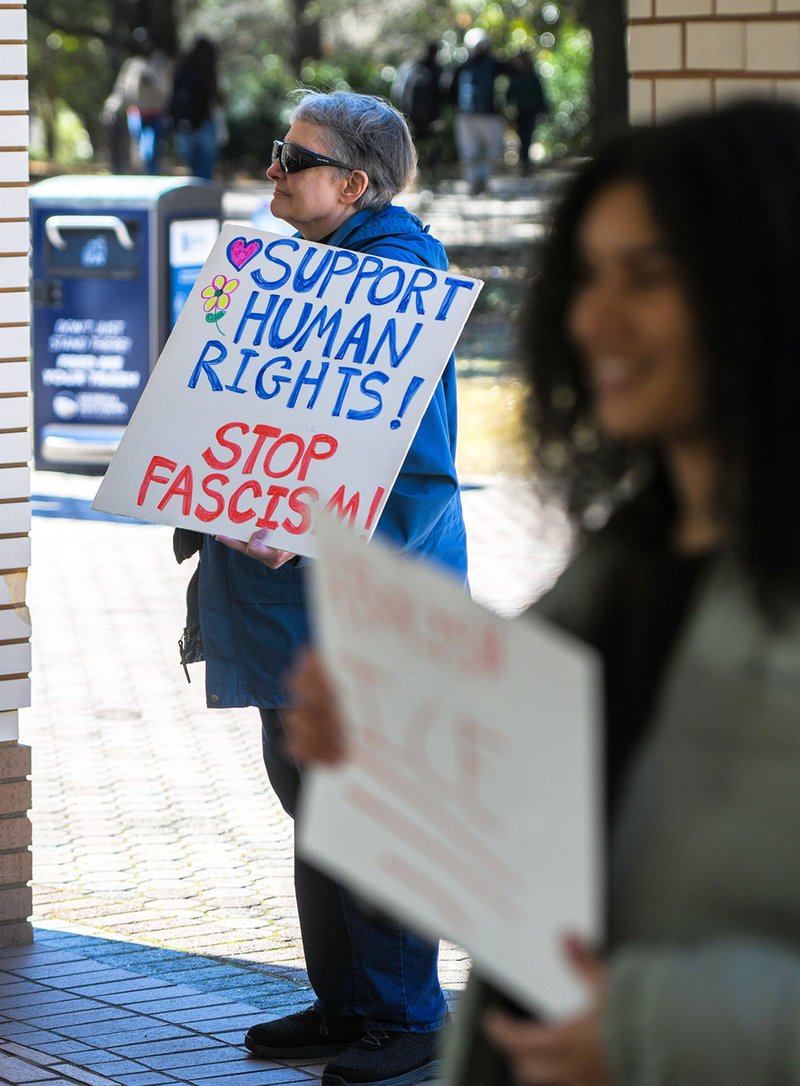
When they marched, they chanted things such as “Abolish ICE!” and “No human is illegal.” Students carried signs with messages such as, “If you’re not outraged, you’re not paying attention,” “Y’all means all,” and “When cruelty becomes normal, compassion becomes radical.” A few signs expressed more profane suggestions toward ICE and someone whose initials are, in the NATO phonetic alphabet, “Delta Tango.”
Some adults who are not current students attended, but relatively few judging from the youthfulness of most participants.
Madeline Ryan Smith, vice chair of the Bulloch County Democratic Committee, said the young student organizers reached out to her to have notices of the rally placed on party social media but that this was entirely a student-initiated event.
“I welcome for other people to plan protests so I don’t have to, and I think it’s awesome to have students doing this. It’s the first student-led protest we’ve had in probably a decade here,” said Smith, who graduated from Georgia Southern with a bachelor’s degree in 2020 and a master’s in 2022.
She said she was there to serve as a mentor and then leave the protest in students’ hands.
Local migrant support
Both co-chairs of the Statesboro Migrant Support Group turned up at the protest.
“I think our migrant families are scared,” one of the Support Group co-chairs, Adrienne Cohen, told the reporter. “I think they are struggling and suffering and afraid to go out and afraid to get groceries, afraid to go to work, afraid to do may things that a lot of us just take for granted.”
A previous story described the activities of the Support Group, volunteers who meet regularly in various churches and offer several kinds of assistance to migrant families, especially who those who have had family members detained by immigration authorities. Although ICE raids occurred in this area of Georgia last summer and fall, lately the activity here has mainly consisted of local law enforcement stopping immigrants for traffic offenses such as driving without a license and then notifying ICE, she said.
When the protest was underway, a number of students got up on the stage, mostly one at a time, to offer remarks or lead chants. Much of this was improvisation. At one point, two students held a U.S. flag, top-down as a symbol of distress, with PEACE painted on it, while most of the group joined in singing the National Anthem.
The reporter who assembled this story left about one hour into the three scheduled hours of the protest.
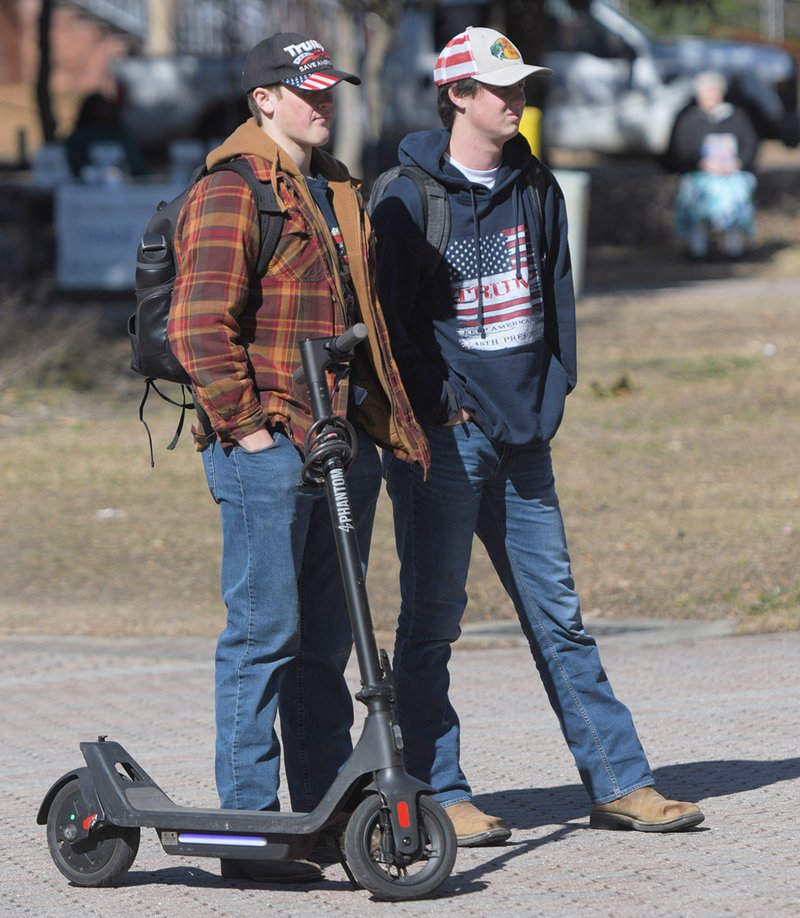
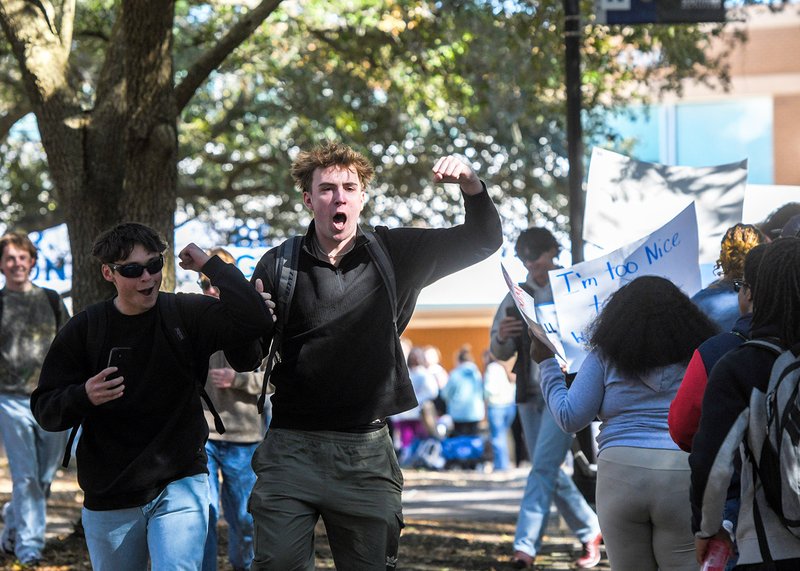
But Statesboro Herald photojournalist Scott Bryant remained on the scene and provided pictures and description of how things took a turn before and after the 90-minute point. First, the protest group strode out on the second of three marches along the Pedestrium and back. This time they encountered some counter-commentary, such as when two young men raised fists above their heads and shouted, “Go Trump!”
Talking breaks out
Meanwhile, the Turning Point USA group – maybe a dozen students, maybe more – arrived and set up their booth on a corner across from the Rotunda. This reportedly led to a loud exchange of remarks between the two groups.
One student, who would identify himself as Michael Sanchez, 19, of Griffin, walked over among the protest students at the Rotunda and repeatedly shouted, “I love ICE!” Sanchez said that his father is an immigrant from Mexico but “did it the right way” and is now a United States citizen. Sanchez did not say whether he was a Turning Point member, and wasn’t asked.
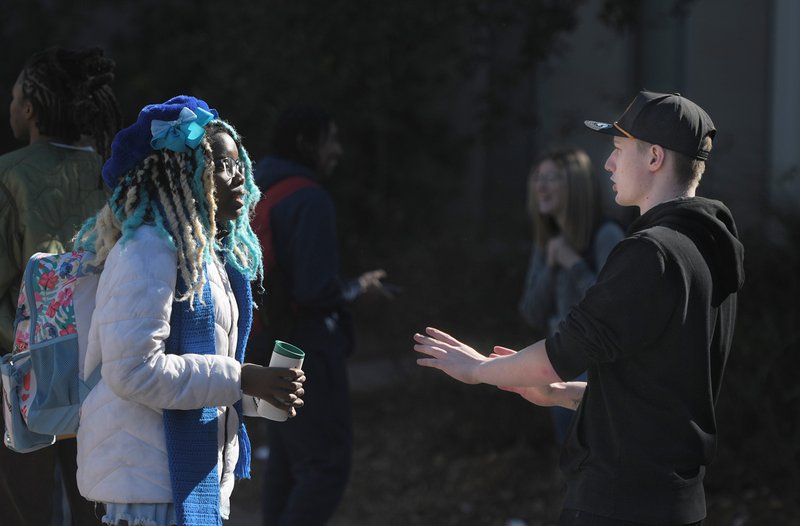
He and some students from the protest group, particularly Kyler Gregory of Statesboro, then got into a lively debate about the reasons for their views. Leaders of the protest group and the Turning Point group also broke into side discussions.
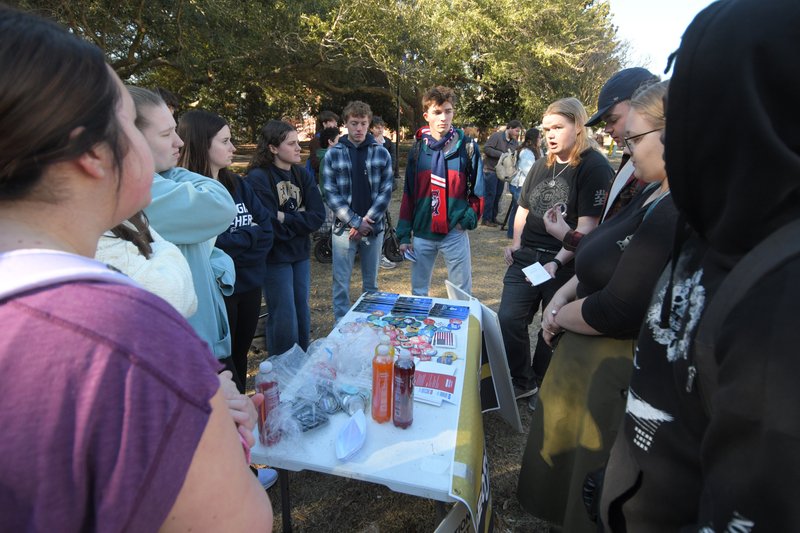
Voices were raised, but students for the most part were talking to each other, not exchanging insults or engaging in name calling, according to one professional observer.
“They were listening to each other too,” Bryant said. “It wasn’t just shouting at each other; they were going back and forth. … If you looked around, everywhere, there were a lot of one-on-one conservations and small group conversations … talking about the issues.”