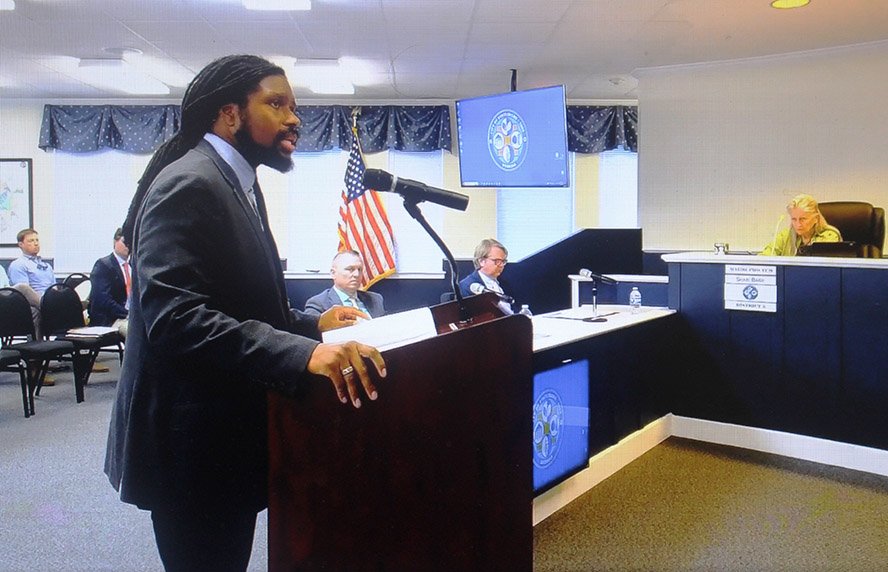
In a change from the usual practice, Statesboro City Council will hold another public hearing for the second reading and possible final approval of a Data Centers Ordinance during council’s 9 a.m. Tuesday, June 2, regular meeting.
This is after the council made changes to the proposed ordinance before voting it forward from a first reading the evening of May 19. Those changes – the most significant of which amounts to a ban on “hyperscale” data centers larger than 50 acres – were announced before the public hearing that evening.
Under the council’s procedural rules, no new hearing for public comment is required if changes are made before and not after a first-reading vote. But some council members asked that an additional hearing be held at the second reading, as has been done a few times before when changes in the city’s laws attracted considerable public interest.
“I think we do have a more stringent model now, but I’m concerned that we didn’t have ample opportunity to look at it in advance, so my recommendation is that we don’t just pass it forward,” District 5 Councilmember Shari Barr said after the hearing within the May 19 regular meeting.
At first, she was suggesting a postponement of the first reading vote because of the changes.
“I want there to be ample opportunity for folks who are concerned about a data center coming here and ramifications to be able to see the whole thing,” Barr said.
Mayor Jonathan McCollar said he did not want to drag the process out longer. Observing that all of the comments heard were from people who wanted stricter limits on data centers, McCollar noted that the changes being made were in that direction.
City Manager Charles Penny said the question was whether the council wanted to have another public hearing, with next week’s meeting being a morning meeting.
District 4 Councilmember John Riggs said he also wanted to move forward but supported having a hearing with the second reading.
“That’s when people are going to come up here and start talking, once they’ve heard about it,” Riggs said.
McCollar also said he had received no direct calls from citizens concerned about the issue, and at least two of the council members said that was true for them as well.
But the changes that were made reflected concerns and requests that had been heard by staff members, including from the city’s own Greener Boro Commission.
Planning board version
In the two hours before the voting meeting at 5:30 p.m. May 19, the mayor and council had held a multi-topic work session, also open to the public. During that non-voting session, city Planning and Development Director Justin Williams presented the ordinance proposal as developed by staff and previously presented to the appointed city Planning Commission, which had unanimously recommended it for approval as presented. Formally the “Technological Facilities and Data Center Ordinance,” the proposal would be an addition to the city’s Unified Development Code.
The mayor, some of the council members and staff visited three data centers in the metro Atlanta area and met with Georgia Power representatives on the topic Jan. 22. Then, as previously reported, the Statesboro council during a Feb. 17 work session gave their informal go-ahead for staff to develop an ordinance.
As presented by Williams, the proposed city law has seven sections: 1. Purpose, 2. Definitions, 3. Permitted districts and lot requirements, 4. Utility use and allowances, 5. Sound generation, 6. Screening and aesthetics, and 7. Community investment and infrastructure.
‘Edge’ centers maybe
The proposed ordinance defines two types of data centers. “Edge” data centers are defined as facilities on a lot not exceeding 50 acres. These “may be located in existing structures,” the definitions list in Williams’ explanatory slideshow noted.
“That’s going to be something that you would see could be turned from an old Winn Dixie,” he said.
Mayor McCollar also mentioned the long-vacant former Winn Dixie building later during that evening’s meeting, and Williams had alluded to it in February when he mentioned Hull Properties. Hull Property Group and associated companies own the former Winn Dixie shopping center on Brannen Street and some commercial spaces on either side of Northside Drive.
But not ‘hyperscale’
“Hyperscale,” centers were defined as larger than 50 acres, and in the planning board-recommended version could have been allowed buildings up to 500,000 square feet on tract sizes up to 200 acres. But in the revised version actually voted forward by the council, a definition remains but hyperscale centers are prohibited.
“It shall be unlawful for these facilities to be constructed in the City,” is now the final sentence of the definition.
Another key definition in the ordinance is of “sensitive receptors,” meaning existing land uses such as homes, schools and churches to be protected.
A special use only
The proposed ordinance would allow data centers only as a “special use” requiring council approval of a special permit, in certain zones and not as a regular, pre-approved use in any zoning classification. Data centers would be restricted to the highway-oriented commercial, or HOC; light industrial, or LI; mixed-use, or MX; and office, or O, zoning districts.
Under the previous version of the proposal, hyperscale facilities would have been allowed only in HOC and LI zones and prohibited in the others. But with hyperscale data centers now to prohibited entirely, that provision, along with rules that would have required that hyperscale facilities have 300-foot setbacks from “sensitive receptor” properties and 250-foot setbacks from all other property lines, as well 200-foot-wide planted buffers, have been removed.
Remaining in the proposal for the second reading, with only “edge” centers up to 50 acres now potentially allowed, are requirements for setbacks of 75 feet from sensitive receptor properties and 60 feet from all other properties, with a 50-foot-wide minimum buffer.
“Utility use” rules include a requirement that any data centers be connected to municipal water and sewer – not wells of their own or private septic systems. Each data center would be required to use a closed-loop water system for cooling and to have a water management plan with projections of monthly and peak water consumption.
“Sound generation” rules center around the requirement for a noise study to establish the ambient sound level at the property line.
“Sound generation starts and ends with the noise study,” Williams told council members in the work session. “The intent is to find the ambient noise (level) in an area and not exceed that ambient noise.”
If the ambient noise were under 50 decibels, the sound generated by the information technology equipment and cooling systems could exceed the ambient level at the property line, but 50 decibels would in general be the cutoff, except in an open area such as along a highway, he said.
One of the more obscure changes made with the amended first reading was the inclusion of a dB(C) decibel limit in addition to a dB(A) limit. This has to do with the frequency ranges measured.
One of the environmental standards allows, but does not require, the city Unified Development Code administrator to require building to Georgia Stormwater Management Manual guidelines. A 35% tree canopy is required, but includes buffers and wetlands.
However, city staff members rejected, and council members did not act on, a suggestion that data centers be allowed only on already open spaces, with clearing of trees prohibited. When council members asked if this would even be legal, City Attorney Cain Smith said it would amount to “a taking” of property value.
“I love trees, but realize that you just can’t develop without clearing land,” said City Manager Charles Penny.
Visual screening with approved trees and opaque fence is required in the direction of “sensitive receptors.” Another aesthetic rule is a maximum building height of 65 feet.
Under “community investment and decommissioning,” any applicant for a data center special use permit must provide a report “showing positive economic impacts” of the project and also submit a “decommissioning plan.” In case the center closes, this plan would assure that the technology equipment and other specialized features will be removed so that the building can be marketed for other uses, Williams explained.
Once issued, a special use permit would expire after 24 months unless the developer takes other steps requiring a land disturbance or building permit.
City doesn’t regulate power
The first citizen to speak during the council’s May 19 hearing, Jason McCoy, said he was curious about the lack of power consumption rules in the ordinance, among other things.
“Georgia residents are already experiencing issues with increased rates through Georgia Power with everything that’s been going on. …,” he said. “Data centers … consume enormous amounts of power, enormous amounts of water. Is there anything within that ordinance that is going to control how that power usage comes?”
Statesboro officials have said that the city has no authority to regulate electrical power use, which is regulated at the state level by the Public Service Commission and Legislature.
“An updated state policy actually addresses that,” McCollar said. “Data centers have to provide their own infrastructure as it relates to power. Again, that is something that cannot necessarily be regulated at the local level.”
The mayor also said he believes that data centers are getting smaller, with “a demand for them to do more with less space,” and noted that the city was reducing the size limit for any centers it could potentially permit.
Two other citizen speakers – Virginia Russell from the Tree Board and David Warren from the Greener Boro Commission – also expressed concerns.
The vote to approve the first reading with the modifications was 4-0, on a motion from District 1 Councilmember Tangie Johnson, seconded by District 2’s then-Councilmember Paulette Chavers. As previously reported, Chavers resigned at the end of the meeting. So the council for now has only four district members, with the mayor wielding a tiebreaker vote.