
City staff members and a consultant brought City Council a framework last week for a fee to residents, businesses and nonprofits to fund the Statesboro Fire Department at its current staffing and expected growth and partly offset what would otherwise be a nearly 4-mill projected cost in property taxes.
One year ago, the council had approved a $60,000 contract with the engineering and planning consultant firm Goodwyn Mills Cawood, or GMC, to conduct a feasibility study for implementing a fire service fee. It would be billed to all or almost all city service customers within Statesboro, including tax-exempt properties.
That same week, in late January 2025, negotiations broke down between city and county officials for renewal of a longstanding intergovernmental agreement under which the Statesboro Fire Department provided service to areas of Bulloch County outside the city limits within five miles of the SFD’s two fire stations. That agreement ended June 30, 2025, and an expanded Bulloch County Fire Department now serves all areas of the county outside Statesboro.
So, the city no longer receives a share of the county’s fire service property tax millage. That share was previously about $2.5 million, while the city government in the final year also transferred about $1 million of its own property tax revenue to its fire fund.
City Manager Charles W. Penny alluded to this turn of events during a Jan. 20 work session before introducing a GMC consultant who provided details from the study.
“The impact of the county’s decision to discontinue our fire district was like $2.5 million financial impact, and even at $2.5 million, we were still having to subsidize the operation of the Fire Department out of the general fund,” Penny told council members, “and so … to try to mitigate that … revenue shortfall, we need to look at a more equitable way to fund the fire service, so the fire service fee is a way to do that.”
Last May, Penny and city Finance Director Cindy West announced a plan to cover the Fire Department’s shortfall for one year with one-time loans totaling almost $3.2 million from the city’s water-sewer fund, natural gas fund and solid waste collection fund. These in-house loans, included in the fiscal year 2026 budget that closes June 30, are to be repaid by the now city-only fire fund or general fund over the next 10 years.
“It’s not sustainable to be able to continue to operate on loans from other funds,” Penny said last week. “So, come July 1, we’re either going to — and I don’t know any other way to put it — we’ve either got to increase the millage rate or look at a fire service fee or some combination of both.”
What Ed DiTommaso from Goodwyn Mills Cawood described as the consulting firm’s recommended approach for Statesboro is a “combination.” GMC’s presentation first charted the Statesboro Fire Department’s budget from fiscal year 2021 through FY 2026. DiTommaso said the cost has “essentially doubled over the past five years.”
“A lot of that has to do with staffing up to maintain the population growth the city has seen over that period of time,” he said.
A line graph in his report indicated the SFD budget more than doubled, from $3.54 million in 2021 to almost $8 million this year.
This apparently did not include all funding sources. A separate list in the slideshow gave the SFD’s “total budget need” as $7,575,745 for fiscal 2025. That year, funding sources included $3.2 million from the city general fund; $825,000 from the water and sewer fund; $2,552,745 from the “special service district,” in other words the now-lost county contribution; $295,000 from fire line fees; and $703,000 from the “SAFER grant.”
SAFER grant ending
In February 2023, the department and city were awarded a $2.1 million federal Staffing for Adequate Fire and Emergency Response grant to hire an additional 12 full-time firefighters. The grant covered their original salaries and benefits for three years, but this fiscal year is the last.
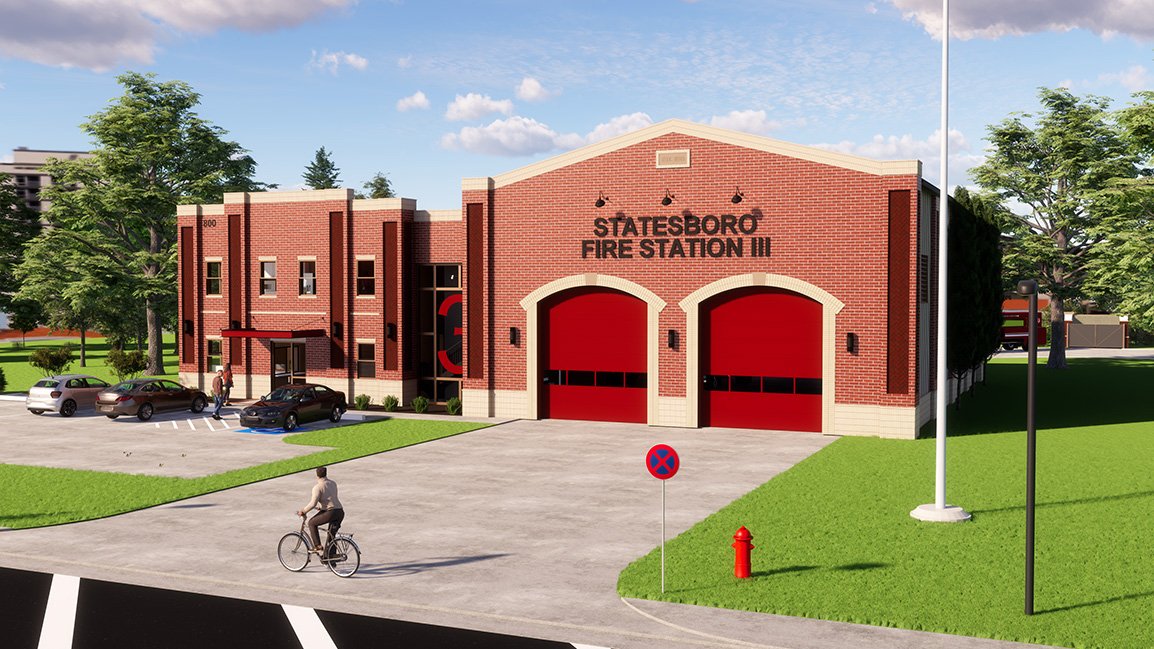
To keep the additional firefighters, the city must fund their salaries and benefits, and officials have presented no plan to cut back. Meanwhile, the city is building its long-proposed Fire Station 3. The construction is separately funded from Special Purpose Local Option Sales Tax, or SPLOST, with long-range financing, so that is not a part of the operating budget.
For fiscal 2026, the chart in DiTommaso’s presentation showed the SFD’s “total budget need” as $8,193,000. Meanwhile, the more than $2.5 million in previous county funding is no longer available, but the $3.17 million in in-house loans are shown as another source.
$4.3 million ‘gap’
However, for fiscal 2027, when the “total need” is projected to be $8.62 million, the SAFER grant, the county contribution and the in-house loans were all shown as “n/a,” not available. So the bottom line for next fiscal year is a projected $4.3 million “funding gap.”
GMC’s recommendation is for a fire service fee program with a “revenue target” of $4 million. This could substitute for a roughly 4-mill increase in property taxes, or a little less than 4 mills with a mill of tax currently bringing about $1.1 million to the city. But the general fund, and therefore property taxes, would still be a major source for the remainder of the SFD’s operational funding.
The fees would be based on rates for three different kinds of property: residential, “non-residential” and undeveloped. The “non-residential” category would include not just commercial buildings, but all types of buildings except single-family homes, DiTommaso said.
For “residential” structures, in other words single-family homes, the basic rate would be 1 cent per square foot, from a minimum monthly charge of $5 to a maximum charge of $25. The rate for non-residential buildings would be 2 cents per square foot, from a minimum of $5 to a maximum of $300 a month. Fees for undeveloped areas would range from $5 up to $200 a month.
According to GMC’s summary, the average residential fee would be $23.25 a month, totaling $279 a year. The average commercial fee would be $141.58 a month, or $1,687 annually. These were compared to a 4-mill property tax hike that might supply the same amount of funding to the Fire Department but cost about $400 annually when applied to a $250,000 market-value property, $640 on a $400,000 property, or $960 a year on a $600,000 property.
None fee-exempt
The fire service fee would also be applied to tax-exempt properties. This, as Penny has acknowledged, is one factor that makes this type of fee attractive for a city where a university, churches and other tax-exempt nonprofit or government organizations own a significant portion of the real estate. That was also a motivating factor in Statesboro’s creation, several years ago, of a fee-funded stormwater utility.
GMC, in reporting on its study, listed nine examples of city and county governments in Georgia that have imposed fire service fees.
Legal challenges
However, at least three of those governments have had their fees challenged in lawsuits. After previous changes and being challenged as an “illegal tax,” Chatham County’s fire fee was overturned in Chatham County Superior Court in October. After collecting a separate fire fee for a number of years, Garden City, which is within Chatham County, settled a class action lawsuit by agreeing to create a $1.4 million refund fund.
But McDuffie County, after 18 months of litigation, had its fire fee upheld in the McDuffie County Superior Court in 2023. The fee structure proposed for Statesboro is based on McDuffie County’s and also somewhat like Garden City’s previous fees, but different from Chatham’s, according to DiTommaso.
“Since we’ve started, there have been challenges to the fire fees throughout the state,” he said. “Chatham County was sued over their fire fee and lost. They’re actually challenging (appealing) it, but in my opinion — I’m not a lawyer — but a lot of it came down to their methodology.”
Fire fee discounts
If Statesboro’s council adopts GMC’s plan for a fire fee, the consultants propose making several discounts available to various classes of property owners. These would include a discount for structures with active, annually inspected sprinkler systems, and a separate discount for homes and small businesses with fire safety “devices” such as smoke alarms, carbon monoxide detectors, fire extinguishers and hood suppression systems.
For larger properties or areas, there could be a “standing fire brigade” discount, and for non-single-family residential, non-industrial properties, an emergency operation plan discount. The Fire Department also could offer a Praise and Preparedness program with training for churches and student fire safety training for schools, both leading to discounts.
Millage alternative
No action was taken during the work session, and the council has not at this point decided whether to enact a fee. Penny observed that if the city instead adopted a millage rate increase to fund the fire service in fiscal 2027, the millage could be rolled back again after one year when revenue becomes available from the Floating Local Option Sales Tax, or FLOST, which has been approved by Bulloch County voters and which by law must be used by the county and cities for millage rollbacks.