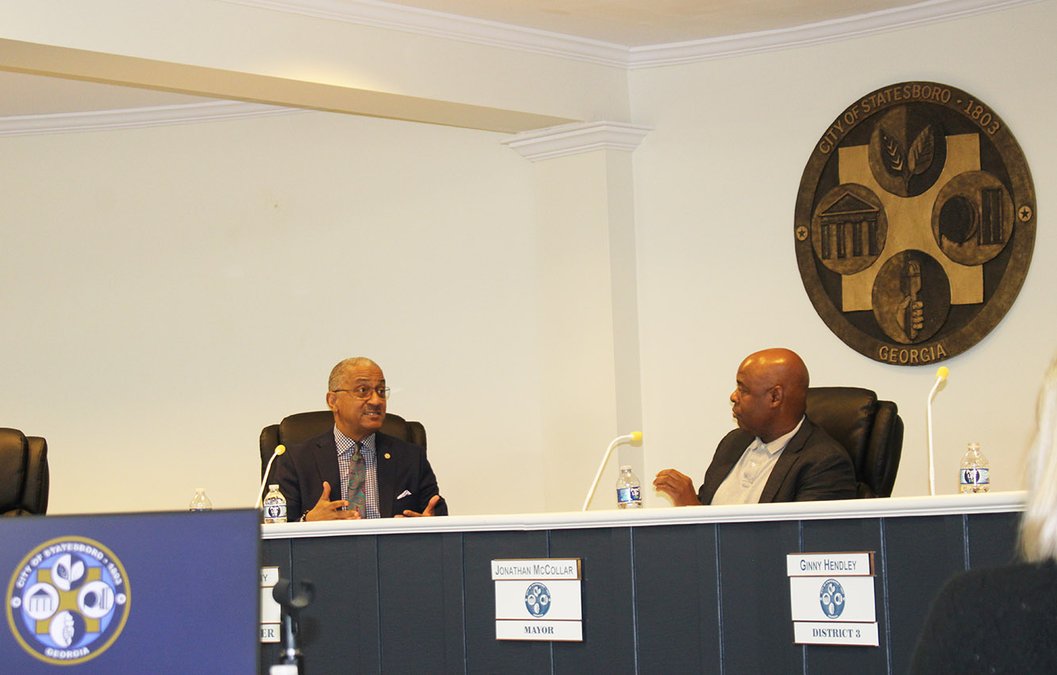
Statesboro City Council during its March 17 meeting by a 4-0 vote passed a resolution, for Mayor Jonathan McCollar to sign, opposing Georgia House Bill 1116, which would generally limit local property tax increases to 3% in a year, or to the national inflation rate if lower.
House Bill 1116, which passed the state House of Representatives by a 98-68 vote on March 6, also proposes to make available a new sales tax, called the Local Homestead Option Sales Tax, or LHOST, to replace some property tax revenue. But City Manager Charles Penny noted that Statesboro, along with the rest of Bulloch County, is already at the limit of 9 cents on the dollar in sales tax, which includes 4 cents of state tax and 5 separate local option taxes.
The most recent of Bulloch County’s sales taxes, the Floating Local Option Sales Tax, or FLOST, was approved by voters last fall and has been collected since Jan. 1, and is already required to be used for a property tax millage rate reduction beginning next year. The limit of 5 cents in local sales taxes would apparently not be lifted by HB 1116, but is restated in the bill as applying to city and county governments and school boards.
“This House bill would have a tremendous impact on the city of Statesboro and all cities and counties across the state. …,” Penny told council members. “It would limit our ability to increase property taxes, and I know to some of the citizens that might be a good thing; however, when we operate our city, the ability to be able to increase property taxes is very critical.”
Effect on borrowing
For one thing, when city government borrows money, or “issues debt,” as he put it, it commits “the full faith and credit of the city” to repayment “to be able to sell bonds at a lower interest rate.” Even when sales taxes, such as the SPLOST, or Special Purpose Local Option Sales Tax, or the T-SPLOST, for transportation projects, are the primary means to repay bonds or a loan, the city or county usually makes a promise of its ability to raise the property tax millage if there is a shortfall in the sales tax.
The Statesboro Fire Department’s new Station 3, now under construction, is one example project, since it is being financed long-term and funded by SPLOST. If the public decided in the next five-year referendum not to continue SPLOST and the council were limited to a 3% property tax increase, the city would then “be in a bad situation,” Penny said.
He also noted that, while Statesboro’s current-year budgets for all funds total about $103 million (a figure that includes transfers and payments between funds), its general fund budget, which receives the property tax, is only a portion of that.
Property tax limited
“Our general fund budget is where your tax dollars go,” said Penny. “Our general fund today is $27 million. … Property taxes make up a third of that $27 million, so only $9 million is collected as property taxes.”
But he noted that the Statesboro Fire Department’s budget alone now includes about $8 million in spending and that the Statesboro Police Department’s budget is about $12 million.
“So those property taxes do not cover the two core services that most people pride themselves on, those public safety services,” Penny said.
However, other than fees for specific services, property taxes are the revenue source City Council can adjust most easily, by setting the annual millage rate.
“So if we’re in a position where we can’t increase property taxes more than 3 percent, we could be in a situation where we could not pay our debts,” Penny said.
He noted that with the city’s current millage rate yielding about $9 million, a 3% increase would yield just about $270,000.
Penny also noted – as Statesboro officials have many times in the past – that Bulloch County is one of just eight Georgia counties where the original Local Option Sales Tax is not divided among the county government and cities but is assigned permanently to the Board of Education for operation of the schools.
From other managers
The resolution was not an item on the agenda for the council’s 5:30 p.m. March 17 meeting, but Penny introduced it under “city manager’s comments” at the end of the meeting, and copies were provided to council members. In a follow-up interview Thursday, he said he received the wording of the resolution from other managers in the Georgia City and County Management Association and did not know how many other cities or counties had adopted it.
To the council members Tuesday, he noted that the Legislature is expected to adjourn around March 30 – before the next regular meeting of the council – and asked for their support in order to convey the city’s position to area representatives and Sen. Billy Hickman, R-District 4, Statesboro.
Mayor McCollar also spoke for the resolution, but in terms of opposing a further use of sales tax to replace property tax.
“In theory it sounds good. The problem with this is that it adds 3 cents to the dollar,” McCollar said. “So for every dollar you spend, it’s going to add three cents to it, and so the savings you think you would receive on the property tax, it’s actually going to transition to your everyday goods.”
The House-passed version of HB 1116 refers to various 1% sales taxes, and especially the proposed new LHOST, not a 3% sales tax. But other property tax replacement or limitation proposals were discussed prior to its passage.
Approved by the council March 17, Resolution 2026-13 actually refers to HB 1116 as having “provisions to replace an existing homestead sales tax with a 1 percent LHOST dedicated to homestead property tax relief.” The resolution further asserts that “in Bulloch County the bill will eliminate the Equalized Homestead Option Sales Tax (EHOST).” But Bulloch has no “EHOST,” unless this is another name for the FLOST, and the possibility of replacing a FLOST with an LHOST is spelled out in the bill.
Again, HB 1116 restates the 5% local sales tax limit, and Bulloch County, including Statesboro, is at that limit.
Asserting ‘home rule’
The city resolution was approved 4-0 on a motion from District 1 Councilmember Tangie Johnson, seconded by District 5 Councilmember Shari Barr, with District 4’s John Riggs absent.
“I haven’t studied this, but just on the face of it, just scanning it here, it sounds like folks in Atlanta trying to reverse home rule, so they decide what people in Bulloch County are going to do, which generally we don’t want,” Barr said before the vote.
Local voters elect City Council to make decisions after holding public hearings on issues such as taxes, she added.
With the resolution, the council asks that members of the Legislature defer action on HB 1116 “until a comprehensive, independent county-by-county and city-by-city financial impact analysis … is completed and shared” and to oppose it in its current form.
Reps voted for it
Two state representatives whose districts include portions of Bulloch County, Rep. Lehman Franklin, R-District 160, Statesboro, and Rep. Butch Parrish, R-District 158, Swainsboro, had both voted “yes” on House Bill 1116, according to the vote record on the Georgia General Assembly website. As speaker of the House, Rep. Jon Burns, R-District 159, Newington, did not vote because no tie-breaker was required.
So the bill is now in the Senate, and if the Senate approved a different version, a common version would have to be worked out, or the bill still wouldn’t become law.
Penny said city officials had talked to Senator Hickman, and the Statesboro Herald is reaching out to him for comment.