
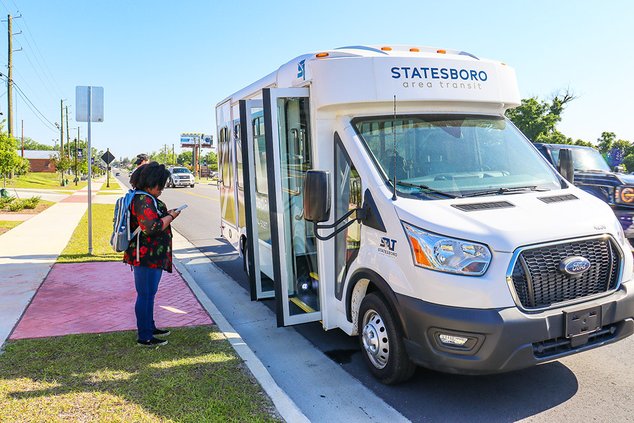
After Statesboro’s little public transit system of four eight-passenger buses carried people for 14,541 rides during its first year of operation, city officials plan to expand it to eight buses and add more shelters and stops.
Its annual operating budget, supplied half by a renewable federal grant, and locally mostly by T-SPLOST, is set to triple, to nearly $822,000.
The November 2022 Bulloch County-wide referendum for five-year renewal of the Transportation-Special Purpose Local Option Sales Tax increased the T-SPLOST revenue dedicated to Statesboro’s transit system to $3 million total, or $600,000 a year, from the one-off $450,000 start-up funding earmarked in the previous five-year T-SPLOST. But the now realized Statesboro Area Transit system, operated by the Coastal Regional Commission of Georgia on behalf of the city of Statesboro, is at least 80% federally funded for bus purchases and other capital expenses and 50% federally funded for annual operations.
In fiscal year 2024, which ended June 30, the bus system had capital expenses of $316,500 budgeted and $211,684 actually spent, city Public Works and Engineering Director John Washington reported in late May. Capital funding for the year included $253,200 from the Federal Transit Administration grant for rural transit, with state 10% matching funds of $31,650 and city matching funds also of $31,650. For the past year’s budgeted operating expenses of $214,200, the federal funds supplied $107,100 and the city the other $107,100.
But in the city’s fiscal year 2025 budget, in effect since July 1, the bus system’s annual operating expenses were budgeted at $821,955, with the city T-SPLOST revenue paying half, or $410,977, and the federal grant projected to pay the other half. Capital expenses are budgeted at $257,418, with $205,934 expected to come from the federal grant program, $25,742 from the state and $25,742 from the city.
As of this week, Statesboro officials had not received confirmation of the federal funding for the current year but remain confident of the numbers, said city staff Civil Engineer Kiara Ahmed. The 10-county Coastal Regional Commission, or CRC, includes the Statesboro system in its application through the Georgia Department of Transportation, or GDOT, to the U.S. DOT.
“We’re still awaiting approval from GDOT for the actual budget. …,” Ahmed said Monday. “Locally we have an approved budget from (City) Council, but the actual budget in regards to the partnership with CRC, we’re still waiting on.”
Ahmed – who has led the city’s planning for the bus service in coordination with the CRC since before the first buses were ordered – prepared the data and slides for the “12-Month Operational Update” that Washington, as department head, delivered to City Council during a May 22 work session.
“You can see that graph continually going up,” Washington said, in front of a screen image of a line graph of monthly ridership. “For the month of March, we almost hit a peak of 2,000 riders for the month. It’s been a steady incline, so it will be interesting to see what that incline is going to be for the next few months.”
From the start of service on May 22, 2023 though April 30, 2024, the four buses rolled a total of 118,036 miles and logged 10,858 operating hours. The first full 12 months’ count of 14,541 passengers – the same person riding twice being counted as two “passengers” and so on – rounds up to 1,212 riders a month on average.
Topping 1,600 rides
But that included the earliest months when the service was building ridership, from just 453 passengers in June 2023 to 1,110 in October. The rider counts for the most recent six months, obtained from Ahmed this week, were 1,611 passengers in January, 1,682 in February, 1,877 in March, 1,788 in April, 1,584 in May and 1,486 in June. That’s 10,028 rides in six months, or 1,671 each month on average.
Extrapolating that recent average to 20,056 riders over 12 months, just the first year’s $214,200 operating budget would amount to $10.68 per ride, not including anything for the capital costs or projected expansion. This calculation was not part of the city’s report but is provided here by the Statesboro Herald.
Obviously, the rider fares, starting at $1 for a one-way trip and $2 for a round trip, with discounted rates available for senior citizens, college students and people with disabilities, are covering only a small part of the cost. Ever since the original feasibility study completed by Connetics Transportation Group, or CTG, in 2019, consultants and city officials have emphasized that the transit system is not expected to pay for itself from fares.
Each little bus can carry up to eight passengers – six in regular seats plus two in fold-down seats that can make room for two passengers in wheelchairs – and has a lift for those passengers.
The buses currently operate from 6 a.m. until 6 p.m. Monday through Friday only.
The two routes, identified on maps as the Blue Route and Red Route, cross in the middle of Statesboro in the city parking lot across South College Street from the post office. The little sheltered bench there is the only stop shared by the two routes and serves as the transfer station.
There are currently 20 bus stops on the Blue Route and 19 stops on the Red Route, but only five stops have bus shelters: along the Blue Route at Eagle Village, Midtown Market and on South Main Street near Tillman Road; and on the Red Route only at the Health Department and the transfer station.
So far there are no definite plans to add another route, only to increase the number of buses. The four additional buses were already part of CRC’s funding request a year ago. However, Washington told City Council that the caution that has come down from the GDOT through the CRC is to expect about a two-year delivery time on the buses.
“But right now we can work with that because we’re being proactive in our program here,” he said.
After the city submitted documentation of ridership counts and its reasons for requesting the additional buses, the state and federal agencies requested no additional information, which is a good sign, according to Ahmed.
“We haven’t heard anything since then, so it’s pretty likely that we should get approval,” she said Monday.
Under special COVID-19 era legislation, the original capital purchase grant used to equip Statesboro’s bus system became a 100% grant, instead of an 80% grant, so starting the system cost the city less than first projected. But these grants have since reverted to 80% federal funding.
More shelters & stops
The 12-month update also included a page on program improvements, noting that bus benches or shelters have been requested for three existing stops and that nine additional stops have been requested. Washington said the budget could actually provide from three to five new bus shelters.
“We do have in the budget for more shelters to add, and so what we’ll do is take into consideration any public input as to where they’ll be most viable,” he said.
The Cambridge at Southern apartment complex, which is one of the most popular stops on the Blue Route, and the Social Security office are two possible bus shelter locations, said Ahmed.
Adding more stops with the additional buses should help to reduce wait times, she said.
Expansion study
Also in the program improvement plans, city staffers propose contracting with transit consultants to do an “expansion analysis” with pubic input on adding routes and stops. CTG was apparently absorbed by another company, so this will probably require a request for proposals to find a new consulting firm, according to Ahmed.