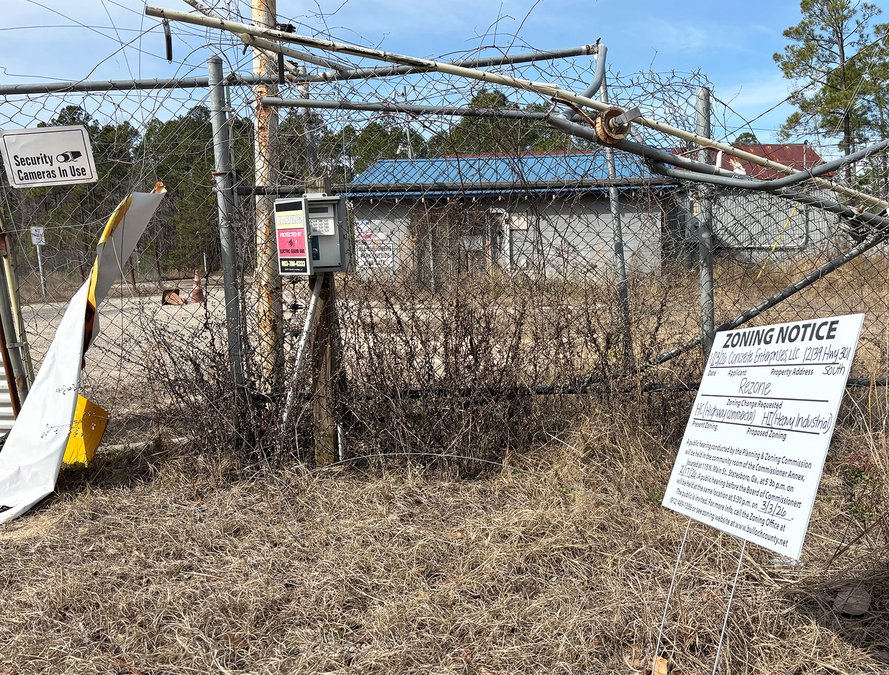
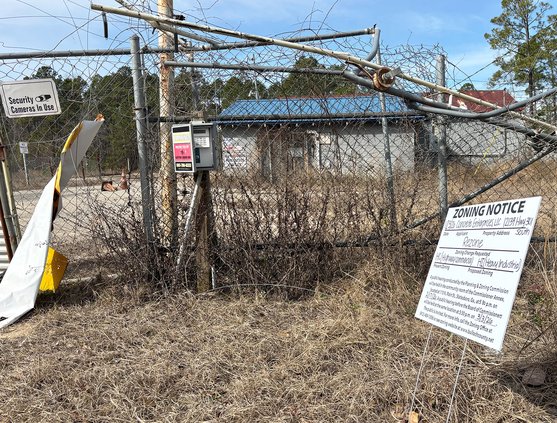
A concrete company’s proposal to place a $1.8 million pairing of a ready-mix concrete plant and an asphalt plant on an approximately 28-acre site west of U.S. Highway 301 south of Statesboro has triggered a Development of Regional Impact notice from the Coastal Regional Commission.
The CRC’s public comment notice went out by email Thursday, Jan. 29 to organizations that have “the potential to be affected” by the proposed development and some news organizations. The public comment period runs from Jan. 29 through Feb. 12.
Concrete Enterprises, a company based in Albany with at least seven other Georgia locations, has also applied to Bulloch County’s Planning and Development Department for a change in the tract’s zoning from HC “highway commercial” to HI “heavy industry.” The current owner of the land is Terri S. Grant of Statesboro. The hearing before the appointed Planning & Zoning Commission is scheduled for Feb. 17, and after that board makes a recommendation, the elected Bulloch County Board of Commissioners could decide on the rezoning March 3.
Former junkyard
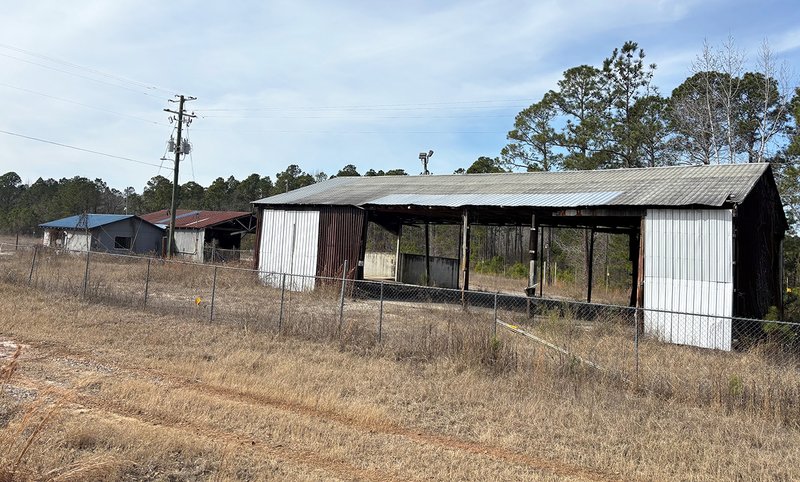
The site, parallel to the Norfolk Southern Railway line, is not visible from Highway 301 but is on the other side of the tracks behind a mobile home dealership that fronts on the highway. An old aerial photograph online shows the property previously covered with junked cars, but these have been removed. The tract is mostly bare and includes a pond.
The proposed asphalt and concrete mixing complex is smaller and presents less obvious demands on public infrastructure than some other projects that go through the Development of Regional Impact, or DRI, process. For example, Burkhalter Village, a subdivision proposed to place almost 1,800 housing units on 714 acres, had been subject to a DRI report when it met with community opposition for annexation and zoning by the city of Statesboro in summer 2024.
But in this case, the process for notification through the Coastal Regional Commission, which is an affiliate of the state Department of Community Affairs, wasn’t triggered by the size of the project but the nature of the facility, said James Pope, the Bulloch County planning and development director.
“The Development of Regional Impact is a fact-gathering process that allows the Coastal Regional Commission to review the project and send out for a 15-day comment period, send out all that information to relevant regional stakeholders,” Pope explained in a phone interview. “That could include other local governments, state agencies, private organizations like the Riverkeeper and different ones that are interested in development.”
Not really a study
After the 15 days for comments, the CRC staff is expected to write up a report.
“It’s just a combination of any comments received from stakeholders and suggestions for the project to adhere to best practices in development in the region,” Pope said. “The type of developments that (DRIs) look at range from large commercial developments to subdivisions.
“This one, really no matter the size, being what they call a ‘quarry, asphalt or cement plant,’ anything … that we’re saying is going to be a permanent development would have to go through this DRI process.”
But he called the proposed business “a relatively small-scale, commercial asphalt plant, not quite as big” as an existing one – the Reeves-Statesboro Asphalt Plant – which is on the other side of U.S. 301 South, just north of Georgia Highway 46. The plant operated by Reeves Construction is the only asphalt plant Pope was aware of in the county. However, there are several ready-mix concrete locations in Bulloch, including at least one in the city limits of Statesboro.
The DRI process also gives the Georgia Environmental Protection Division and other agencies a chance to “weigh in” with any concerns about air quality or other environmental issues.
“From what I’ve been told the technology with asphalt plants has improved so there’s not quite as much emissions from these plants,” Pope said.
The Georgia Department of Transportation will have a role in the public planning, according to the “Transportation” paragraph of the CRC’s summary.
“A traffic study has not been conducted for the proposed development,” it states. “The applicant estimates that the project will generate approximately 50-60 peak-hour vehicle trips per day. Traffic improvements will be implemented, to include improving access to the property from U.S. 301, which will require GDOT permitting.”
The way the summary describes the water supply and wastewater needs of the project suggests that the terminology is meant for larger projects. The water demand is stated as “0.02 million gallons per day.” That’s 20,000 gallons. But an “800-foot, 6-to-8-inch service line extension” will be needed for fire protection, and the city of Statesboro will be the water provider, according to the summary.
The anticipated sewage flow from the project is estimated at “0.001 million gallons,” which means just 100 gallons, per day. Approximately 800 feet of sewer lines are expected to be added, but a septic tank may be used because of the minimal flow, the summary states.
Other expected impacts include two to three tons of solid waste generated daily, and the use of a modest 0.001-0.005 megawatts of electricity daily from Georgia Power. The state recently added the requirement for energy supply estimates in DRI reports with higher-usage projects, particularly data centers, in mind, Pope noted.
Approximately 15-20% of the site is expected to be covered with impervious surface upon completion. “The applicate indicates that vegetative buffers and a stormwater management pond are proposed,” the summary states.
Distance requirement
The project plan map shows the asphalt and concrete plants as two separate structures, and Pope said a separate company, C.W. Matthews, may operate the asphalt plant if it is built. A county zoning standard requires either structure to be at least 1,000 feet from any residence or obtain a variance from the P and Z Commission. The concrete plant, as drawn, would meet that requirement anyway, but the asphalt plant would be about 415 feet from a residence in the Barn Mobile Home Park, so the developers may also seek a variance, he said.
Other impacts
Noise, the visual impact of materials storage silos and a potential for smoke or odors can be concerns when such plants are near housing, Pope said when asked.
A “small portion” of the site is covered with freshwater forested or shrub wetland, according to the description.
Besides giving an estimate of $1.8 million for the value of the project at full build-out, the CRC summary states that it is expected to generate $20,000 annually in local tax revenue. The project location is 12139 Highway 301 South, Statesboro.
The email address for comments on the project is planning@crc.ga.gov.