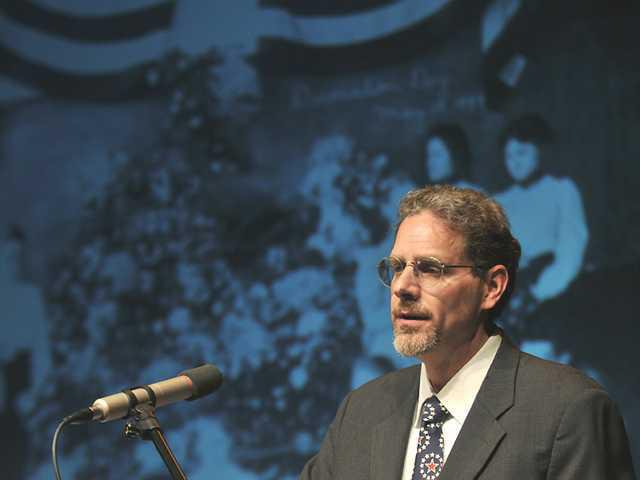
Beginning to read the first lines from “In Flanders Field,” the voice of World War II veteran Burton Higgins started to crack.
“In Flanders fields the poppies blow
Between the crosses, row on row …”
Higgins paused, collected himself and continued to recite the traditional poem during Monday’s annual Memorial Day Observance at the Averitt Center for the Arts.
More than 100 people gathered inside the Emma Kelly Theater for the emotional and inspirational ceremony to honor all Bulloch County residents killed in the wartime service of the United States.
“We’re here today because we must always remember the sacrifices made to keep our nation safe and all of us free,” said retired Naval Commander Cliff Holt, who served as master of ceremonies. “It’s a debt of gratitude we can never repay but we can always honor.”
Monday’s observance took on some added significance as a Bulloch resident was killed in action for the first time since the Vietnam War. Sgt. Brock Henry Chavers of Portal was killed in July 2009 while serving in Afghanistan. Chavers’ name was intoned by 1st Sgt. Bobbie Babot as the last of 64 Bulloch residents killed in action since World War I.
“Today let us proudly remember and honor all who met death while serving under the flag of these United States,” said Joe McGlamery, president of the Bulloch County Historical Society. “Let us reflect on their lives. Let us cherish their memories. And let us forever be grateful for their full measure of devotion to a cause they thought just.”
After the names of the Bulloch dead were intoned, Joe Bill Brannon, a Vietnam veteran, introduced the program’s keynote speaker, Dr. Brent Tharp. Tharp is director of the Georgia Southern Museum and an assistant professor of history at GSU.
Tharp then offered a concise history of the origins of Memorial Day though the traditions of today.
“…We need to recognize their ultimate sacrifice and remember how our country came to commemorate this uniquely American holiday Memorial Day,” Tharp said. “The U.S. Government recognized Memorial Day as a federal holiday in 1967. But this just standardized the name and the date of century-old community traditions that had been forged by the grief and the loss of the American Civil War.”
Tharp described how communities, north and south, forged their own observances and how honoring military service became part of American culture. Tharp related how the observance became so important that Japanese-American citizens interned during World War II held a ceremony inside the Manzanar Internment Camp to honor their relatives who died fighting for the United States.
Tharp concluded by encouraging everyone to keep alive the deeds of our fallen heroes.
“Our goal here today is to take the examples of the ladies of Columbus, Mississippi, the internees of Manzanar and the many others who have gathered over the past century in the Spring to remember and honor friends, family, comrades and perfect strangers who gave their ultimate sacrifice for us,” Tharp said. “Let us not let them be merely names on a stone or statistics in a book, but living heroes through our memory and our actions.”
Memorial Day 2010 - A debt of gratitude
Annual observance emotional, inspirational