
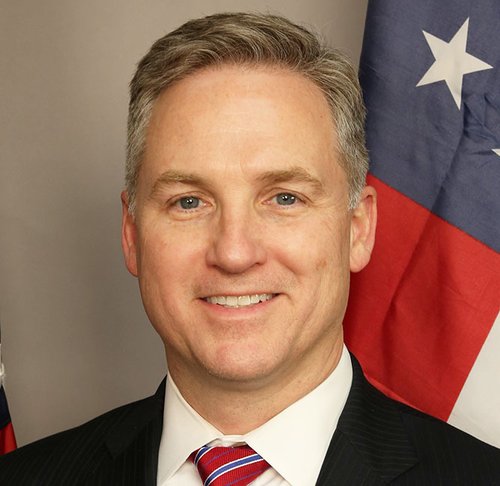
Sen. John F. Kennedy, Republican from Macon, gave up technically the second-highest post in the Georgia Senate, president pro tempore, in early June to start his run for lieutenant governor. Interviewed by phone while making a recent visit to Statesboro, he sized up the shuffle set to take place in Georgia’s government in 2026.
“We are at a very critical time for Georgia in our, not just politics and not just 2026 being a very important year for us politically, but we’re going to have a changing of the guard – if you will – of all of our top constitutional officers,” Kennedy said, “and I quite frankly think that we’ve been lucky to have Brian Kemp’s leadership and hands on the helm of our state and our economy, and it’s critically important that we maintain, going forward, some of those same pro-business, pro-growth policies.”
Kemp will be in his eighth year as governor next year and is limited to two four-year terms. Current Lt. Gov. Burt Jones, after one four-term term in that office, isn’t term-limited, but he is instead running for governor, so both top offices are available and have attracted multiple contenders.
Unlike the lieutenant governor, who is elected statewide and serves as president of the Georgia Senate, the president pro tem is a regular, district-elected elected senator chosen by a majority of fellow senators for that leadership post. A specific Senate rule states that as soon as a president pro tem announces or files paperwork to run for any office other than his or her Senate seat, the office of president pro tem becomes vacant.
So that’s what happened when Kennedy, who had been president pro tem since January 2023, announced his campaign. But he remains, through next year, the senator from the 18th District, which first elected him in 2014.
Now 60, he was born a little less than two years after the assassination of the president whose famous initials he shares. But the Georgia-born state senator’s middle name is Flanders, not Fitgerald. Also, although he grew up in the little town of Adrian, about halfway between Swainsboro and Dublin, his father was from northeast Georgia, and he doesn’t know if he’s any relation to the late Sen. Joseph E. “Joe” Kennedy of Claxton, who represented the 4th District for 24 years and was president pro tem circa 1983-1990.
But this John Kennedy moved to Macon at age 18 to attend Mercer University, where he attained his bachelor’s degree before also going to the Mercer University School of Law for his law degree. He also met his wife, Susan, at Mercer, but he first practiced law in Atlanta before they returned to make their home in Macon in 1995.
Now a partner with the James Bates Brannan Groover law firm in its Macon location, he handles business litigation and advice and business-related matters such as receiverships.
This Kennedy spoke of Kemp’s pro-business, pro-growth policies as having “served all of Georgia so well.”
‘Keep Georgia growing’
“One of my platforms is that we’ve got to keep Georgia growing,” Kennedy said. “I think that means that we have a pro-business environment for our job creators so that folks can find good-paying jobs and take care of their families, and that’s not just a talking point, it’s something that I have worked hard for.”
After Kemp last year identified “lawsuit abuse reform” as a top legislative priority, Kennedy sponsored the bills and led in getting them passed, he notes, and the governor signed them into law.
“That’s going to have a big impact on making sure that we stabilize insurance rates that people are paying in Georgia, stabilize the insurance market and keep a pro-job-creating business environment,”Kennedy said.
Exactly what this legislation does is beyond the scope of this profile, but he said the purpose was to “rebalance” the situation, and that some insurers and medical or health care providers that were leaving Georgia are already deciding to come back.
“It is a very balanced, very fair bill that simply rebalanced our civil justice rules in ways where they were clearly out of balance,” he said. “It was never the goal of the work we did on the tort reform measures that people that are harmed or injured shouldn’t be fully and fairly compensated.”
School absenteeism
Another of Kennedy’s platform planks is to “keep Georgia learning.” Over the past year and a half, he said, he discovered and has worked to do something about “a hidden crisis,” the extent of chronic absenteeism in Georgia’s schools.
“Out chronic absenteeism spiked during COVID and has come back. It has come down some, but it’s still at 21%, which means that 360,000 school children are chronically absent, meaning they’re missing 18 days or more of the school year. …,” Kennedy said. “Those kids don’t have a chance for the Georgia dream we want for them, or the American dream we want them to enjoy, being productive members of society.”
He introduced, as lead sponsor, this year’s Senate Bill 123, which passed and was signed into law by Kemp. Among other things, it requires each local school district with a chronic absenteeism rate higher than 10% to create a district “attendance review team,” and a separate team for each school with a rate higher than 15%. The teams are to meet monthly and develop intervention plans for chronically absent students or their parents or guardians.
He has also formed a chronic absenteeism study committee that met with school system leaders and experts around the state last summer.
Kennedy’s third platform plank is to “keep Georgia safe.”
“We’ve got to make sure that our law enforcement, our sheriffs and those that protect us in the times we need them the most are well funded, well resourced and they understand we appreciate what they do for us because … if we can’t keep Georgia safe, we can’t keep Georgia growing, if we don’t keep Georgia safe, we can’t keep Georgia learning,” he said.
All 3 on 1 committee
Then there’s taxation. Last summer, Jones named a Senate Special Committee on Eliminating Georgia’s Income Tax. As it turns out, three Republican senators now campaigning to succeed Jones as lieutenant governor are serving together on that committee.
Sen. Blake Tillery, R-Vidalia, the Senate Appropriations Committee chair previously interviewed here as a lieutenant governor candidate, chairs the special committee. But Kennedy, as well as Sen. Steve Gooch, R-Dahlonega, the former Senate majority leader running for lieutenant governor, are also members.
Kennedy noted that the Legislature has been reducing the state income tax rate incrementally each year so that, after having been 6% for more than 50 years, the rate is now 5.19%.
“The work of the committee will be to find a way to eliminate the state income tax, and I want to make sure that it’s done in a thoughtful way, so that we understand, with the decreases as they come … that we know what the impact will be,” Kennedy said.
The party primaries will be held May 19, and the general election, Nov. 3, 2026.