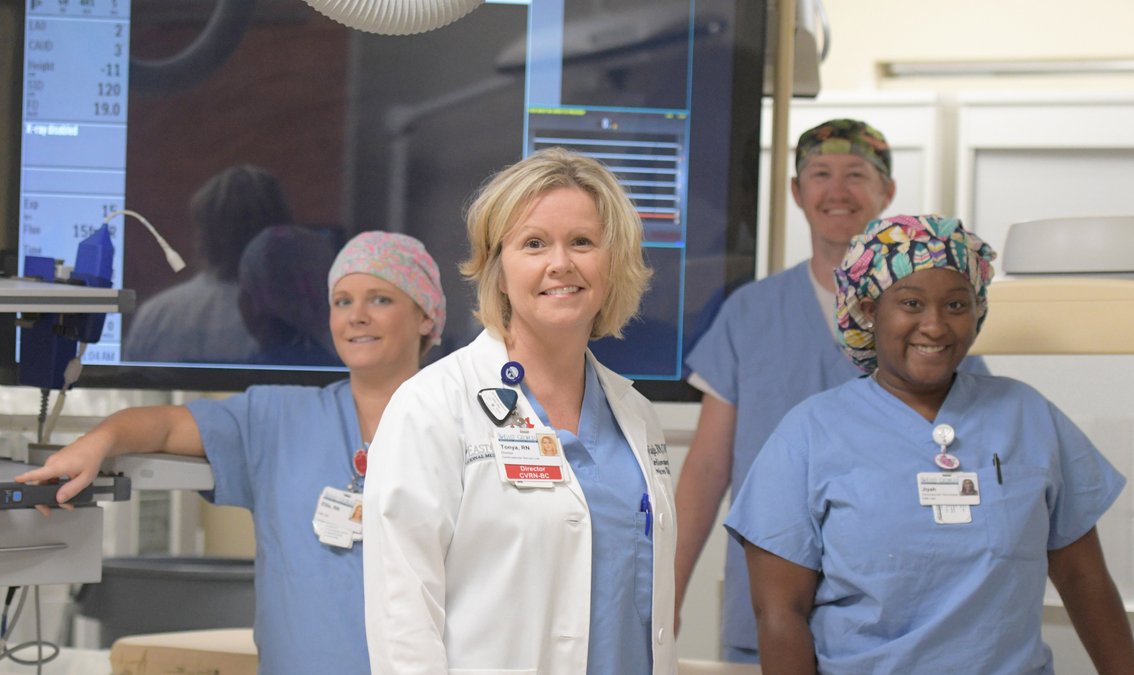
After the Georgia Department of Public Health had completed its evaluation of cardiac care at East Georgia Regional Medical Center that resulted in the hospital being designated in May as a Level II Cardiac Care Center in the state, CEO Stephen Pennington said he came away with three key points.
“One, we do a really good job of treatment once a patient gets inside the door that result in the best possible outcomes,” he said. “But we need to do a better job in the community in two areas: Educate people to come get treatment sooner once they first experience a possible heart attack and to use EMS services when they have those symptoms instead of driving themselves to the hospital.”
And while Pennington and the staff and physicians at EGRMC are formulating plans to create more outreach in the community, the Statesboro hospital marked a prestigious milestone in achieving the Level II designation. In fact, East Georgia Regional is only the second Level II Cardiac Care Center in south Georgia, with the other located in Brunswick.
“Receiving the (Level II) designation is such an extraordinary accomplishment for our team,” said Tonya Eagle, EGRMC director of Cardiovascular Services. “But this achievement extends far beyond the walls of our hospital. (It) connects first responders, surrounding emergency departments and cardiologists throughout the region to ensure each patient receives the level of care they need.”
According to the Georgia DPH, the Office of Cardiac Care was established in 2017 as part of an effort to improve survival rates in the state for both cardiac arrests and heart attacks. One way to improve care is building a better system of coordination of all health services in understanding what is the best course of treatment for a patient, especially in an emergency cardiac situation.
“There hasn’t been a consistency of coordination of care on the state level,” said Bryan Realiza, who is the Centers for Excellence Accreditation Manager at EGRMC. “(The program of designating Level I, II and III cardiac care centers) is an effort to coordinate all the efforts leading up to the patient arriving. This is a huge win for EMS, because it is attempting to coordinate consistency with EMS agencies and also with smaller critical access hospitals that send cardiac patients to East Georgia.”
Level I, II and III
Health care organizations seeking designation by the Georgia DPH as an Emergency Cardiac Care Center undergo a thorough evaluation process. Once the process is complete, the Georgia DPH uses a three-level designation system to rank the capabilities of each facility:
Level I hospitals perform open heart surgery and interventional cardiac catheterizations.
Level II hospitals perform interventional cardiac catheterizations.
Level III hospitals stabilize patients until they are transported to a Level 1 or Level 2 center.
East Georgia Regional is now one of 14 Level II Cardiac Care Centers in Georgia and the Department of Health described hospitals that become Level II “as giving (the community) peace of mind knowing that if they go to (East Georgia Regional), they’ll receive the correct treatment.”
Eagle said the state now provides a list to emergency medical services, such as county EMS providers, as well as Air Evac and all other transport services, that shows which is the most appropriate facility to send a particular patient to for their particular cardiac need. As a Level II designated center, EGRMC is recognized as a facility that can meet emergency cardiac needs.
“Why this is so important is that time is muscle,” Eagle said. “Whenever you are talking about cardiac emergencies, you are losing myocardial function with every tick of the clock. So you want to get the closest and most appropriate care for that patient.
“So, for example, a cardiac patient is brought to Evans Memorial in Claxton and stabilized. Iinstead of then taking 90 minutes to two hours to get that patient to Augusta or Savannah, you can come 25 minutes down the road to East Georgia, which can now provide the exact same emergency care that a hospital in Augusta would. So you’re saving a lot of myocardial function for that patient by saving time in getting that critical care.”
Evaluation team
Realiza said the evaluation team for the designation included three officials with the Georgia Department of Health and three staff members from Phoebe Putney Memorial Hospital in Albany. The group really emphasized the importance of getting patients treatment in a timely manner as part of the overall effort in coordinating cardiac care services.
“The goal is always to make our processes faster and more efficient for every single patient,” Realiza said. “When we analyzed our data of the patients that we take care of here in Bulloch County, patients that began experiencing chest pain at home would typically wait 26 hours before they would come to the hospital.
“The most tissue damage to the heart occurs during the first few hours of a heart attack. That in itself shows there’s a huge education gap in our community.”
Another way to improve care and save time is for people who have heart attack symptoms to call EMS for help immediately.
“We have a lot of people who come in a private car to the hospital when they start experiencing chest pains instead of calling EMS because they think that’s faster, but it’s not,” Pennington said. “When you call EMS, they’re doing an EKG right as soon as they get to you. They’re sending that information to the hospital, the ER, the physicians and we’re preparing our team with a lot more knowledge of what that patient may need immediately. When you call from your private car, the direct care doesn’t begin until you get inside the door.”
In fact, Realiza said hospital data showed that 75% of cardiac emergency patients came to EGRMC by private vehicle and 25% by EMS.
“We want to push the information out to our community about improving the outcomes for our loved ones and friends and that means we need to really ramp up our education efforts,” he said.
With the Level II designation and the Georgia Department of Health’s concerted plan to better coordinate all emergency cardiac care elements from EMS to hospitals, Pennington said he expects East Georgia will see more patients presenting with heart episodes.
“There’s a lot of effort, equipment, staff, physicians, and all around components that are needed to respond to cardiac needs already in place at the hospital,” he said. “We think we have the infrastructure to handle a lot more heart-related procedures, if necessary.”