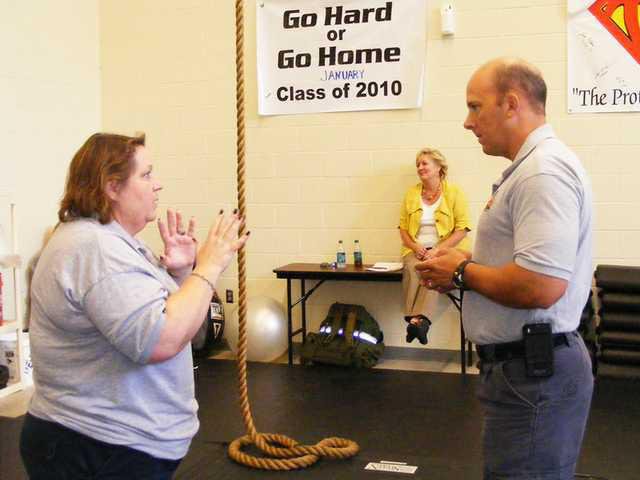
Approaching an intersection, a Georgia State Patrol trooper finds traffic unexpectedly backed up. Then he sees a confused civilian in the middle of the highway directing traffic.
The trooper gets out of his car, introduces himself as a Crisis Intervention Team member, and politely asks the woman to join him on the side of the road. In the conversation that follows, he learns that she doesn't drive but is concerned for the safety of "these idiots" who do.
It didn't actually happen out on U.S. 301, but it was one of several role playing exercises used in a 40-hour, five-day Crisis Intervention Team course at Ogeechee Technical College's police academy in Claxton.
Unlike the academy's regular classes for police cadets, the CIT training is an in-service program for active-duty officers. With the aim of avoiding the use of jail time or force, they learn new ways of dealing with people who are living with mental illness.
An experienced officer can learn some things from the course, said GSP Senior Trooper Tommy Strickland. He had just taken part in a skit where a person who called in a complaint of criminal activity turned out to be experiencing a delusion after she stopped taking her medication. This was his first time taking this kind of training, but he has seen similar, real-life situations in his 17 years of law enforcement.
"The biggest thing is learning how to talk with people," Strickland said. "You want to understand their feelings. The more you talk with them and learn where they're coming from, the better you know how to assist them and get their situation resolved."
GSP participates
Sgt. First Class Brad Mosher, new commander of State Patrol Post 45 in Statesboro, was another of the 10 GSP troopers taking part. Georgia Bureau of Investigation agents and Department of Natural Resources rangers rounded out the 20-member class.
CIT training remains voluntary for troopers, but Mosher believes it is beneficial. Like other officers in the program, he has learned to speak of mental health services "consumers" to avoid thinking of them as suspects or patients.
"We're going to have an opportunity where we're going to be running across these consumers and maybe where before our thinking has been to incarcerate the individual, maybe now we can think along the lines of something to keep them out of the jails, out of the prisons and seeking rehabilitation or help," Mosher said.
The OTC Law Enforcement Academy had previously hosted CIT training for sheriff's departments and city police forces in the area, beginning with one in early 2010 organized by the Evans County Sheriff's Office. But this was the first such course for the state's three law enforcement agencies, the GSP, GBI and DNR.
GBI Special Agent Debbie Shaw, CIT law enforcement coordinator for the state, came to Claxton to lead the training. Courses will be offered at eight other sites around Georgia, with about 250 troopers, GBI agents and DNR rangers expected to complete the course by the end of the year, she said. That will be about one-fifth of the officers the state employs.
CIT teams
Crisis Intervention Teams are usually based in local police agencies. But with the training, Shaw said, state officers will be better prepared to assist.
"This is a community-oriented program, but they also want the state agencies to participate and understand what's going on within their communities, so we're going around the state providing this training to all three state agencies," she explained.
Recent incidents with Afghanistan and Iraq veterans suffering from post-traumatic stress disorder have alerted all agencies to a need to be better prepared, Shaw added.
The course began last Monday with classroom lessons. Officers then spent that Tuesday visiting two facilities in Statesboro operated by the Pineland Mental Health agency.
Role-playing exercises followed more classroom hours at midweek, and the Friday morning was devoted to legal issues, with a judge talking to the class.
The Statesboro affiliate of the National Alliance on Mental Illness stocked the break room with refreshments for officers taking the course. NAMI, a support and advocacy group that includes families of people with mental illness, also provides "family perspective" and "consumer perspective" elements of the training. NAMI has applauded steps to implement CIT training in Georgia since they began under former Gov. Sonny Perdue.
Local NAMI President Bill Coussons thought the visits to John's Place and New Beginnings were an especially helpful part of the program. At New Beginnings, a day treatment location, officers and consumers talked face-to-face.
"This group just did wonderfully in their dialogue with consumers," Coussons said. "It was one of the better experiences I have had."
Dealing with the mentally ill
State troopers train at OTC police academy