US House bill has key Savannah harbor provision
SAVANNAH — A bill that's passed the U.S. House includes a key provision for deepening the shipping channel to the Port of Savannah.
The House voted a near-unanimous 417-3 Wednesday to approve $8.2 billion worth of plans for dams, harbors, river navigation and other water projects nationwide.
The bill would clear a final bureaucratic hurdle to the long-sought Savannah harbor deepening by raising the project's authorized spending limit nearly $200 million to the current cost estimate of $652 million.
Georgia's 14 House members all voted to pass the bill. A different version has already passed the Senate, which must agree on a final version with the House.
Savannah and other East Coast ports want deeper harbors to accommodate supersized cargo ships expected to begin arriving through an expanded Panama Canal in 2015.
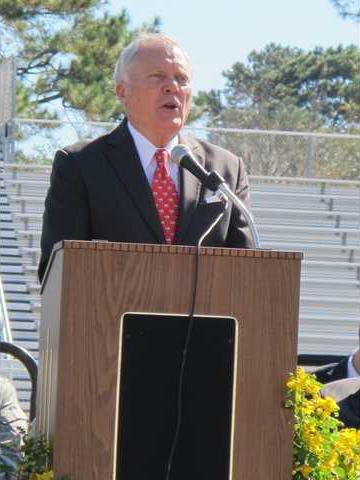
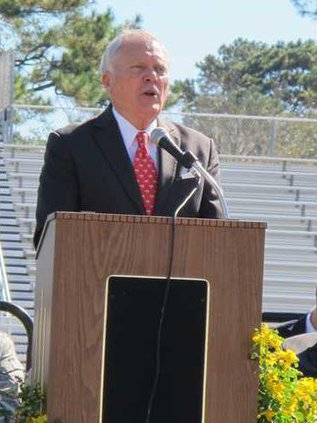
HINESVILLE — Gov. Nathan Deal spoke Wednesday for 30 minutes about job creation and growing the economy, educating the future workforce, benefits of the Port of Savannah expansion project and criminal justice reform during his visit to Liberty County.
Deal and his wife, first lady Sandra Deal, joined local leaders and state Sen. Buddy Carter, R-Pooler, and Rep. Al Williams, D-Midway, on-stage at Bradwell Institute's Olvey Field. The Liberty County Chamber of Commerce hosted the event.
Elizabeth Rogers, a student at Joseph Martin Elementary School in Hinesville, stole the podium when she told Deal that Liberty County students and community members fashioned the world's largest crayon by melting 119,000 crayons "in a Lowcountry boil pot." The recycled crayon stands 9½ feet tall and weighs more than 650 pounds. She was featured on the cover of a recent chamber publication, according to Leah Poole, the CEO of the chamber and the Liberty County Convention and Visitors Bureau.
Deal's first topic was job creation. He said more than 177,000 private-sector jobs have been created in Georgia since he took office in January 2011. Deal said 3,000 of those jobs have been created in coastal Georgia, with 100 of them in Liberty County, thanks to Firth Rixson.
The governor said he is determined to make Georgia the No. 1 state for doing business. The General Assembly took a step in that direction by agreeing to roll back an energy sales tax on manufacturers during the next four years, he said.
Another component to growing jobs in Georgia is the Port of Savannah deepening project, Deal said.
The U.S. House of Representatives approved legislation Wednesday that would allow Georgia to spend the $231 million the state has allocated for the project. Georgia Ports Authority currently generates more than 350,000 jobs. The bill now returns to the U.S. Senate, which must reconcile differences in the version it passed in May.
Supplying a well-educated and skilled workforce is another key factor in drawing businesses to the state, Deal said.
"We can't attract jobs without that," he said.
The governor said now that more military members are separating from the service due to the drawdown of troops overseas, they must be assisted in transferring their military job skills to the civilian workforce.
"I don't want to see our veterans on the unemployment rolls," Deal said.
He said his administration has worked to shorten the licensure process for veterans and to recognize here in Georgia the licenses military spouses have earned in other states. He added there is a shortage of operators with commercial driver's licenses in Georgia, which is why he supports the Troops to Trucks initiative.
The program will allow qualified military-service members to apply for a CDL without having to take the road-skills test, according to the Georgia Department of Drivers Services' website.
Military service members who have been honorably discharged within 90 days or less or have experience operating a commercial motor vehicle of the same class and type for at least two years prior to an honorable discharge qualify for the program, according to dds.ga.gov.
Deal praised the state's technical college system. He also said funds have been added to the state's education budget to hire reading mentors in public schools. The governor said too many students are being promoted past third grade without mastering basic reading skills.
Deal touched on legislation passed last year after two fatal boating accidents occurred on Lake Lanier. The new, tougher law included reducing the blood-alcohol concentration from 0.10 to 0.08, the same limit as for the state's automobile DUI limit.
"If you're too drunk to drive a car, you're too drunk to drive a boat," he said.
Deal also spoke about his efforts to reform the criminal-justice system, focusing on adult non-violent offenders and juvenile offenders. Georgia had the fourth-highest prison population in the country when he became governor, according to Deal, who added that Georgia spends, on average, $1.2 billion on the correctional system each year.
"It costs $18,000 a year for a bed for an adult offender," he said. "It costs upwards of $90,000 a year for a bed for a juvenile offender."
Deal said the state is attempting to cut down on recidivism of adult and juvenile offenders rather than spend tax dollars to build more prisons.
"I was a juvenile court judge," Deal said, recalling he had two choices when sentencing a youthful offender — either send them back home or incarcerate them in a youth-detention facility. Sometimes, neither choice was appropriate, he said.
To help rehabilitate nonviolent offenders, accountability courts have been created. These courts address offenders' substance-abuse and mental-health issues and the particular challenges faced by veterans, the governor said.
Deal said the state's criminal-justice-reform council also is working on ways to ensure long-term felons are able to find a place to live and a job upon release from prison.
"If they don't find those two things, it's likely they'll wind up back in our criminal-justice system," he said.
The governor encourages religious and civic groups to get involved in helping solve the state's problems.
"Government cannot do it by itself," Deal said.