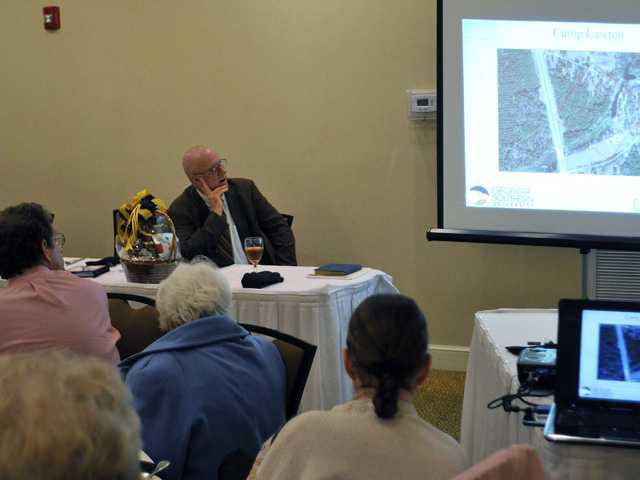
To honor Georgia’s founding, the Archibald Bulloch Chapter of the Daughters of the American Revolution gathered Thursday for its 15th Annual Georgia Day Luncheon.
The Georgia Day holiday is traditionally observed close to Feb. 12, when James Oglethorpe landed the state’s first settlers near modern-day Savannah.
Local members of the DAR, all descendents from men or women who played a part in the American Revolution, celebrated the day with a presentation about Camp Lawton, a Confederate prisoner-of-war camp located at modern-day Magnolia Springs State Park near Millen.
The featured speaker, Lance Greene, an associate professor of anthropology at Georgia Southern University, provided a progress report on work being done at the site and posed the questions his team continually attempt to answer.
“The (Camp Lawton) site is really unique and remarkable for a lot of different reasons,” Greene said. “This was a massive undertaking by the Confederate Army.”
The camp represents a key chapter in Civil War history, and in the history of the State of Georgia. At the time of its construction in 1864, the Confederate camp was billed as “the largest prison in the world,” he said.
Georgia Southern has taken the lead in research efforts — which began in 2009 — to uncover artifacts at the site, and solve mysteries still associated with the camp.
“We have already figured out what we believe is a relatively accurate idea of where the stockade wall was located,” Greene said. “One of the things we’ve worked on in recent years is finding evidence of the Union prisoner area. We’ve worked within the walls to find remnants of huts, materials and other items that were left behind that give us a depiction of everyday life.”
Greene said teams have performed excavations, conducted geophysical surveys and even took part in a bit of diving — to inspect a creek that runs through the site — in their efforts to learn more about Camp Lawton.
Researchers are gaining a clearer idea of what the lives of Union prisoners, and their Confederate captors, were like during the camp’s brief existence.
Still, there is much more to learn.
“Camp Lawton is something that is a lifetime’s work,” Greene said. “We want to learn about every aspect of this fortification —the barracks, hospitals and mass graves. What we want to do is expand our research beyond the stockade and identify the lives of all the people who lived there. I think archaeology can address a lot of our questions.”
The special event served as one of two monthly meetings for the Archibald Bulloch Chapter of DAR.
For more information about the organization visit archibaldbulloch.georgiastatedar.org.
Jeff Harrison may be reached at (912) 489-9454.
DAR celebrates Georgia Day
Host presentation on Camp Lawton