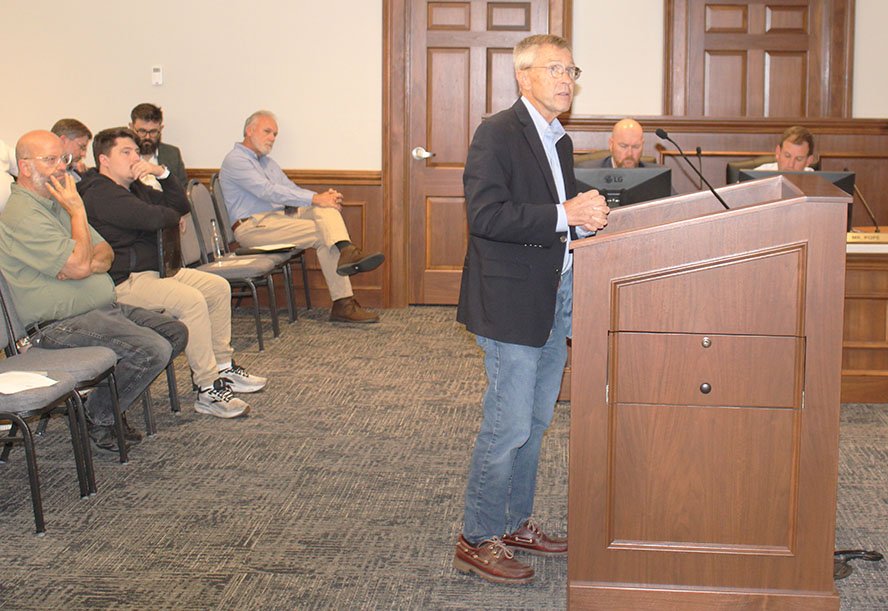
The Bulloch County commissioners on May 5 extended their moratoriums barring rezoning for residential or planned unit development and creation of “data centers” in the county to the end of the year. Then they took an additional separate step, also with a 5-0 vote, to initiate a process to ban data centers through a zoning amendment.
Both moratoriums – temporary freezes preventing certain permissions from being granted by the county – had been initiated in mid-February, originally for 90 days, suggesting a deadline next week. However, public hearings on both were slated from the first to be part of the May 5 evening regular Board of Commissioners meeting, with language suggesting possible extensions.
Indeed, newly drafted, separate resolutions extending both moratoriums to Dec. 31, 2026 – unless the board takes other actions that would end them sooner – were included in commissioners’ paperwork packets for the meeting, published the previous Friday.
Meanwhile, opposition to data centers in particular had become a talking point in the current election season, with Commissioner Toby Conner facing two challengers – Frank Bedell and Dr. Ted Redman – in the May 19 Republican primary in multi-seat District 2 with early voting well underway. Commissioner Anthony Simmons, a Democrat, faces a Republican challenger, Spencer Johnson, in District 1, but that can’t be decided until November.
Bedell voices an ‘N-O’
When Chairman David Bennett opened the public hearing on the moratorium against rezoning to residential or PUD classifications, the first person signed up to speak was Bedell, the candidate. He identified himself by name and as a small-business owner and taxpayer.
“I came here today with a simple message on data centers in Bulloch County, N-O, no!” Bedell said. “Over the past few years, many of us have felt like this county has taken a financial hit, higher costs, higher taxes, much uncertainty. Before getting something new, like a large data center, we need answers.”
He went on to express support for both moratoriums, but spoke mostly against data centers.
“Data centers are called development, but let’s be honest: few long-term local jobs, very high power demands, significant water usage, direct and indirect … and real infrastructure strain. …,” he said.
“So today, I give you two yeses and one no,” Bedell said. “‘Yes’ to the residential moratorium, because infrastructure is already stretched, ‘yes’ to the data center moratorium because we clearly do not know the answers, but most importantly, ‘no’ to data centers in Bulloch County, not later, not after studies and not after deals are lined up, ‘No.’”
Bedell’s declaration against data centers was actually given during the time for public comment on the residential rezoning moratorium, Bennett noted, but also acknowledged that nobody else had signed up to speak on that issue.
Zoning-change moratorium
Then, with commissioners offering no discussion of their own, Commissioner Conner made the motion to “continue the moratorium” on rezoning, and Commissioner Nick Newkirk seconded that motion.
County Attorney Jeff Akins asked for clarification that they meant to adopt the resolution on the residential zoning moratorium as proposed in their agenda packets. The commissioners agreed, and the vote to approve was 5-0, with Commissioner Timmy Rushing absent.
This resolution bars county officials and staff from accepting applications to rezone any parcels to any of the residential classifications R-80, R-40, R-25, R-15, R-8, R-2, R-3 or to any of the planned unit development classifications PUD-1, PUD-2 or PUD-3. The resolution states that the moratorium “shall terminate at the earliest date of (1) December 31, 2026; (2) approval by the … Board of Commissioners of an extension” of the moratorium; or (3) their majority vote to terminate the moratorium; or (4) the effective date of an impact fee ordinance adopted by the commissioners.
This “earliest date” language seemed to cause some confusion. But the meaning is actually similar to “whichever comes first,” and Akins explained that the commissioners could end the moratorium sooner or extend it again by taking one of the other actions.
When Bennett and the commissioners opened the hearing for public comment actually on the data centers moratorium, the first citizen to speak was Molly Nagy. Declaring in favor the moratorium, she spoke of fears about purported effects of data centers including high-volume water usage, water pollution and light and noise pollution.
“There’s almost a leaning toward it being a necessary part of our modern life,” Nagy said early in her remarks. “I think we’re undergoing something very unusual, the commandeering of our public waterways for private companies.”
Dr. Frank Davis, a retired surgeon who serves on the advisory committees for the two-county Groundwater Sustainability Program and Bulloch County’s study for impact fees, also spoke in support of extending the moratorium. But he stressed that the time should be used to gather more information.
“The bottom line is, how data centers are governed will determine whether communities will benefit … or bear the brunt,” Davis said. “There are a lot of places that have really (borne) the brunt, but there are a lot of lessons learned out there.”
Abandoned first draft?
He noted that an initial draft of a data center ordinance had been posted on the Bulloch County Board of Commissioners page on Facebook and credited Planning and Development Director James Pope with having put “a lot of good ideas” into this.
“Again, with the lessons learned I think it can be done in a manner which would benefit this county’s tax revenue base and still not destroy the environment. I think at this point the moratorium would give us more time to study …, have more public information meetings,” Frank Davis said.
John Smith, who spoke after him, said he was concerned and referred to seeing a map “where they’re planning to put this on 301 North” but said “there’s very little information about it” and said he didn’t want one near his business or family. Chairman Bennett stated again, a few minutes later, that the county had no proposal, and had not received any, for a data center.
Conner’s ‘flat no’
But Conner was the first commissioner to speak directly on the topic of data centers. After noting that he’d received many phone calls, he said the moratorium extension resolution was “fine … and it will prolong, and we can do some more studies on it, we can eat up more time,” but his tone made it clear that wasn’t where he wanted to go.
“We’ve been forced into things before. Nobody’s forcing our hands on this one. I don’t think we should even go on with the moratorium; I think we should just put the flat ‘no’ on this,” Conner said.
Some applause erupted from the audience, as had also occurred after Bedell’s comments.
To amend zoning
Then Akins, the county attorney, said, “If you don’t want to allow them at all, it may require an amendment to the Zoning Ordinance. We’re going to need to study that a little more carefully.”
Zoning text amendments go through a public notification process and are heard by the appointed Planning & Zoning Board for a recommendation before coming to the elected commissioners for a final decision. The process usually takes a little over two months, sometimes three months, Pope said during the meeting.
Akins noted that the Zoning Ordinance currently makes no provision for data centers as such, but that there is a section, added a few years ago, for cryptocurrency operations, which are somewhat like data centers.
“So that’s going to have to be addressed,” he said.
No data center pending
Bennett spoke, reiterating that the proposal for the moratorium started months ago from his desire to not see “somebody show up here and say, ‘Hey we want to put a data center in Bulloch County,’ when we didn’t have any kind of planning and zoning ordinances available or anything to protect the people.
“And that’s why I went about asking for this moratorium,” Bennett said. “The intent was not to try to sneak in a data center, and I will tell you officially, on the record, yet again, that Bulloch County has not had any kind of discussion, either through the Development Authority or otherwise, with anyone about putting a data center in Bulloch County.”
After about six months’ research on data centers, Bennett said, he doesn’t have all the answers, but doesn’t “think they’re the boogeyman that they’re made out to be on social media.” He also asserted that, on the other hand, something like a $40 billion project on 150 acres of land could benefit current Bulloch taxpayers by becoming a major tax revenue source for the county, allowing lower rates.
But Commissioner Ray Davis spoke of concerns that a data center’s electrical demands could produce a need for eminent domain to acquire land for the power infrastructure, creating “a very difficult situation.” He also noted the concerns about water use, and questioned whether the tax revenue gain would offset these concerns.
Two 5-0 votes
Ultimately, Conner first made the motion to approve the resolution extending the moratorium to Dec. 31 or until the commissioners enact a zoning amendment addressing data centers or otherwise end the moratorium. Davis seconded, and this motion passed 5-0.
Meanwhile, Newkirk offered a motion “to start the process” for a zoning amendment prohibiting data centers in Bulloch County outright. Conner seconded it, and this motion was also approved 5-0.