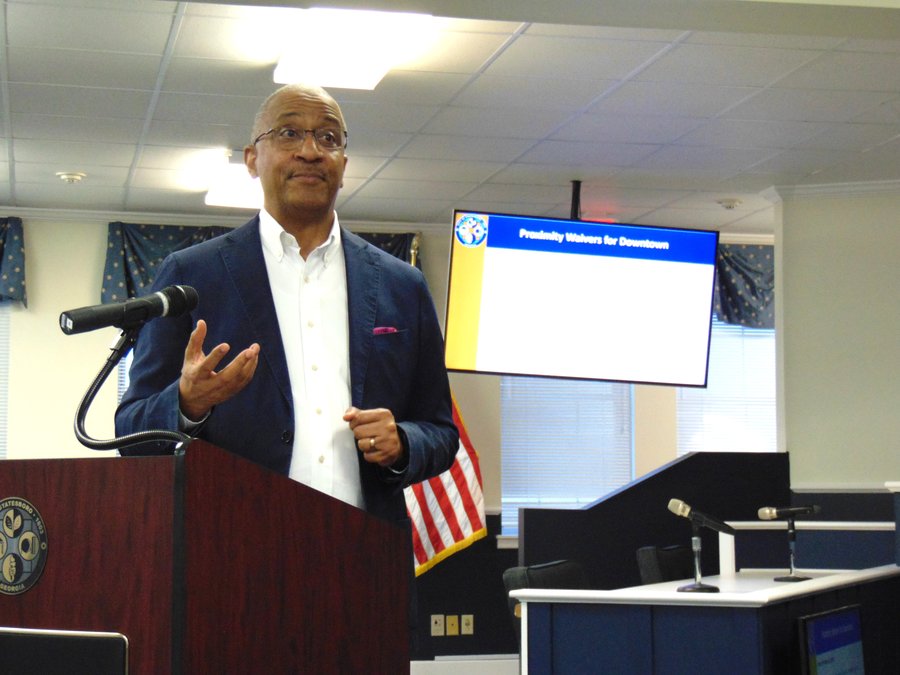
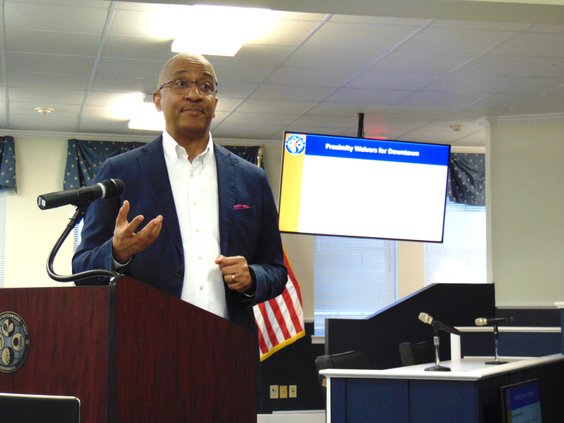
About a dozen people attended a 5 p.m. March 26 public information meeting hosted by Statesboro city staff about the ordinance change pending final City Council approval that would exempt an area of downtown from a rule prohibiting bars and other pouring establishments within 100 yards of any church, educational building or alcohol addiction treatment facility.
Pastors from one church came to the meeting. As it turns out, that church – First Baptist Church Statesboro – is more than 100 yards from any commercially developable property in the area of the proposed exemption, according to City Attorney Cain Smith. The second reading and possible final approval of the ordinance amendment is slated for the 9 a.m. Tuesday, April 2, council meeting. A hearing for public comment usually is not required for a second reading, only the first. However, Mayor Pro Tem Shari Barr and City Manager Charles Penny said the mayor and council will hold another hearing on the amendment during Tuesday’s meeting.
“They just want to make sure people are heard,” Penny said.
The current ordinance already allows the mayor and council to grant a “distance waiver” for the licensing of a proposed restaurant, pub or low-volume establishment (such as a salon that serves wine) less than 100 yards from a church, school or treatment facility. But it makes no provision for a waiver for a “bar” or a “bar with kitchen,” business types defined in the city law for places that make most of their money from alcoholic beverages.
The passage proposed to be added to the Alcoholic Beverage Ordinance states: “The proximity requirements for on-premises licenses shall not be in effect for that portion of downtown bound by Cherry Street on the south, Hill and Elm Streets to the north, College Avenue to the west, and Mulberry Street to the east.”
Leading Tuesday’s information meeting with a short slide show, Penny said the goal of “proximity waivers” has been to provide “expanded business opportunities,” boost “downtown vibrancy” and improve the “outdoor experience” for visitors.
“What we’re trying to do in Statesboro is, one, we’re trying to create a downtown that is inviting and exciting for our community, and so one of the things that we found when we looked at our downtown, sometimes we have churches that can become storefront churches, and once they go into a building, the proximity issue will limit how property can be used,” he said.
Storefront churches
As the name indicates, a “storefront” church is a congregation that meets in what was historically a commercial building. A number of these have come to and gone from downtown Statesboro over the years, but at present none is located where it is preventing the licensing of any proposed business.
Other “proximity concerns” have arisen from the realization that Georgia Southern’s Business Innovation Group complex between East Main Street and Vine Street, seen as a college or educational facility, also rules out the development of certain kinds of businesses in surrounding properties, Penny explained.
“When we look at our downtown, we want life in downtown after 5 o’clock,” he said. “Now, when we say that, we do qualify that. We want safe life. We want people to enjoy themselves. We want people to be able to walk around freely and enjoy a vibrant downtown.”
Legacy churches
Penny and Smith addressed the concern that long-established “legacy churches” downtown might be affected by the removal of the proximity rule within the defined area, which Penny called the “core city center.” He noted the two legacy churches mentioned by council members during previous discussions, First Baptist and First United Methodist.
The distance from locations within the exemption zone along Hill Street – which intersects North Main Street at Truist Bank – to First Baptist is more than 100 yards, Smith said. The Prince H. Preston Federal Building and a parking lot are between the church and Hill Street. On the other side of North Main, the exemption zone goes farther north, to Elm Street, but that corner is occupied by the county government’s North Main Annex.
“First Baptist is more than a hundred yards from the edge of the proximity map,” Smith said Tuesday. “There’s going to be absolutely zero effect on First Baptist Church, zero.”
East Cherry Street runs directly beside First United Methodist Church, and the historic Masonic Hall building on the corner and property behind it are well within 100 yards of the church. But city staff members said they had not been contacted by anyone from First United Methodist with concerns.
Penny again noted that the council could still reject any specific license application.
“Even by eliminating the proximity issue, our mayor and council still have control,” he said. “Even on East Main or West Main, if someone decides that they want to go in and get an alcohol license and it’s not a good person, it’s not a good business opportunity, our council still has the final say.”
From First Baptist Church, both Senior Pastor John Waters and Executive Pastor Keith Hagan came to City Hall for the meeting. After receiving an emergency call, Waters left before the presentation began but was briefed later by Hagan and Penny.
“Our main desire was to get a better understanding of what the waiver changes might possibly mean, and that’s why we were so appreciative and thankful for the gracious response from Charles Penny and the staff to explain it a little more and give us a chance to ask questions. …,” Waters said Wednesday. “Some of it is, our church has been in the downtown area for 141 years on the same piece of property, and we just want to be good downtown partners and we want to have a positive impact on the community, and we just were searching for more information so we could understand it better.”
The council had tabled a second reading for final approval March 19 after some members heard from leaders at First Baptist, and this week’s information meeting was announced. It was not a City Council meeting, and of the elected city officials, only Barr, the District 5 council member, attended.