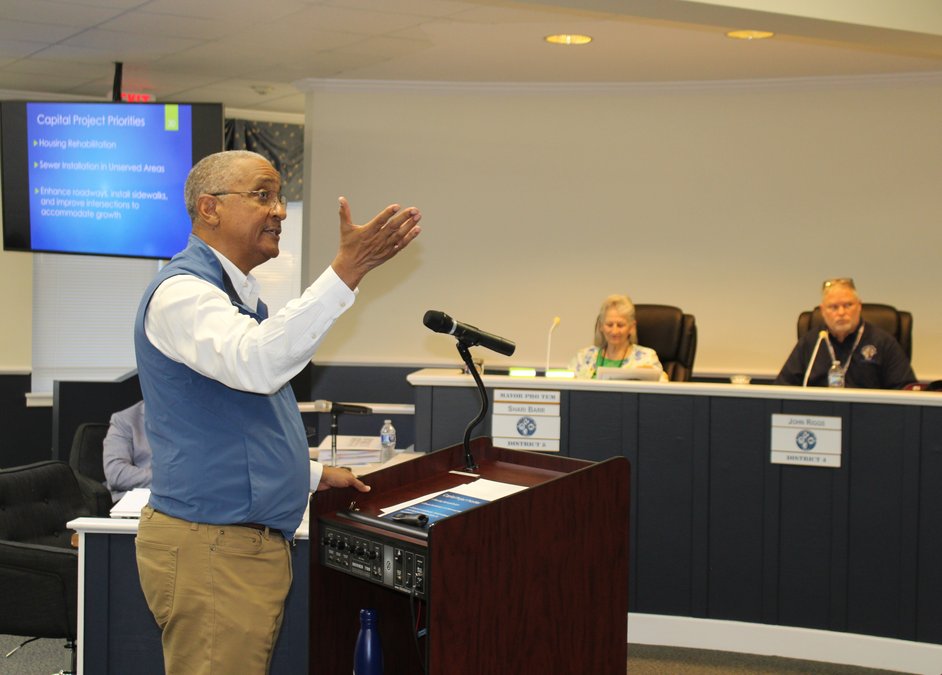
In a City Council work session Tuesday afternoon, Statesboro City Manager Charles Penny proposed a fiscal year 2027 operating budget that he predicted will require a 3.835-mill increase in city property taxes, to make up for more than $4 million in lost and expired Fire Department funding sources.
That added millage would be an over 44% increase from the city’s current tax rate of 8.625 mills.
The budget proposal includes no additional personnel to be hired in any department. It would offer only a 2% upward adjustment in the city’s overall pay plan, which is less than current federal inflation rates, but continue “pay for performance” opportunities for city employees, and would require a 15% increase in employee-related insurance premiums.
“This is not a budget with a lot of frills or anything like that,” Penny told the mayor and council at the start of his presentation.
An “emphasis on public safety” topped his outline of budget objectives, followed by a goal to “retain and recruit exceptional employees.” These are perennial goals, not new ones, and Penny told the elected officials they have made good progress on retaining employees.
“There you’ve done a good job now because turnover in the city staff has been, for the past two years, it’s been less than 5 percent a year,” he said.
Other stated objectives are an emphasis on adding utility infrastructure – water, sewer and natural gas – in “natural growth areas” and growing the tax base.
Spending up 5%
For all of the city’s funds considered together, the proposed budget for fiscal 2027, which will begin July 1, represents a 5% increase in projected revenue and spending from fiscal 2026. Considered together, the general fund and fire fund operating budgets would also increase by roughly 5% under this proposal, according to Penny’s summary.
For now, the city is continuing to account for the fire fund as separate, although the city’s general fund will now be the source for almost all of the fire fund’s revenue, Penny acknowledged.
Lost SFD funding
This follows the termination, effective July 1, 2025, of the longstanding intergovernmental agreement under which the Bulloch County government supplied a portion of the Statesboro Fire Department’s revenue, in exchange for the SFD’s providing primary response to areas outside the Statesboro city limits within five miles of its two stations.
In Penny’s budget presentation, the loss of the fire tax district funding was estimated at $2,755,000. Meanwhile, a three-year federal Staffing for Adequate Fire and Emergency Response, or SAFER, grant totaling $2.1 million the city was awarded in 2023 to hire an additional 12 full-time firefighters expires in August. So, this is resulting in the loss of another $703,000 in annual funding.
With this proposed budget, the amount to be transferred from the city’s general fund to its fire fund will increase from $3.2 million in fiscal 2026 to almost $7.5 million in fiscal 2027. (The slideshow gave $7,485,550 as the precisely proposed new amount, an increase of $4,285,550 over last year’s “transfer.”)
Potential FLOST offset
Frame 34 in Penny’s 36-frame budget proposal slideshow stated:
“To balance the City’s budget for fiscal year 2027 will require a 3.835 mill increase. This increase is due to the County’s decision to dissolve the Fire District. The increase will be offset next year by the FLOST funds, which are estimated at ($3.5 million).”
Penny said he did not want news outlets or anyone to characterize that middle sentence as the city manager blaming the county for the city’s proposed increase.
“I’m just being factual,” he said. “It’s a fact. When the decision was made to dissolve the fire district, it had a $2.7 million impact.”
The “FLOST” he spoke of is the Floating Local Option Sales Tax, the ninth penny authorized by 71.7% of Bulloch County voters in a November referendum and collected since Jan. 1, 2026. The revenue is scheduled to be available beginning July 1, 2027, for proportional rollbacks of property tax rates by the county and the cities of Statesboro, Brooklet, Portal and Register. The $3.5 million was a rough estimate of Statesboro’s first-year share.
‘One-year impact’
Penny said he knows the mayor and council members don’t want to raise taxes and that, as a city manager, he doesn’t like to recommend it.
“But in order to be able to operate the city … and to do it efficiently, it is something we have to recommend, but in this case, it’s a one-year impact, because you raise it this year, the next year you’re going to be able to roll it back, basically to where it is now.”
Penny had first mentioned the possibility of a nearly 4-mill tax increase several months ago, when the city government had consultants developing a plan for a monthly fire service fee on all addresses to fill the shortfall in funding. The fee was suggested as an alternative to a millage increase, but the council and mayor set aside the fire fee proposal in April, after Penny and City Attorney Cain Smith warned of the likelihood of costly lawsuits like those faced by several Georgia cities and counties with similar fees.
Keeping 69 firefighters
Besides the 12 firefighters added with SAFER grant funding, the council a few years ago authorized adding another nine full-time firefighter positions, for a total force expansion of 21 firefighters. Now the SFD has 69 career firefighters.
The department recently attained an Insurance Services Office fire protection Class 1 rating, the best available on the ISO’s 10 to 1 scale, for the service area, now pulled back to the Statesboro city limits. This was an improvement from the Class 2 rating the department had obtained for its previous, larger area that included the five-mile district.
Now the city also has Fire Station 3 under construction and nearing completion. Penny noted that this project is Special Purpose Local Option Sales Tax funded and so does not factor in the property tax increase proposal. The added station, he said, is needed to accommodate all of the firefighters and serve a growing city.
“Mayor and council, y’all have been supportive about employees. We have 69 firefighters, and some folks would say, well, now that you don’t provide service to the fire district, why do you need those 69 firefighters?” Penny said. “Well, I will tell you, you needed those 69 firefighters just to serve our community.”
He later reiterated this with “just to serve the city of Statesboro.”
“It was an extra bonus for us to be able to serve that district for 47 years, and honestly, I don’t know how they did it, but I do know … you just have a damn good fire department, because in 2019 y’all were doing that with 48 people,” he continued.
Unlike then, each fire truck now rolls with the full standard compliment of firefighters, who can mount an immediate attack on a fire instead of waiting for more to arrive, he said.
During the current fiscal year, which ends June 30, the city filled the gap left by the loss of the county fire district revenue with almost $3.2 million in loans from three of the city’s fee-funded “enterprise” budgets to the fire service fund. These included $1.8 million from the water and sewer fund, $707,000 from the solid waste collection fund and $680,000 from the natural gas fund, to be repaid over 10 years.
But as Penny and city Finance Director Cindy West cautioned a year ago, these loans were a one-time measure that could not be sustainably repeated.
Now, even with the suggested 3.8-mill tax increase, the city’s general fund projected spending will exceed the projected revenue and reduce the fund’s year-end balance – which functions as an informal emergency reserve – by about $205,210, Penny predicted with input from West. This will cause the balance to fall below the council’s preferred target of a 25% reserve against budgeted spending to somewhere in the 19% to 21% range, West said.
Staffing cuts alternative
Without a millage increase, Penny said, the city could have to “cut probably 40 positions.”
“I couldn’t recommend that you that we cut the fire department, because again, we just got a Class 1 fire department, so then we’d have to look at other positions in the city,” he said.
Council took no action during the budget work session, which lasted about an hour.
A public hearing on the budget is slated for the June 2 council meeting, after which the council could adopt the budget June 16. But the millage rate would not be set until after a later series of tax increase hearings, probably in August or September, after the county tax assessors determine the final value of the city’s property digest.