Because of drought conditions, the Bulloch County Board of Commissioners on Tuesday morning enacted a ban on open burning of yard debris, effective Wednesday. But it does not prohibit agricultural or forestry burns — which are regulated by the state with required permits — or cooking fires in grills or fire pits.
Chairman David Bennett asked County Attorney Jeff Akins, who had a draft of the ordinance included in the commissioner's agenda folder, to explain it. After Akins spoke briefly, Commissioner Nick Newkirk asked county Fire Chief Benjamin Tapley to come forward, and he talked about reasons for the ban.
"I have mixed emotions about telling people what they can and can't do on their own personal property, but I have to balance that with, you know, the overall safety of everyone in the county," Tapley said.
March and April 2026 have been a hectic time for the Bulloch County Fire Department and other county fire departments in the region and the Forestry Commission, he said.
"We've been busy, as you know, counties all around us, counties to the south of us," Tapley said, and added that he had seen something Monday indicating that about 98% of Georgia is now in a severe drought.
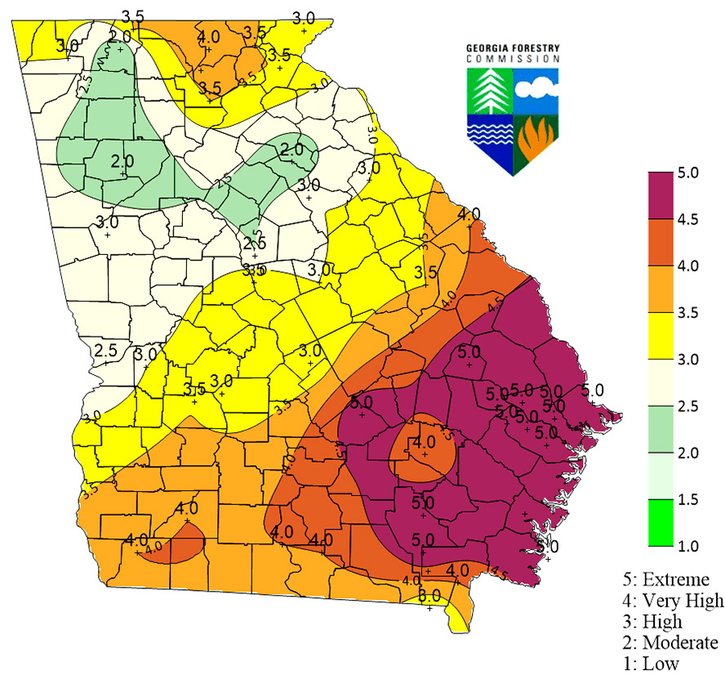
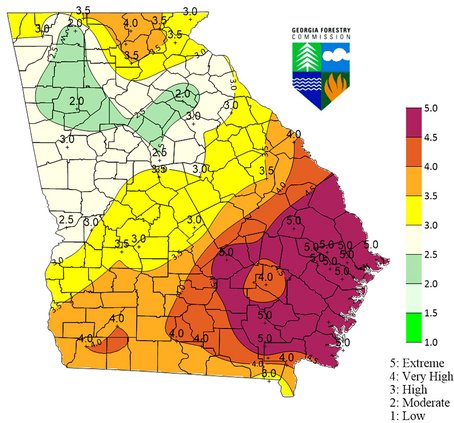
But with unusually low humidity and after weeks without rain, Bulloch and neighboring counties are in a worse condition for fire hazards than much of the state. A fire danger forecast map, issued Monday for Tuesday, April 21, on the Georgia Forestry Commission website, assigned Screven, Bulloch, Candler, Tatnall, Evans, Effingham and other counties to their southeast the color purple, for a Category 5, or "extreme" fire danger.
"It's rough for the guys out there running all these calls," Tapley said, and reported that the BCFD had responded to 37 brush fire calls in April so far, including "a mutual-aid big one" in Effingham County over the weekend.
This was after 69 brush fire calls in March, Tapley reported.
The BCFD can't do much toward fighting actual forest fires, such as those the Forestry Commission would need to respond to, he said. But Tapley said the ban on burning yard waste could help in subdivisions and other areas "in close proximity" to homes and other structures.
"That's what we're aiming to do, just protect people's property, and ultimately their lives," he said.
Akins had noted that the burn ban ordinance carries no expiration date. Although intended to be temporary, the county law states that it "shall remain in effect until drought conditions improve and the Board of Commissioners formally rescinds" it.
"It does not prohibit controlled agricultural or forestry burns because by state law those are governed or regulated by the Georgia Forestry Commission, so they issue permits for those," Akins said.
He noted another exemption, for "fires used for cooking in grills or fire pits."
Ordinance's key points
After a few "whereas" clauses, beginning, "Whereas, Bulloch County has experience prolonged dry weather resulting in drought conditions; and Whereas, open burning of yard debris poses a serious threat to public safety, property and natural resources during periods of extreme dryness …" the ordinance imposes just one temporary restriction and lists just one prohibited activity.
"1. Temporary Restriction. All open burning of yard debris, including leaves, limbs, grass and other vegetative matter, is hereby restricted within the unincorporated area of Bulloch County effective as of April 22, 2026."
By referring to the "unincorporated area," the county government is making no attempt to enforce its ban inside the city limits of Brooklet, Portal, Register or Statesboro.
"2. Prohibited Activities. No person shall ignite or allow the burning of yard debris outdoors except as provided in this Ordinance."
Section 3, "Exemptions," is actually a little longer in stating what the ordinance doesn't prohibit than the two previous sentences were in stating what it does. It doesn't prohibit "controlled burns conducted by government agencies or authorized personnel for forestry or public safety purposes," nor does it prohibit those fires used for cooking "in approved grills or fire pits, provided they are attended and comply with applicable safety regulations."
And to be specific, the ordinance doesn't prohibit "agricultural or forestry burns conducted under a valid permit from the Georgia Forestry Commission in compliance with state law and (GFC) guidelines."
The ordinance can be enforced by "Bulloch County officials" including those of the Bulloch County Fire Department and the county code enforcement officers.
Code enforcement officers are assigned to the Planning and Development office, but Tapley said the Fire Department works closely with them and that Fire Prevention Chief Joe Carter would be the department's lead on enforcement.
Tapley also agreed, after Commissioner Ray Davis asked, that people who start fires can be held responsible for damage to neighbors' property, "whether it's trees or their homes," when a fire spreads out of control.
Closes state gap
The page on "Burn Permits and Notifications" at the Georgia Forestry Commission's website includes a statement that, under a state law in effect since July 2021, no permit is required to burn "hand-piled natural vegetation/yard debris." So, the county's ban appears to cover exactly what the state permit requirement would not.
The GFC website also notes that state law prohibits burning "man-made material such as household garbage, lumber or plastic."
That state website further asserts that city or county ordinances "concerning open/debris burning must be followed where they exist."
Stated in Bulloch County's temporary ordinance, the maximum punishment for violating it is a $1,000 fine, 60 days jail time, or both. Akins noted that these are the maximum penalties under state law for violating county ordinances in general. Offenses would be referred to the county Magistrate Court.
Commissioner Toby Conner made the motion to enact the burn ban, seconded by Commissioner Nick Newkirk, and the vote was 6-0.