The Brier Creek Revolutionary War Battlefield Association reports receiving a $6,000 grant from the Southern Culture Foundation to continue the association's work in documenting the field of the 1779 battle and improving its park-like features as a publicly accessible site with historic significance.
The BCRWBA's annual Education Day, to be held at the site Friday, Feb. 27, and Memorial Event, Saturday, Feb. 28, will give members of the public, including area school children, an opportunity to learn more about the site and its history.
Among other improvements, a 2.5-mile walking trail has recently been completed across the battlefield area, mostly following the route of the original River Road between Savannah and Augusta. The existing memorial has been reconfigured, refurbished and is being maintained by the BCRWBA in cooperation with the Georgia Department of Natural Resources.
Near the confluence of Brier Creek and the Savannah River, the battlefield is in Screven County and within the Tuckahoe Wildlife Management Area. Although seldom discussed in popular accounts of the American Revolution, the Battle of Brier Creek, fought on March 3, 1779, was the second-largest battle in Georgia during the war, according to the association.
John K. Derden, Ph.D., an East Georgia State College professor emeritus of history who serves on the BCRW Battlefield Association board, supplied a press release announcing the Southern Culture Foundation grant, noting the association's cooperative work with several other organizations, and listing "accomplishments so far."
A follow-up question in a phone interview was what the association intends to add with this latest grant, a relatively small part of a continuing funding and fundraising effort.
"We're going to put some signs at intervals along the walking trail right where things occurred, stages of the battle and that kind of thing, very much like you'd see at a state park," Derden said. "We want to put some benches at intervals along the two-and-half-mile walking trail, and probably those benches will be located where will have some of these polychrome, UV-protected signs."
In recent years, the BCRWBA has worked with the Georgia DNR, Georgia Southern University and area chapters of the Sons of the American Revolution and Daughters of the American Revolution to plan and carry out a series of projects at the site "and has plans for more in the future," the press release stated.
An intern from Georgia Southern's public history program may be sought to research information for the signs, but that is not part of the grant, Derden said.
Park-like features
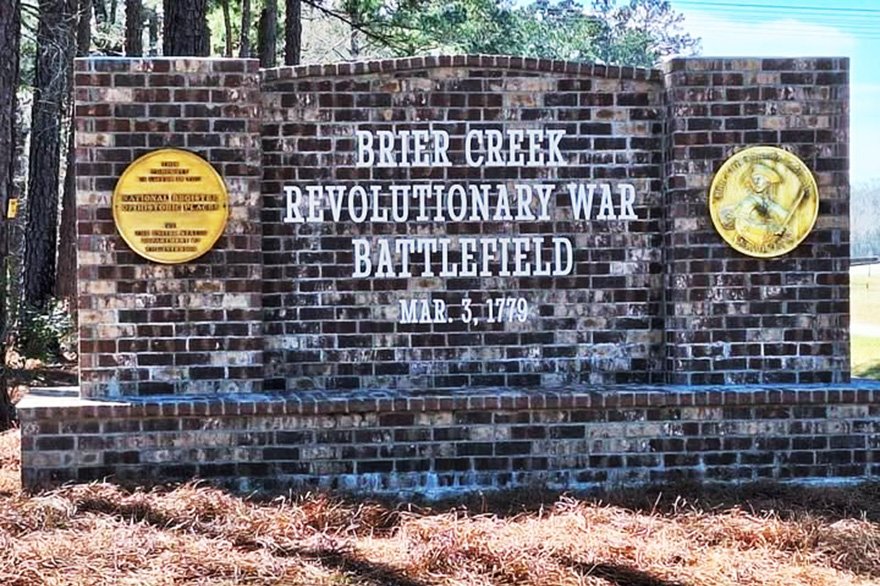
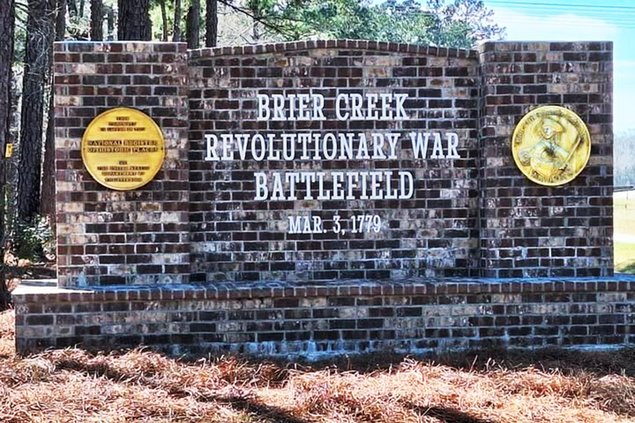
One of the recent upgrades is a monumental brick sign erected at the highway entrance to the battlefield site. Also described as a "state park-type" sign, it announces the battlefield name and the date of the battle with large white lettering between two bronze-color round seals. One seal is the association's logo with the stylized image of a Patriot soldier, while the other notes the site's placement on the National Register of Historic Places. The Georgia DNR's Historic Preservation Division was the sponsor for that designation, according to the December 2017 nomination summary available online.
Hard day for Patriots
"The battle occurred on March 3, 1779, and the victorious British army, along with surviving American prisoners, vacated the area on March 4, 1779," that summary stated. "The overwhelming American defeat firmly established British military control of the Georgia side of the Savannah River, between Savannah and Augusta. General William Moultrie of the South Carolina militia later stated that the American defeat at Brier Creek was so disastrous that it extended the war by at least a year, and that without this British victory, the subsequent 1780 British invasion and capture of South Carolina would likely never have happened."
One or more DNR consultants gave a candid assessment of why the site for a long time was not well known or researched. "As an American defeat, historians and archaeologists have largely neglected study of the Battle of Brier Creek," they stated in the application summary.
But a lack of development along the river and its Black Creek tributary in an area eventually protected as part of a WMA also kept the battlefield area relatively "pristine." That adjective is used in the release by the BCRWBA, whose donors and volunteers have contributed to archeological research and documentation work in recent years, as well as efforts to provide public access and interpretation.
The association funded the use of cadaver dogs to find potential soldier gravesites by sniffing the earth without disturbing graves. An expert handler brought in two dogs for this purpose in the spring to summer of 2024. Also that spring, the association funded the use of LiDar, or "light detection and ranging," from a helicopter to assist in mapping the site before an archaeological dig got underway.
LiDar "will pick up subtle differences in the landscape, let you erase the tree cover," field archeologist Daniel T. Elliott told the Statesboro Herald that September. "It came up with a map where you could see this line going down the ridge. We went out there and found it and just followed it."
That line turned out to be the original Savannah-Augusta Road, which was in use from the 1730s until it was abandoned circa 1800, after which it faded from public memory.
"There was a lot of battle debris along the road," he said.
After artifacts ranging from buttons and a broken bayonet to two iron grapeshot from a shotgun-like artillery blast were catalogued and removed for further study, the line of the 2024 excavations became the 2.5-mile walking trail.
Refurbished memorial
The refurbishment of the existing memorial included the installation of a 30-foot lighted flagpole. Placement of custom-inscribed pavers around the flagpole base has been one of the BCRWBA's fundraising efforts.
Two older historical markers which were previously located away from the battlefield were refurbished and moved to the memorial, and existing memorial markers were refinished and reinstalled. The walkway through the memorial has been paved, replacing the previous pea-gravel surface. Brick walls were added to the memorial and brick columns placed at the entrance to the paved memorial walkways.
Further plans
Beyond the placement of the interpretive signs, benches and a kiosk along the walking trail, the association's future plans include building a pavilion, acquiring property on the other side of Brier Creek at the Miller Bridge site with the help of the American Battlefield Trust, and construction of a small museum to house artifacts collected through archeology.
Meanwhile, some of the interpretive signs added along the trail may diverge from the purely historical interest of the site to highlight "the natural environment, the flora and fauna," said Derden.
"We know not everybody goes there just for the history," he said. "Sometimes people just enjoy a walk through the woods."
For more information, visit briercreekbattlefield.org.
The award of the $6,000 grant by the Southern Culture Foundation Inc. to the Brier Creek Revolutionary War Battlefield Association Inc. was a grant from one Georgia-based 501c3 tax-deductible nonprofit corporation to another. Although the Southern Culture Foundation previously had a Macon address, its current address, found in its incorporation filings and financial disclosures, is that of a law firm in Hazlehurst.
A call and email there Monday did not immediately yield a reply for further information or comment.