After a public input session in which more than 20 of the 25 citizens who signed up to speak spoke in favor of a tax increase if it would avoid eliminating classroom teaching jobs and closing the Transitions Learning Center, the Bulloch County Board of Education voted 5-3 Wednesday evening to publish a tentative 2025 property tax rate of 10.4 mills. This was discussed as a “3-mill” increase.
As a roughly 2.5-mill hike above last year’s rate of 7.932 mills, it is in that sense a 31.1% increase. But under requirements of the Georgia law known as the Taxpayer’s Bill of Rights, it will be advertised as a 2.954-mill, or 39.67%, increase above the “rollback rate” of 7.446 mills that would have been necessary to counteract inflation in average property values in the year’s tax assessments. The board must now hold three public hearings on that tax increase, set for Thursday, Aug. 14, at 12 noon and then Aug. 21 at both 9 a.m. and 6 p.m., before a final vote to set the millage rate, slated for the Aug. 21 board meeting.
A change in direction had begun during the board’s regular meeting last week, on Thursday, July 24, where some of the board members and a few public speakers voiced opposition to deep cuts in personnel and programs Superintendent Charles Wilson had said would be necessary not this school year but by next – the July 1, 2026-June 30, 2027 fiscal year – to continue the board’s stance of rolling back the property tax rate and keeping it low. Those suggested cuts included eliminating around 125 Bulloch County Schools teachers’ jobs, laying off instructional coaches and certain other district personnel and closing the Transitions Learning Center, or TLC, alternative-school program.
But after the concerns voiced last week, board Chairman Elizabeth “Liz” Williams asked how much of a millage increase would be needed to avoid teacher layoffs and keep the TLC open. Wilson then recommended a return to 10.4 mills, approximately the rate when he became superintendent 13 years ago.
Even at that rate, the school system, which is projected to spend about $13.2 million of its $37 million remaining general fund balance, or informal reserve, this year, will need to make some cuts affecting some personnel next school year, Wilson said.
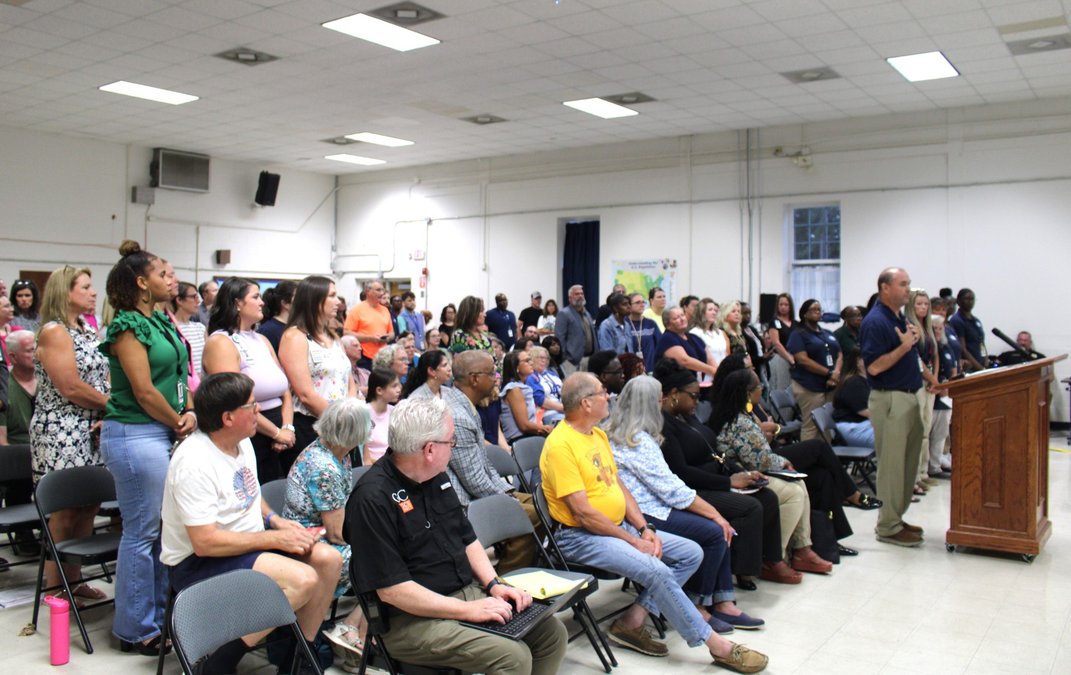
More than 150 chairs were filled, and other people stood in back, for Wednesday’s 4 p.m. special called meeting, in the cafetorium of the William James Educational Complex, the facility shared by the TLC and the Bulloch County Schools Central offices. Unusually for a meeting on a taxes, “Please raise the millage rate” was a request heard several times from citizens who signed up to speak to the board. They included several TLC faculty members and other teachers in the school district, but also the Statesboro-Bulloch Chamber of Commerce’s president, speaking as a parent, and Statesboro’s city manager, speaking as a community resident, as well as others who are not school district employees.
About two hour and a half hours into the meeting, Wilson formally recommended the rate increase and the board members held their discussion. Board member Jay Cook made the motion for the increase, seconded by Donna Clifton, and members Glennera Martin, Maurice Hill and Elizabeth Williams, who while chair retains her vote as a district-elected board member, joined in voting “yes.”
Board members Lannie Lanier, Jennifer C. Mock and Lisha Nevil voted “no,” after saying they thought any millage increase should wait for next year, since the board had already adopted its current-year budget based on the rollback rate.
An update of this story, including some of Wednesday’s comments, will be published in the Friday e-Edition. What follows here is from last week’s meeting.
Background to the decision
The suggestion of drastic spending cuts followed from discussions last spring, when Wilson told the board members the school system could make up for an approximately $9 million reduction in expected state funding and continued rising costs by spending $13.2 million this fiscal year of an otherwise $37 million general fund balance, or informal reserve. Already in April, he said the administration and board would need to look at a “reduction in force” for the following school year so as to plan effectively and inform employees well in advance.
More recently, Wilson and staff predicted that further contraction between Bulloch County’s lower expected state funding and increased costs could result in a $15 million “deficit” for fiscal year 2027.
After Wilson presented the specifics during a July 11 board meeting, 10 full-time and one half-time “district support” personnel, such as central office-based instructional coaches, were informed that, although they have jobs for the 2025-2026 school year, they would not for the following year. Meanwhile, principals were notified that school allocations for staffing would be cut approximately 25%, also for 2026-2027 (not 25% of all teachers, but 25% of those that principals and their “leadership teams” have a choice in hiring).
These notifications, and word of the other cuts that were proposed to occur a year from now, such as closing the TLC and also of the LIFE program that provides virtual instruction to high school students in hardship cases, got the attention of school employees and other people in the community.
When the board met again at 6:30 p.m. Thursday, July 24, the chairs in its chamber were filled and some people were standing in back.
Two or three of the board members, including Williams, then indicated they wanted alternatives to these cuts.
“After much reflection from the last meeting and learning that we need to cut $15 million, resulting in the loss of 125 teaching positions, plus other cuts, I’ve concluded that this decision would be devasting to our children…,” Williams said. “Our sole purpose as an educational organization is to educate our children, period, and we can’t do it without our teachers.
“That being said, I as a board member – I’m speaking for Liz and Liz only – I support decisions that we can make that will save our teachers who are needed to ensure the best educational experience for our children,” she continued. “I do not support getting rid of TLC, because if we get rid of TLC, what are we going to do with our children that violate our code of conduct? We can’t put them in the street.”
District 4 board member Clifton, who like Williams is a retired school principal, had spoken first.
“I want the reduction in focus not to affect our children,” Clifton said. “If we need to reduce non-instructional staff …, if every department needs to go back and look at their budget and cut their spending …, if we need to raise the millage rate one or two mills, then that’s what we’re going to have to do, but I do not want to affect the daily instruction of our children.”
Reductions in state money
During the “superintendent’s report,” he reviewed the factors in this year’s increased gap between the school system’s state funding and expenditures. Bulloch County’s state equalization grant decreased by $5.9 million because of the county’s increased wealth as seen in rising property values, which also contributed to a $2 million increase in the district’s required 5-mill “fair share” as the value of a mill rose. Meanwhile, the school district staff projected a $1 million loss to the House Bill 581 tax relief legislation.
So, this produced an expected decline in state funding in the $7.9 million to $8.9 million range. Meanwhile, on the expense side the staff expects a $300,000 increase this year and up to $800,000 next year for adding school resource officers to cover all of the schools. An increase in athletic coaching supplements was projected to cost $500,000, and health insurance and Teacher Retirement System costs continue to increase.
But with salaries and benefits making up over 88% of general fund expenditures, the school system had little room to cut except through a reduction in force, or “RIF” of personnel, Wilson said.
A 13-year lookback
When he became superintendent, 13 years ago, the salary of a certified teacher with no experience was $34,000. It has risen to $50,000, while the salary of a teacher with 15 years experience and a typical level of certification has risen from $54,000 to $72,000. Wilson noted similar increases in Teacher Retirement System contribution rates and health insurance costs since fiscal year 2012 and said that the cumulative inflation rate since 2020, “mainly due to COVID” amounts to 24%.
“When I walked in as superintendent, it was 10.4 mills. …,” Wilson said last week. “Mrs. Williams, I’ll answer you’re question, if you’re asking Charles Wilson as superintendent, I’m telling you right now that three mills is not going to get us to $15 million. … Take it back to 10.4 mills. That is what Charles Wilson says that this district should do. It doesn’t get us to the $15 million. We’re still going to have to probably cut $4 million.”
Some millage increase this year would reduce the drawdown of the fund balance and could allow most staff reductions to occur by “natural attrition” instead of layoffs, he said.
With one mill of tax currently worth about $3.8 million to the school system, three mills would bring in about $11.4 million. A mill is 1/1000th the assessed value of property, with most in Georgia assessed at 40% of market value. So a 3-mill hike would be $300 added tax on $250,000 worth of non-exempt property.