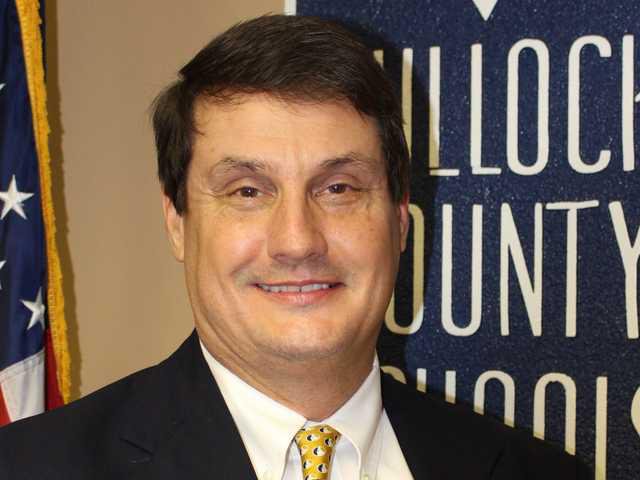
Hiring a school safety director, creating a school safety advisory committee and dedicating a one-mill tax increase to school safety improvements are three of five ideas that one Bulloch County Board of Education member recently suggested merit serious discussion.
“As a board member with a child in the schools, it would mean a lot. …,” Dr. Stuart Tedders said concluding his remarks during the board’s April 12 regular session. “Now that the emotion has died down from Parkland, we just can’t let this go. We have to continue to talk about this.”
The Feb. 14 mass shooting at Marjory Stoneman Douglas High School in Parkland, Florida, left 17 people dead and a 19-year-old former student charged with their murders as well as 17 attempted murders. The national discussion and arrests of several local students for making threats or false reports prompted Bulloch County Schools Superintendent Charles Wilson to hold a series public listening sessions on school safety.
In an email to all eight board members, Wilson then stated he needs their help and urged the board to exert leadership.
“The superintendent made very clear that he was looking to the board for guidance in issues related to school safety, and many of the board members here have kids in schools, so it touches us on a very personal note to ensure that our kids are safe,” Tedders said.
A professor in the Jiann-Ping Hsu College of Public Health at Georgia Southern University, Tedders, Ph.D., represents District 3 on the county school board and is not up for election this year. He had included the other members in an email reply to Wilson listing the five ideas, and summarized them for the public.
Safety director
First, a new job of county-wide school safety director could be created and a “highly qualified individual” with knowledge of safety protocols, threat assessments and safety training hired to fill it, Tedders suggested.
Second, he submitted that Wilson take the lead in forming an advisory committee. In Tedders’ email, he offered the committee could include from five to eight “stakeholders” such as law enforcement personnel, community members and representatives of the school system and the Georgia Emergency Management Agency. The committee would make prioritized recommendations for securing the schools, make threat assessments and “routinely monitor established protocols of safety at each school,” Tedders emailed.
Third, the school system could compile an inventory of its employees interested in serving as volunteers in efforts to keep schools safe.
Fourth, a similar inventory could be made of community members interested in taking part in “future, proposed safety initiatives on a volunteer basis,” he suggested. In his email, Tedders mentioned “veterans, retired military, concerned citizens” as examples.
Dedicated mill
Fifth, Tedders said the board could adopt a one-mill tax increase specifically dedicated to school safety.
“If we’re going to have a bold and robust initiative in this district, it’s going to have to be paid for, and the budget is what the budget is, so I would think that we would need to at least talk about the possibility of adopting a one-mill tax increase to pay for these initiatives throughout the district,” he said.
During the April 12 meeting, Tedders had prefaced his suggestions as “in no way a proposal or a recommendation, but just simply talking points.” He put conditions on his suggestion of a tax increase.
Mental health
“The only way I would personally support this is that if these revenues were tagged specifically for school safety, number one,” he said, “and number two, because there’s such a unique and intimate link between violence and mental health, that these funds should be used to actually increase capacity within the schools to provide mental health counseling and referral networks and things to actually provide skills for our students to cope.”
“Anti-bullying campaigns” were another example he mentioned.
In his email, Tedders used “hardening schools” and employing school resources officers as examples of things the first portion of the money could fund. After the meeting, he said he didn’t really like the term “hardening schools” and was thinking of measures such as staff training, and not just equipment or changes to buildings.
Used in setting annual property tax rates, a mill is one-thousandth of a property’s total value. With most real estate in Georgia assessed at 40 percent of market value, one mill draws $40 tax from a home or business worth $100,000. In the current budget year, each mill of tax netted the Bulloch County Board of Education about $1.8 million.
During the school safety listening sessions, Superintendent Wilson gave a rough estimate that adding more school resource officers so that every school has its own would cost, roughly, one-half mill, continuing each year. At Statesboro High, he acknowledged hearing interest in adding a second resource officer at that school.
Currently, just four resource officers serve at six of the 15 schools. Southeast Bulloch Middle School and Southeast Bulloch High School share one officer, as do Langston Chapel Middle School and Langston Chapel Elementary. Those two officers and one at William James Middle School are Bulloch County Sheriff’s Office deputies. A Statesboro Police Department officer is assigned to Statesboro High School.
Thursday work session
Interviewed this week, Wilson said he welcomed Tedders’ ideas and hopes the board would discuss them further during its “work session” on Thursday.
“I think we need to talk pretty quickly about these ideas he has because we need to know whether I should go ahead and act on some things or whether we want to implement some of the things he’s talking about to make these other things happen,” Wilson said.
In particular, naming a director could be the first step toward some further decisions, he said.
“There are a lot of important things we need to address, and I think having someone that’s a designated safety director in this district, or safety coordinator, whatever we would call it, is an important piece, and for the board to be serious about considering that is important to me,” Wilson said.
During some of the school sessions, he mentioned the possibility of re-examining priorities within the purposes funded by last fall’s Education Special Purpose Local Option Sales Tax referendum. But while E-SPLOST money can be used for facilities changes and safety equipment, it cannot go to salaries.
“It’s going to take some resources,” Wilson said. “Whether we spend down our fund balance or cut other expenditures or whether we designate a mill towards it, we’re going to have to be able to follow through on these commitments we make.”
The board’s second regular meeting each month is called a work session but remains a public meeting where votes can be taken. Thursday’s session is set for 6:30 p.m. in the board’s central office meeting room.
Herald reporter Al Hackle may be reached at (912) 489-9458.