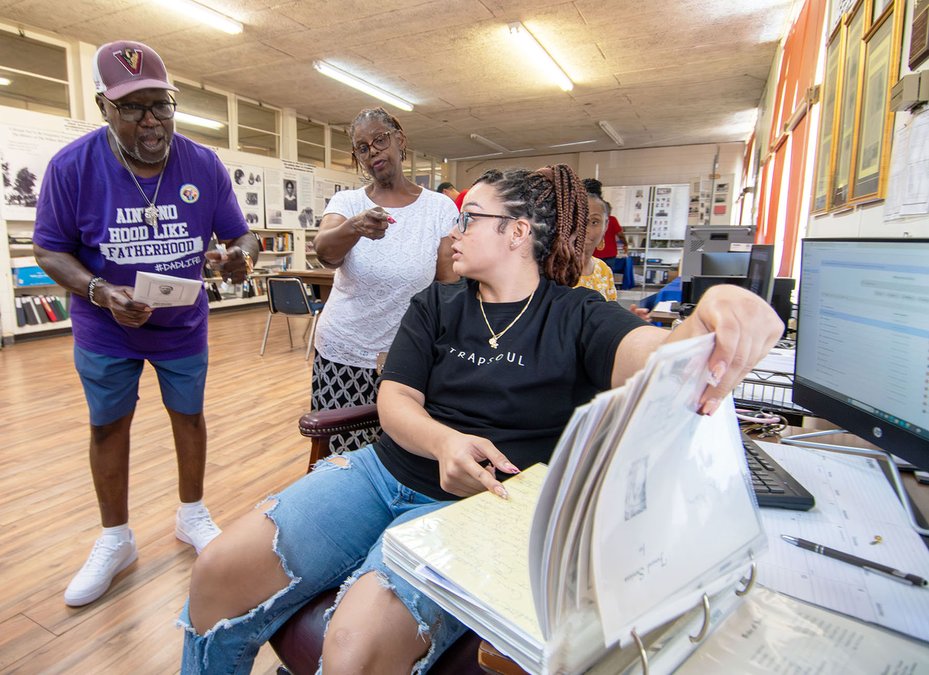
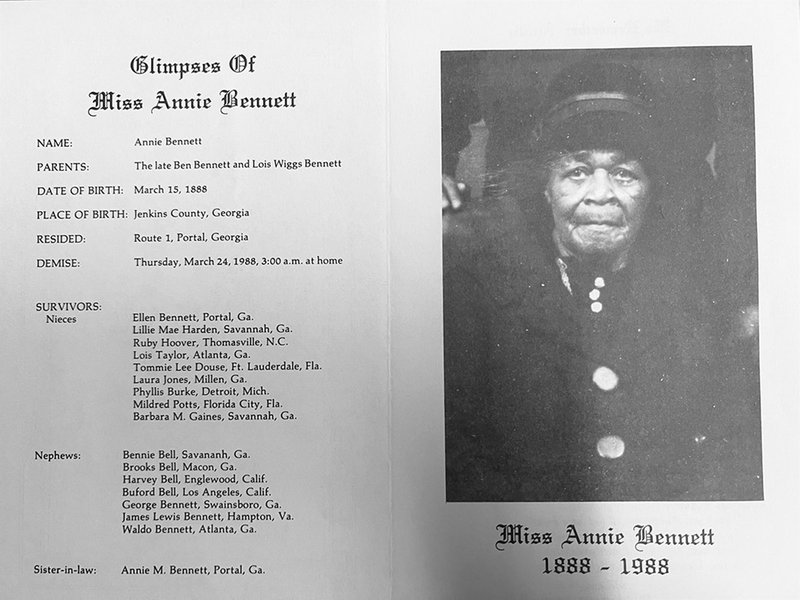
The Institute of Museum and Library Services, or IMLS, has awarded the Willow Hill Heritage and Renaissance Center another $100,000 grant to continue and advance its work in preserving, digitizing and interpreting printed and written programs from African American funerals, the Willow Hill Center announced Monday.
As just one aspect, the Willow Hill Center and staff members at the Georgia Southern University Libraries have begun using publicly available artificial intelligence resources to improve the collection’s searchability and reduce errors and duplication. Four leaders in the project are scheduled to deliver a presentation highlighting this use of “A.I.” during the Oct. 8-10 Georgia Libraries Conference 2025 in Columbus.
Professors and students from the university’s Department of History have been working with Willow Hill’s volunteers and staff in this African American Funeral Programs Project since its launch. Volunteers began collecting and organizing the programs nine years ago. The Georgia Southern Libraries have been part of the collaborative effort for several years now, especially in the work to digitize the collection and make it available online.
This is the third time the Willow Hill Heritage and Renaissance Center, a 501(c)3 nonprofit organization based at the historic Willow Hill School near Portal, has won a grant from IMLS, a federal agency.
“This IMLS support is transformative for our mission,” Dr. Alvin D. Jackson, president of the Willow Hill Center’s board, said in a news release. “Our goal is to protect these fragile yet invaluable records, and to shine a light on local African American legacies that might otherwise remain hidden or inaccessible.”
In addition to his continued leadership on the board of the Willow Hill Center, of which he was a founder, Jackson serves as president of the board of the Georgia African American Historic Preservation Network.
Previous IMLS grants
Willow Hill’s first IMLS grant, in 2020, was for $109,420 from a special COVID pandemic-era allocation and helped equip the center’s campus and pavilion with broadband, Wi-Fi, computers and staff for open-air learning.
The second award, announced in mid-2023, was a regular two-year grant for $92,000 that helped launch the digitization and preservation work for the African American Funeral Programs Collection.
So far, 20,000 programs, from funerals of African American residents of Bulloch County and the surrounding area from circa 1940 onward, have been collected. Of these, 9,300 have been digitized and made available through Georgia Southern’s Digital Commons. The availability to families and researchers has so far resulted in 157,804 downloads and 63,464 metadata page hits, according to information received Tuesday.
This third grant, from a Sept. 19 award decision, funds a second phase of this project, from Oct. 1, 2025 to Sept. 30, 2027, at a stated amount of exactly $100,000.
GLC presentation
Jackson and his daughter Dr. Nkenge Jackson-Flowers, secretary of the Willow Hill Center board and African American Funeral Programs Project coordinator, are two of the scheduled presenters for the 4:30 p.m. Oct. 9 session during the Georgia Libraries Conference at the Columbus Convention & Trade Center.
The other presenters are Jeffrey Mortimore, MLIS, MTS, digital scholarship librarian and associate professor with the Georgia Southern University Libraries, and Nathan Banks, MLIS, the university’s institutional repository manager. The presentation title is “A.I. in the Institutional Repository: Leveraging ChatGPT and Python to Support a Community Partner Collection.”
How A.I. can help
This aspect of the project seeks to use those A.I.-assisted tools to help improve the cataloging of the digitized funeral programs by reducing errors and unnecessary duplication, and by augmenting the “metadata,” such as keywords, dates and cross-references available for searches.
Improving the quality of scanned images of the funeral bulletins, many of which include photographs, is another stated goal of the grant-funded Phase 2 work, which will also continue the Phase 1 tasks of scanning and cataloging the printed programs.
The grant will support the salaries of two paid student interns and one full-time collection manager. But volunteers have been a key to the work so far, and the stated grant project activities include outreach, training and retention of community volunteers.
“This collection has relied heavily on volunteers since its inception in 2016,” Jackson-Flowers said in a reply email. “We will work to continue our outreach for volunteers, improve the training experience. … Unfortunately, a low retention rate for volunteers persists. We plan to survey our past volunteers and improve their experience. “
Already, the project leaders have instituted a feedback and support session for volunteers early on during their digitization efforts, she said.
“Digital Librarian” Jeffrey Mortimore’s involvement goes far beyond the conference presentation, since the university library division has supported his working directly with the project team, said Jackson-Flowers.
“We meet with him monthly in addition to the weekly team meetings,” she said. “He has explored ways to make some of the curation of the collection easier specifically in using code from Chat GPT and Python to look for duplicate records, assist with adding keywords and metadata …, functions that will not only make curation of this collection easier but also serve as a model for other university-community partnerships.”