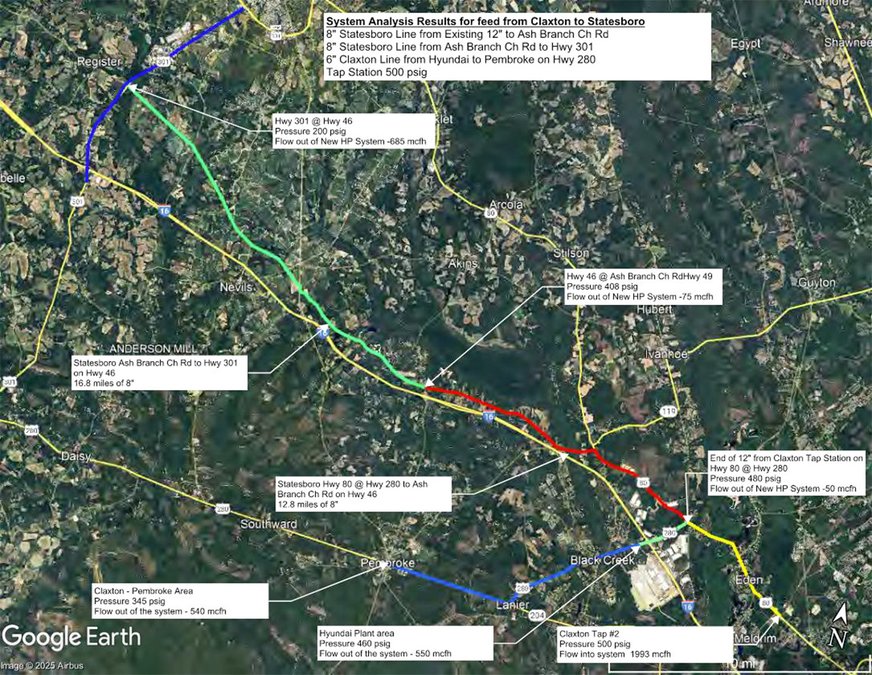
Statesboro's mayor and council took a look Tuesday afternoon at two scenarios for the possible expansion of the city's natural gas system to serve industrial customers along I-16 in the direction of Hyundai Motor Group Metaplant America.
A single high-pressure, six-inch diameter pipeline built from a connection in Screven County still supplies all of Statesboro's city-operated natural gas service, noted Public Utilities Director Matt Aycock.
"That was put in in the 1950s, so 70 years later we're finally running out of gas," he said.
The central part of the system was built along U.S. Highway 301 through town by the 1970s. In the 1990s, a southward extension reached Gateway Industrial Park, where the Walmart Distribution Center and Briggs & Stratton are located. In the early 2000s, another pipeline was built to Metter. Circa 2010, the city of Statesboro installed a pipeline to what is now Bruce Yawn Commerce Park across the I-16 interchange on U.S. Highway 301.
The system currently has only about 75 million cubic feet an hour, or mcfh, of capacity left, he said.
Although the Aspen Aerogels plant, once expected to be a major gas customer at the Bruce Yawn Commerce Park, was cancelled during construction and the completed Ajin USA plant is not currently a natural gas user, SECO Ecoplastic, just north of the interstate, is a natural gas customer. Ajin has now asked for 40 mcfh for an expansion and the former Aspen site is being marketed as having 30 mcfh available, according to Statesboro officials.
In November 2022, Steve Hotchkiss, who was then the city's public utilities director, and contracted natural gas engineer Jack Sapp presented a plan to install an eight-inch line parallel to the six-inch line. That proposal, with a projected price tag of about $15 million, would have increased the system's gas capacity but not expanded the area for customers served, Aycock. noted.
That project was never undertaken.
Claxton supplies Hyundai
Then the city of Claxton, which is in Evans County but has a long-established natural gas system that included a four-inch line through Pembroke in Bryan County, built a separate natural gas line to Hyundai Motor Group Metaplant America. To do this, Claxton established a new tap on the Kinder Morgan Cypress supply line and had eight miles of 12-inch steel pipe and four miles of 8-inch steel pipe installed.
Claxton's project cost about $15 million, and after the Savannah Harbor I-16 Corridor Joint Development Authority contributed $9.8 million, Claxton's city gas system financed the remaining costs with the Municipal Gas Authority of Georgia, according to the summary that Chris Coan, the Gas Authority's director of government affairs and economic development, presented Tuesday.
During Tuesday's Statesboro mayor and council work session, Aycock, Sapp, Coan and finally, Statesboro City Manager Charles Penny, presented information about two scenarios for increasing the capacity of Statesboro's natural gas system. Both scenarios would have Statesboro attach a new pipeline to the supply Claxton has provided for the Hyundai plant, and one scenario would have Claxton and Statesboro share costs in an extension to serve new areas.
Scenario 1
The first scenario, with lower capacity and lesser reach, would have Statesboro invest a little over $20 million to extend an 8-inch diameter gas line from the Hyundai plant's existing 12-inch line to reach U.S. Highway 301 at State Route 46.
This would expand the Statesboro system's capacity by about 685 mcfh, according to Sapp, but it wouldn't really add any significant territory for new customers.
Incidentally, the pipeline Claxton supplied to the Hyundai plant site was designed to supply more than needed there, with seven buildings on the site at first expected to use up to 70% of the available gas. But the Environmental Protection Agency allowed natural gas only for the two buildings where it was needed for production processes, so the other buildings have to be heated with electricity. That leaves more than the originally proposed 30% of the pipeline's natural gas capacity for other customers.
Scenario 2
The more ambitious scenario, reaching along I-16 for potential new Statesboro natural gas customers and supplying more capacity for Claxton natural gas customers around U.S. Highway 280, would have the two city governments share costs for one phase of the plan.
In that larger plan, extending not an eight-inch but a 12-inch diameter line parallel to Interstate 16 from the Hyundai plant to Ash Branch Church Road could cost almost $10.9 million, including design, engineering and construction, according to an estimate by Jack Sapp Engineering. If Statesboro and Claxton split the cost evenly, Statesboro's estimated share of this phase of Scenario 2 would be $5,433,614.
Then another phase of that scenario, extending a new 8-inch diameter line from the 12-inch line at Ash Branch Church Road to connect with Statesboro's existing 6-inch pipeline at U.S. Highway 301 is estimated to cost $11,521,910, all from Statesboro. Added to the cost share from the other phase, that would make Statesboro's projected cost in this second scenario $16,955,524.
This scenario is projected to add 960 mcfh capacity of gas flow.
Claxton would also pay a $5,433,614 share in that scenario, but Sapp acknowledged that much remains to be decided around how the two city governments would share the costs, if they do, and the revenue. Penny said this "would have to be discussed with Claxton (officials) in detail."
Funding options
Funding options, which the Municipal Gas Authority of Georgia, or MGAG, is helping these two member cities explore, Coan said, include state funding through the Georgia Environmental Finance Authority, or GEFA, financing by the MGAG, or issuing municipal bonds.
The authority's list of goals for the project states that it "will have the capacity to support economic development along the Interstate 16 corridor, the City of Pembroke, the City of Metter," and that interconnecting systems will help maintain gas flow during an outage or pipeline failure.
Nothing was decided or even scheduled to be decided this week. But Penny said this is something Statesboro officials need to work on, not just consider.
"We're just at the beginning of this, but if we don't, any industry that needs natural gas, we won't have the capacity to bring them to our community," he said after the meeting, "and so we've got to get it figured out. As I said, I don't see it as a problem, I see it as an opportunity."