After hearing from several citizens expressing a range of concerns — including some outright opposition to allowing “data centers” of any size anywhere, Statesboro City Council by a 3-1 vote Tuesday approved an ordinance that could allow data centers occupying up to 50 acres each in certain zones.
But no actual, specific data center is currently proposed, and if landowners or developers were to plan one, the new ordinance requires a special permit. Any data center will be required to use a closed-loop system for cooling and city water and wastewater connections, not a private well or septic system. Ambient noise limits at the property line are to be enforced with testing around a roughly 50-decibel level. An economic impact report showing positive results for the community and a decommissioning plan for eventual shutdown are required.
As spelled out in an existing section of the city’s Unified Development Code, the special permit could only be approved by the council after a public hearing on the specific proposal and a recommendation from the Planning Commission, somewhat like the process that preceded approval of the ordinance itself.
However, what occurred during Tuesday’s 9 a.m. regular council meeting was an optional public hearing during a second reading of the ordinance as voted forward by the council two weeks earlier. Under the council’s procedural rules, no new hearing is required if changes are made before and not after a first-reading vote. But after several changes were made going into the May 19 first reading — which was during an election night meeting and with nobody from the public signing up to speak — some council members requested the additional public comment opportunity.
So the city’s Planning and Development Director Justin Williams observed that a second hearing was “a little unusual” when he summarized the current version Tuesday morning.
“What’s been brought before you today does include the language revisions that were discussed as our last meeting, such as the elimination of hyperscale facilities, which was that 200-acre maximum development,” he told the council. “So everything has been scaled back down to 50 acres for maximum size.”
The amended ordinance also “includes more robust requirements for sound studies” and some additions to environmental standards, such as the “addition of bioswales and other opportunities to allow storm water to be retained on sites,” Williams said.
Some of these changes were suggested by the city’s own Greener Boro Commission, and others by council members after the appointed Planning Commission had unanimously recommended the previous version, which provided for both “hyperscale” data centers with buildings up to 500,000 square feet on tract sizes up to 200 acres, and “edge” centers on sites no larger than 50 acres.
The ordinance as brought forward and now made city law still includes a definition of hyperscale centers. But the final sentence of that definition is now, “It shall be unlawful for these facilities to be constructed in the City.”
The smaller, “edge” centers could be permitted as a special use in highway-oriented commercial, or HOC; light industrial, or LI; mixed-use, or MX; and office, or O, zoning districts.
No ‘use by right’
Before the mayor invited public comments Tuesday, City Manager Charles Penny explained another point he suggested was essential for the public to understand the new city law. (In what follows, “use” is the noun rhyming with “juice.”)
“If council approves this ordinance, it does not provide a ‘use by right’ for data centers. …,” Penny said. “A ‘use by right’ would mean that if a data center wanted to come here, they would just say, ‘Here we are,’ and that zoning is set and you couldn’t stop them.
“But the special use permit requires that every applicant for a data center has to come before this body,” he explained. “The mayor and the council get to decide whether they can come or not. … Even if you adopt this ordinance, and you decide that you don’t want a data center, we just won’t have one.”
Public hearing
Opening the hearing, Mayor Jonathan McCollar first asked for any citizens who wanted to speak “for” the proposed ordinance to come forward, as is standard practice. But the commentary immediately went a different direction when local business owner Noel Burnsed stood up to ask why the ordinance was even been considered.
“Why entertain it at all at this point, if you don’t even have somebody knocking at your door?” Burnsed asked.
The mayor said he would answer that.
“I like to look at things down the road, and … when I first was introduced to this, my immediate reaction was that we don’t want any data centers in our community. …,” McCollar said. “But I do not believe in making decisions in vacuums, because I did not have enough information to make an educated decision, and so what we charged the staff with doing was to take us to see hands-on what do data centers look like.”
As previously reported, the mayor, some council members and staff members visited three data centers in the metro Atlanta area and met with Georgia Power representatives on the topic Jan. 22. Williams summarized what they saw during a Feb. 17 work session, and it was then that council members gave their informal go-ahead for staff to develop an ordinance.
The biggest site the Statesboro city group visited, from outside, on their January exploratory trip was Meta’s vast “hyperscale” center, with buildings covering 970,000 square feet on a 285-acre tract of land near Social Circle.
McCollar said the visitors heard no sound at all from this center, which they also learned used “recycled” water in a closed-loop cooling system. They also visited a couple of edge centers, which McCollar described as “much, much smaller,” facilities that “basically look like office buildings.”
“Based on information that we were able to find … many of the things that were associated with data centers was not the case for what we were seeing. …,” the mayor said. “What our decision was, was to put together an ordinance that safeguards our community, and ultimately if there was a decision for one to come, it has to come back to this body.”
Questions transparency
When public comments resumed, local resident Stephen McDaniel said, “It seems to me like a smoke show. You stick a big number up there, 200 acres. … Is there a 200-acre tract in the city of Statesboro?”
McCollar said there is, in fact, one 300-acre tract in the city limits.
But McDaniel suggested the “smoke show” was that the city gave out a big number so that the reduction to 50 acres would prompt people to say, “That sounds terrific.”
He said the process didn’t seem very transparent, and asserted that the city would make existing taxpayers pay data centers’ infrastructure costs.
McCollar thanked McDaniel for his comments but noted that, in regard to transparency, the city started its process toward an ordinance months ago and was holding a second hearing.
“You brought up a great question about infrastructure,” the mayor said. “Whatever infrastructure that this facility may need, that’s at their cost, it’s not on us.”
Georgia officials have written this into state law, making data center developers responsible for their own infrastructure, McCollar said. Something like that is at least the case in the Public Service Commission’s rules for large data centers and electrical power infrastructure, according to previous presentations by Georgia Power representatives to local officials.
Alleges ‘corporate grift’
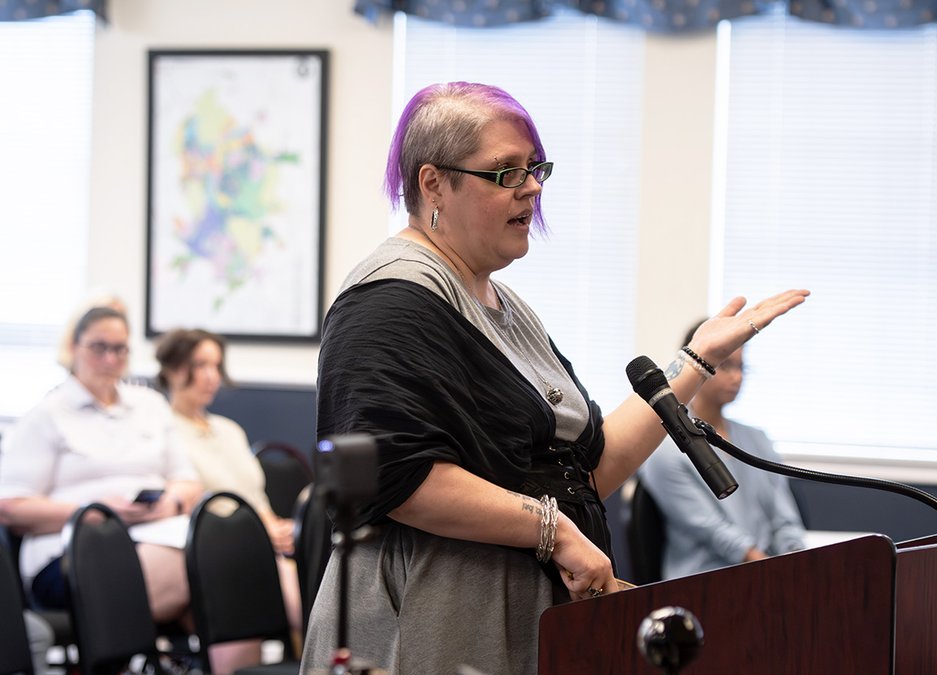
Kiki Cannon, a resident of City Council District 1, spoke in opposition to permitting data centers of any size, anywhere. Later in public conversation with the mayor, Cannon said she believes that he and the council members want the best for the community but that, as she suggested in her opening remarks, they have been misled.
“It does seem that the council has been given a lot of corporate propaganda,” Cannon said. “I do not hear where you have said you have spoken to any academics, any independent economists, anyone who’s studied these data centers, their impact or the technology they support outside of the corporate structure of the corporations who are proposing them.”
Cannon said she is an advocate for technology when it serves humanity but does not believe that is the goal in the drive toward artificial intelligence and data centers.
She told Penny he shouldn’t compare a data center ordinance to one regulating townhouses, as he had done by noting that a townhome ordinance was written and adopted, a couple of years ago, in advance of development.
“Housing is a human right; data centers and generative A.I. are a corporate grift. …,” Cannon said. “After much study and consideration into data centers and generative A.I., I must object to the construction of these centers, no matter their size.”
McCollar at one point held up his cellphone, asking everyone who has one to raise a hand, and said these are actually what most data centers support. He also said that Georgia Southern University, on its Statesboro campus, already has a “data center” of the size the city might allow with its ordinance. He again mentioned the long-vacant former Winn Dixie shopping center space on Brannen Street as a possible location, as city officials have done several times, and had said that an edge center could bring the city “roughly about $2 million a year” in tax revenue.
“That $2 million would allow us to alleviate the tax burden on our citizens,” McCollar said.
Council action
When the council discussion began, District 5 Councilmember Shari Barr was first to speak.
“I’ve heard a lot of good information today, but my situation is, I just keep hearing more and more and realize how much I don’t know and feel like I need to know more,” Barr said. “So even though I have invested a good bit of time and energy in trying to keep up in reading all of this, I’m not ready to vote for us to have an ordinance to allow a data center to come here.”
She said her biggest concern remains water use and disposal of wastewater, as must eventually occur even from a closed-loop system.
District 4 Councilmember John Riggs said that, having learned “the name ‘data center’” just a year ago at a Georgia Municipal Association event, he started out “very anti” but after six months’ research had changed his mind.
“This ordinance puts us in the driver’s seat,” Riggs said. “If some place wants to come to us … we tell them, this is what you have to work with. … And something else may come up, but we can address it at the time.”
He made the motion to approve. District 1’s Tangie Johnson seconded, and District 3’s Ginny Hendley joined the “yes” vote, with Barr voting “no” and the District 2 seat now vacant.