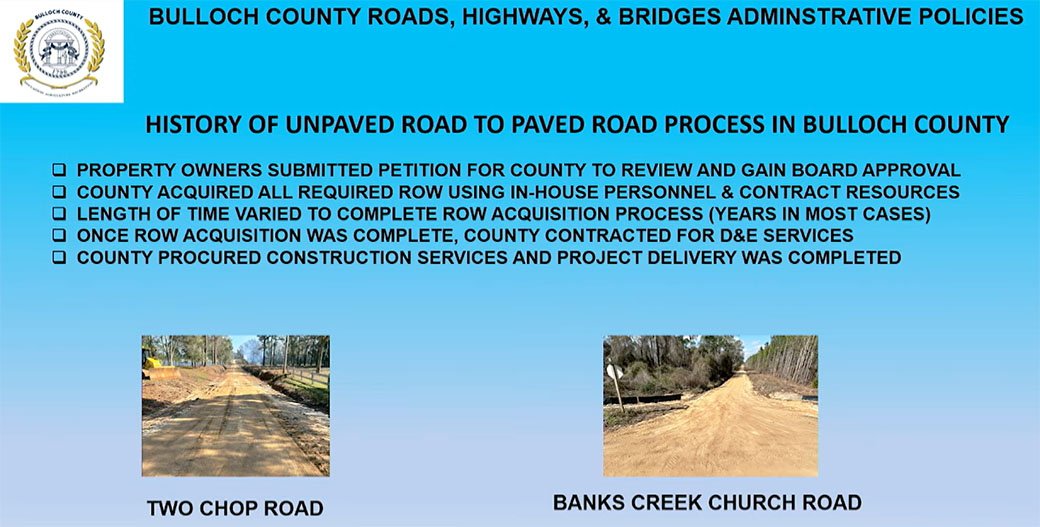
County Engineer Ron Nelson, after collecting facts for an update of Bulloch County's policies for road and bridge projects, noted Tuesday that some dirt roads here have been in a petition and right of way acquisition process for more than 20 years without getting paved.
Nelson spoke, and accompanied his remarks with a slide show, during Tuesday morning's Board of Commissioners meeting. The current process, whereby property owners along an unpaved road are expected to request paving and support it by signing a petition, has been in use 40 years or longer, he observed.
"It was a long-term, long-duration type of process, always has been, where right of way is the most essential component, and right of way is what holds up things, to a degree, when you're trying to deal with people and coming across donations or either (determining) what's the value of property," Nelson said.
"Everybody has their own idea of what value is. …," he said, with photos of Two Chop Road and Banks Creek Church Road shown on his introductory slide. He wasn't necessarily referring to these in his next comment, but they are among roads that the county has been looking at paving for some time.
"In some cases, some of these roads have been petitioned to be paved in excess of two decades," Nelson continued.
Specific projects
He then presented lists of unpaved roads currently in the design-and-engineering and right of way acquiring phases.
These include a batch of three road projects scheduled for those phases since the county's fiscal year 2023 budget.
For Moore Road, or about a half mile of it from Moore Circle to west of Old Portal Road, right of way acquisition was listed as "ongoing" but is actually stalled, with 18 of 30 parcels donated to the county. Permitting is complete, but the design requires a reduction in scope or other action for paving to move forward, Nelson reported.
"Currently, Moore Road, as we are aware from a couple of meetings ago, we're somewhat embattled, we're kind of at a point where we need to figure out what we're going to try to do to finish up Moore Road," he said. "I can report that recently, over the last month, we've had several property owners donate."
But one, who owns half of the land needed for right of way, is the holdout, Nelson said later.
He reported that the Lee Road project, which would be to extend pavement for about a half mile from Arcola Road, was in a somewhat similar situation, "at a pause at this point." The slide stated that 11 of 20 parcels had been donated, but Nelson said it is mostly down to one property owner the county is trying to locate.
Right of way acquisition for the third FY 2023 project, J.A. Hart Road from Zettwell Road to the dead end, is also ongoing, with design and permitting complete.
Two FY 2024-budgeted paving projects — one for Clark Farm Road and W.D. Peacock Road from U.S. Highway 80 West of Portal to Candler County, and the other for Old Happy Road from Old Highway 46 to Mud Road, are reportedly in the final phase of design and permitting. But that means the county staff and right of way consultants are only now preparing for the right of way acquisition phase.
Meanwhile, some more recently slated paving projects are "moving along pretty swiftly," Nelson said. These include three "Batch 1 Fiscal Year 2025" projects, one being the extension of pavement on Prather Road for about 0.8 mile. Another is the proposed paving of Grimshaw Road/Grimshaw Lane, also from U.S. 80 west of Brooklet, and the third project would pave Floyd Clark Road, Deer Run Road, Deer Run Lane and Deer Run Court, which are off State Route 24.
"One of the key points is that Prather Road, 28 of 29 parcels have been donated at this point," said Nelson. "There's one parcel owner we're currently working with to try to finalize right of way."
For Floyd Clark Road and the three Deer Run segments, 13 of 23 parcels have reportedly been donated to the county.
He had no firm report on the number of donated parcels for the Grimshaw project. But JMT (Johnson, Mirmiran and Thompson), the consulting firm retained by the county to help with right of way acquisitions, is also working on that one.
Two "Batch 2" FY 2025 projects were also listed, but right of way acquisition for these has not begun.
A central purpose of Tuesday's presentation was to suggest an evaluation-based process that would replace the petition process as the driving force behind county paving decisions.
"We want to try to put this into more of an evaluation, so we're not asking for petitions," Nelson said. "We want to actually get out ahead of it. We want to actually work through and evaluate roads that are unpaved … put them in categories where they could become eligible for consideration."
He outlined several phases of this proposed process.
"By and large we want to be positive with this," Nelson said. "We want to let people know that this is an opportunity to gain not only a paved road but also drainage improvements and also a paved driveway access. ... We would definitely be on the side of donation as much as possible."
Eminent domain
But he and County Manager Chris Eldridge also suggested that "condemnation" by eminent domain, or asserting the county's right to acquire property for public use, must be used at some point to complete right of way acquisition for some roads. At his first mention of this, Nelson had called it "a topic that nobody likes to really go through."
Although sometimes called a "forced taking," eminent domain actually requires payment of a negotiated or court-determined "fair price."
Bulloch officials are talking in terms of the county obtaining a certain percentage of the right of way for a project by donations or accepted purchase offers before resorting to eminent domain.
"I think there needs to be some breaking point, percentage-wise, once you have it donated, where the commission's willing to use eminent domain to move the project forward, so you're not stuck," Eldridge said.
"I mean there needs to be some kind of hard-and-fast, where these projects don't just continue to languish, where you've got a key majority of people who support the project and want to see it through," he continued.
Nelson mentioned 85% of right of way as a target the staff has generally been working toward before suggesting condemnation procedures. Commissioner Timmy Rushing said "80 percent of the signatures" was the traditional guideline.
"So you're saying that there's a willingness to try to condemn the final 20 percent, if necessary?" Nelson asked.
"That's the way it has been in the past, yes," Rushing said.
But 80% of what?
This led to brief discussion of whether this means 80% of property owners along a road or 80% of the required area of right of way. Commissioner Ray Davis suggested that it could mean "both," and also wanted to clarify that eminent domain is being discussed for road projects only, not for any other purpose.
County Attorney Jeff Akins suggested that the commissioners might adopt such a percentage as a guideline but should avoid "tying (their) hands" with a firm rule.
"The history of road paving in Bulloch County has evolved into a totally different paradigm than what we had before, because when I first came here … we never paved a road unless people donated the right of way," Akins said.
But he recalled that this has long led to situations in which people signed a petition only to back out when the road was surveyed, "and so these projects would just drag on."
"But I do think you're going to need to eminent domain because these projects, you've put a lot of money into them to get to a certain point," Akins said. "You've bought some of the right of way, you've paid for the engineering, and then you're going to just abandon it if you don't move forward with eminent domain for property owners that not only will they not donate, they don't want to sell the property either."
Nelson noted that the presentation was only a beginning and a request for commissioners' input. The staff will develop a draft of new rules and guidelines to present later.
"We're definitely going to have it later this summer or early fall," he said. "I'll share my portion of it with leadership over the course of the next several weeks. Then it will go through a legal review with Jeff. So it will go through several permutations before we could actually put it before the board for a vote."