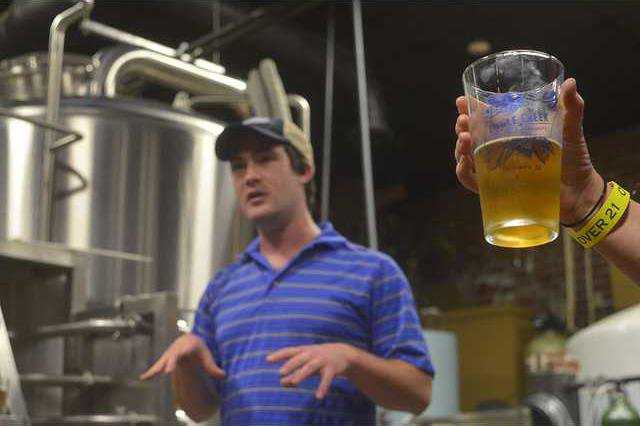
If a bill the Georgia Senate passed Friday becomes law, Eagle Creek Brewing Co. will be allowed to serve larger samples to adults touring the little brewery in the middle of Statesboro, and they will be able to take sealed samples home. But Eagle Creek still won’t be allowed to sell beer directly to consumers.
After the Senate Regulated Industries and Utilities Committee finished with Senate Bill 63, it was no longer the “Beer Jobs Bill” that Eagle Creek owner Franklin Dismuke and other craft brewers wanted, he said earlier this week.
“I’d already kind of sat down and run the numbers, and it would have allowed me to hire three full-time people within the next six months,” Dismuke said. “With the revised bill, unfortunately, I won’t be able to hire anyone else.”
Under Georgia’s current law, Eagle Creek Brewing offers Friday and Saturday evening tours. Participants who buy a 16-ounce souvenir glass can be served up to 32 ounces of beer during a tour. But those 32, technically free, ounces are the limit of a brewery’s direct-to-consumer service under existing Georgia law.
The original Senate Bill 63 sought by the Georgia Craft Brewers Guild would have allowed an individual to buy 72 ounces, or 4½ pints, of draft beer, for consumption at the brewery, or up to 144 ounces, the equivalent of a 12-pack, to take home.
But the committee changed this, watering down the bill from the craft brewers’ perspective. If the version passed by the Senate becomes law, breweries may then charge tour fees “based on the amount of the malt beverages to be furnished to the individual.” But the beer itself would be considered a free “tasting” or “souvenir.”
Under the Senate-approved version, tastings for on-premises consumption will be limited to 36 ounces, an increase of 4 ounces. The bill would also allow, for the first time, a take-home souvenir, of up to 64 ounces, in a single, sealed “growler.”
‘Philosophical difference’
While much of the media attention has been on the ounces, the more significant shift from the original bill was that the Senate leadership steered away from authorizing direct sales, Nancy Palmer, the Georgia Craft Brewers Guild’s executive director, told the Statesboro Herald.
“It’s a philosophical difference, but it’s a huge difference when it actually comes down to the way that the law is handled and the way that the Department of Revenue regulates the industry,” Palmer said.
Georgia’s regulation of the alcoholic beverages industry involves a three-tier system, designed to keep manufacturers, distributors and retailers under separate ownership. Many states adopted this approach after the 21st Amendment repealed nationwide prohibition in 1933.
But Georgia is now one of just five states that do not allow production breweries to sell some beer direct to consumers for either on-premise or to-go consumption, previous media reports quoted Palmer as saying. The other states were Hawaii, Mississippi, North Dakota and West Virginia. The Atlanta Journal Constitution and PolitiFact, at www.politifact.com/georgia, reported that North Dakota didn’t belong in this list but judged Palmer’s statement “mostly true.”
Not law yet
Friday was “crossover day,” the last day for an original bill to be passed by one chamber of the Georgia General Assembly for consideration by the other in 2015. So the Senate’s approval kept the bill alive.
The craft beer lobby perceives the version that passed as a positive change, but will hope to see it modified in the House, Palmer acknowledged.
“Ultimately what we’re trying to do is just keep the bill alive so that we can continue working on it, and when we get to the House of Representatives, work with those guys on coming up with something that would work for everybody involved,” she said Thursday.
Georgia’s law does allow brewpubs, as distinguished from breweries, to sell alcohol directly to consumers. Unlike craft brewers such as Eagle Creek, which does not serve food, a brewpub must operate as a restaurant, earning at least 50 percent of its revenue from food.
Brewpubs can produce up to 10,000 barrels a year for consumption on premises and sell up to 5,000 barrels to wholesalers, after the Legislature upped these limits in 2012. A barrel of beer is 31 gallons.
The Georgia Craft Brewers Guild’s membership consists of 33 member breweries, of which 11 qualify as brewpubs, plus three “breweries in planning,” Palmer said.
While a brewpub that previously operated in Statesboro closed last year, Eagle Creek added a canning line and now sells brews such as Spot Tail Blonde Ale through nine distributors across much of Georgia. Eagle Creek now has three full-time and six part-time employees.
Sen. Hunter Hill, R-Atlanta, was the bill’s lead sponsor. The Hill who represents Statesboro, Sen. Jack Hill, R-Reidsville, was not a sponsor but is a member of the committee and voted for the final version. The Senate vote was 51-5.
“We do appreciate the effort that especially Jack Hill made in trying to move this bill forward,” Dismuke said.
But the Eagle Creek owner added that he is still disappointed with the way the bill turned out and also hopes for changes in the House.
“I think it accomplishes most of what they set out to do,” Hill said, calling from Atlanta before heading back to the district Friday evening.
Craft brewery advocates can probably come back at a later time and get the souvenir growler provision “broken down into a smaller package that they can sell retail,” he added.
Hill hadn’t talked to beer wholesalers and retailers personally, he said, but he had heard some were “resistant” to breweries getting into six-pack and 12-pack sales.
“I think the growler was a compromise,” Hill said.
The Downtown Statesboro Development Authority sent letters to Hill and Rep. Jan Tankersley, R-Brooklet, supporting the legislation. DSDA Executive Director Allen Muldrew says Eagle Creek is helping generate tourism and downtown redevelopment.
“I liked the original bill that gave them the flexibility to have their tours as well as to sell what we thought was a very modest and even small amount out the door just to help supplement their business plan,” Muldrew said Friday.
Beer wholesalers and some retailers lobbied in opposition to the bill, Palmer acknowledged.
A detailed message left on the “Contact” page of the Georgia Beer Wholesalers Association website Thursday produced an automatic email confirmation but no further contact by press time. The GBWA site listed Steve Economos of Eagle Rock Distributing as the association’s president, and a voice mail message to his business line drew no reply by press time.
Al Hackle may be reached at (912) 489-9458.
Proposed bill doesnt quench brewers thirst
Would allow larger beer samples, but no direct sales