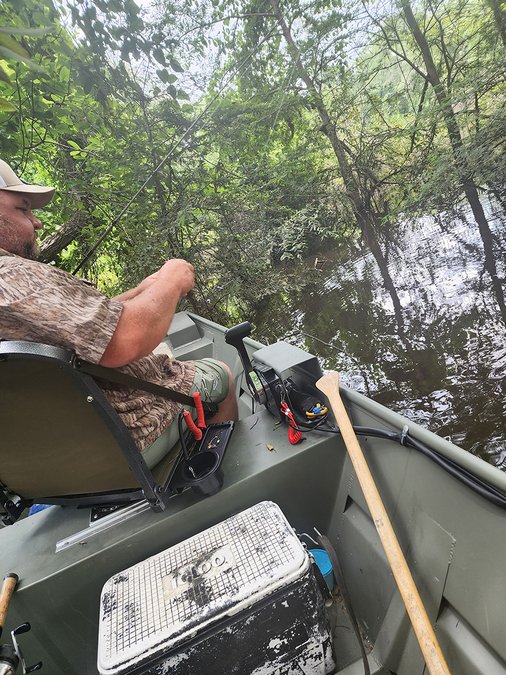
A Georgia law limits boat motors used on the Ogeechee River upstream from the Highway 119 bridge to a maximum of 9.9 horsepower. Apparently no other river or stream in the state is subject to a similar restriction, and an Emanuel County couple, Ron and Tiegg Cannady, have a drive underway to change the law.
The Cannadys, whose home at Twin City is about a half hour from the Ogeechee but who like to take a boat onto area rivers and go fishing, launched a petition on Change.org in the first week of August. As of Friday, Sept. 5, it carried 1,312 signatures.
“We’re within 30 minutes of the Ogeechee River, the Ohoopee River or the Canoochee River. …,” said Ron Cannady. All his life, he said, he has enjoyed fishing “in the rivers or the ocean or somewhere; I’ve fished between here and the big water.”
As he noted, the Canoochee, which eventually flows into the Ogeechee, and the Ohoopee River, a tributary of the Altamaha, are smaller rivers with no such motor restriction. Brier Creek, a Savannah River tributary, is another relatively small, meandering eastern Georgia stream the Cannadys mentioned as having no motor size restrictions.
After a decade of making ocean fishing his favored sport, Ron Cannady recently got back into river fishing, and became more acutely aware of the restriction he had long known was in place.
“Me and my wife, we just bought a boat four months ago, a new river boat, and I bought a 9.9 motor to go on it so I could be legal to be in the Ogeechee River,” he said. “And I got to thinking about and I said, you know, we can’t go to the Savannah River in this boat; we can’t go to the Altamaha in this boat, the motor’s not big enough.”
He acknowledged that he could, actually, take a boat with a 9.9 hp motor onto one of the larger rivers, but said he “wouldn’t feel safe at all” doing so. So, to be legal on Ogeechee and safe against the current in the larger rivers, anglers and boaters in this region may feel the need to have two motors, or two separate boats, the Cannadys maintain.
“Most times nowadays that you pass a boat in the Ogeechee River, it’s not a legal motor, and you just risk a chance of getting a ticket if you get stopped,” he said. “And it shouldn’t be that way whenever you can go to the Ohoopee River and run a 30-horse if you want to and not worry about nothing.”
Only the Ogeechee
This is not a distinction that occurs between rivers or river segments of different sizes and depths across Georgia.
Indeed, on the Georgia Department of Natural Resources, or DNR, website, specifically the page https://gadnrle.org/boating-motor-restrictions, the list begins with “outboard motor restrictions.” But only two are listed for the entire state: “no motor in excess of 9.9 hp … on the Ogeechee River upstream of Highway 119,” and none in excess of 25 hp on Lake Juliette (an unrelated reservoir north of Macon).
The Highway 119 bridge crosses the Ogeechee, which serves as the boundary between Bulloch and Effingham counties, toward the southern end of Bulloch. Therefore, much of the river’s course between these two counties, and on upstream, is subject to the horsepower restriction.
With Tiegg Cannady named as “petition starter,” the issue statement on Change.org asserts in part:
“Many larger motorboats, which are still safe for the environment under responsible usage, are unable to navigate the river, reducing the potential influx of visitors to nearby towns. With appropriate regulations and responsibilities, larger motors could be used without harming the ecosystem, much like they are on other monitored waterways.”
The petition doesn’t call for repeal but only for “amending the law to increase the available horsepower.” However, the Cannadys said it is meant as a starting point for legislative study and negotiation.
He said he would agree that “the Ogeechee doesn’t need a hundred-horsepower motor.”
“But if the legislators teetotally decided to do away with it, then it would boil down to common sense,” she added. “Most of your fishermen out there do have pretty good common sense.”
Origin unknown
Why and when the 9.9 hp restriction was created is something of a mystery, both to the petitioners and to several state officials the reporter contacted.
“I wish I could answer that question because it’s been asked of me dozens of times and I’ve followed it up the line several times and nobody’s really been able to tell me how that got passed and how many years ago,” said Capt. Bob Lynn, DNR Law Enforcement regional supervisor out of the Region 4 office in Metter.
“It must’ve been a while ago, a long time ago, when that law came into effect, because anybody that’s in DNR currently has no idea,” he said.
Lynn has been in the regional supervisor role in Metter for six years but had been aware of the 9.9 hp limit ever since he “fished the Ogeechee a little bit as a child,” and so figures the law has been in effect for at least 35 or 40 years.
It is a Georgia law, not simply a regulation – he looked it up in his book and cited the code section – and so, Lynn notes, changing it would require legislative action. He was aware of the petition, but at this early stage of the discussion, he doesn’t know what the DNR’s position might be on a raising or eliminating the horsepower limit.
But he thinks that before making a change, state lawmakers would probably consult the DNR.
“Usually if a bill is introduced that directly affects the Department of Natural Resources or affects a law that we enforce, they would get an opinion from us to say, is it detrimental to the resources, is it detrimental to public safety, what would be our stance on that,” Lynn said.
That feedback would pass through the DNR headquarters at Social Circle, where the law enforcement agency colonel and departmental commissioner are based, for a “no change or positive or negative” recommendation, he said.
Lawmakers’ comments
District 160 Rep. Lehman Franklin III, R-Statesboro, had received an email from the Cannadys about their petition
“I remember as a little boy, as a kid going on that river, and I remember that law was there, and no one knew about it back then,” Franklin said. “I mean everybody did it, of course it was the law, but I remember every now and then some bad apples would get a 15-horsepower engine and wrap a 9.9 shell around it.”
So he knows about the issue, but not the law’s origin.
“My thinking is that it’s high time for somebody to at least find out the reasons why, whether it was for safety reasons or they had an issue with somebody zooming up and down the rivers back then, if it became dangerous or hurt other people,” Franklin said. But since no one really knows, I think it’s a good idea to look at it.”
He said he planned to call the Cannadys and is willing to sit down and talk with them about it.
“I’d love for more people to enjoy our rivers and get on them,” said Franklin. “It was great for my childhood, and I’d love for more people to experience that. At the same time though, I’d hate to see that river flooded with people just moving up and down and doing more powersports kind of things instead of just enjoying nature and fishing.”
District 158 Rep. Butch Parrish, R-Swainsboro, said he had seen something about the petition. A constituent in the Swainsboro area had also talked to him about it.
“They were wanting to do the same thing, which was to increase that horsepower, and I told them what I would do is talk to the folks who are on the Natural Resources Committee or the Fish, Game and Parks Committee, and I’m sure that they’ll be looking at that,” Parrish said.
Neither Parrish nor Franklin serve on either of those state House committees.