Several Statesboro homeowners have made the unpleasant and costly discovery over the years that an old sewer pipe material called "Orangeburg pipe" is giving way and that the city holds them responsible for upkeep of their "lateral" sewer lines from the house all the way to the city main.
When the Statesboro Herald reported on one such situation 10 years ago — in April 2016, to be exact — the location was on Azalea Drive, west of the southern end of South Main Street. One resident homeowner there did some research and became outspoken after having to spend about $4,000 in two years to have the crumbling lateral line replaced and then have the street pavement repaired on top.
That cost could seem almost quaint now, after a decade's overall inflation and a construction boom's effects on contractor pricing. On the other hand, the city now has a program it didn't have then to assistant resident homeowners — but only of owner-occupied houses — with the cost of replacing sewer laterals.
Just last week, the owner of a home in a different but in some ways similar area of town, off Fletcher Drive at Ladd Circle, east of North Main Street, informed us of similar situations in that neighborhood. What makes the Azalea and Fletcher Drive areas similar is that these were on the growing edges of Statesboro's single-family-home residential area when Orangeburg pipe was being installed in the 1960s and 1970s.
What's Orangeburg?
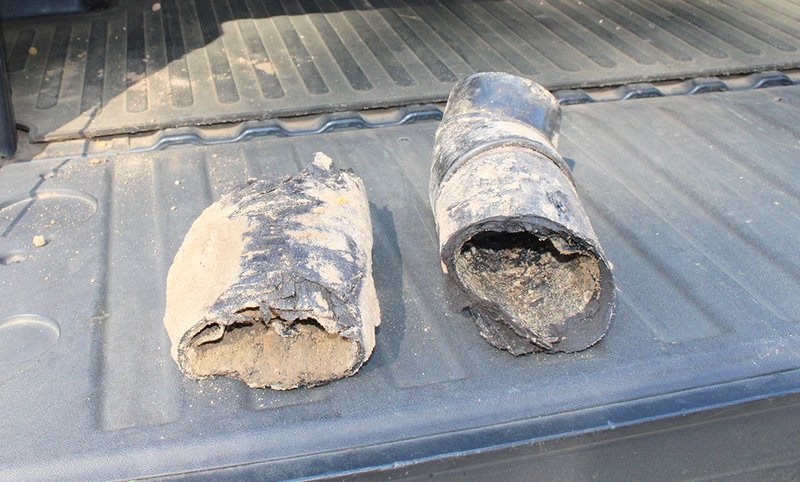
Named for a factory in Orangeburg, New York — and not the town on U.S. 301 in South Carolina — this pipe was made from wood pulp and coal tar or petroleum pitch.
"I've heard it described as wood fiber and hot tar," said Statesboro's city Public Utilities Director Matt Aycock.
It sounds pitiful now and looks like a sad roll of old tarpaper when it's dug up out of the clay, but consider that it has often lasted 50 or 60 years. Even iron sewer pipes, especially when cracked and infiltrated by tree roots, can give way with the passage of time.
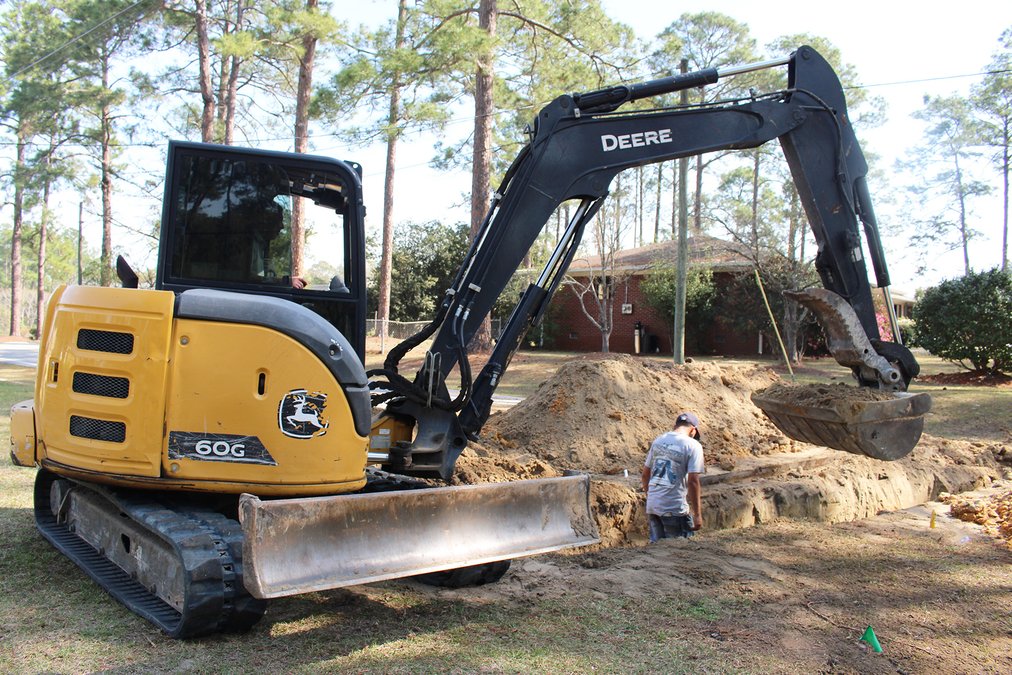
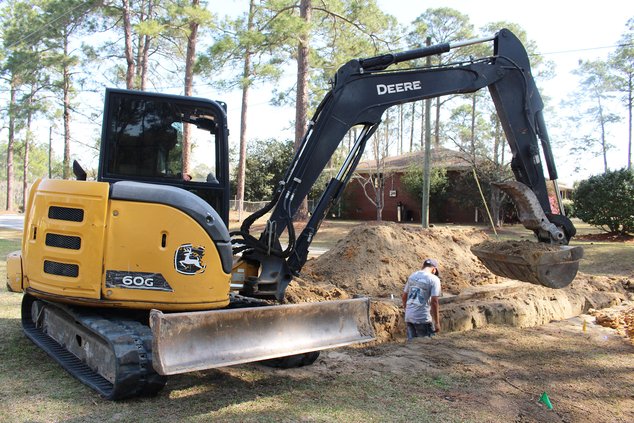
Margot Bragg owns the house on the corner at Ladd Circle where she had a contractor, Jay Owens, with an excavator and employee dig out the last remaining piece of Orangeburg sewer line connected to that lot one day last week. Then they replaced it with PVC pipe, refilled the trench and repaired the street.
Bragg had already had the Orangeburg line under the yard replaced with PVC a year earlier. But the recent collapse of the last remaining piece, which ran from the edge of the city right of way and underneath Ladd Circle to the city main on the other side, caused an alarming problem.
"You'd flush the toilet and the sewage would come up in the bathtub. …," Bragg said. "The sewage problem was one day, but it's taken me several days to get somebody out here. So there was very little you could do inside the house."
City involvement
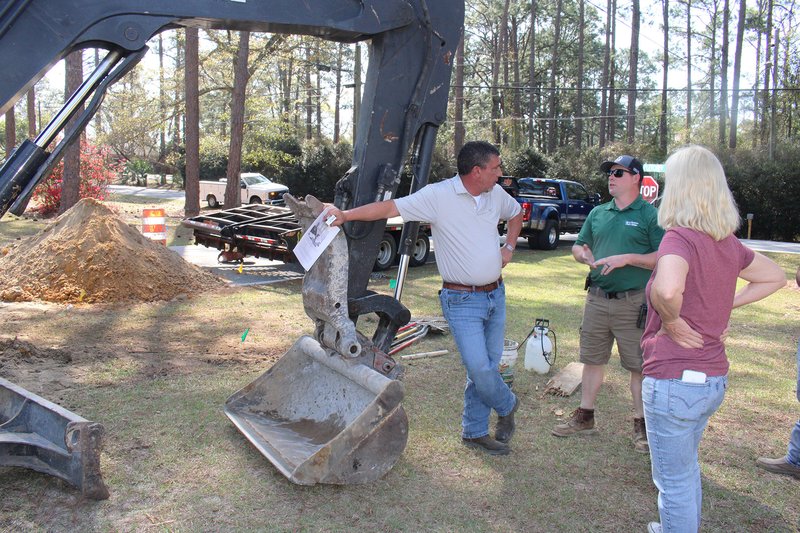
Of course, digging up the street requires getting the attention of City Hall. There's a permit you need, and one city employee who came over was Nick Lewis, officially the sewer camera crew leader. Bragg said he was very helpful.
"My goal is to make sure that the sewer main is not compromised and that things are put back the way that they're supposed to be," said Lewis. "The road needs to be put back correctly as well."
The sewer lateral collapse problem is a "fairly common" one, since "a lot of the older-built houses have Orangeburg going all the way to the main," he said. Lewis also confirmed that the city has an assistance program, but "for homeowners living in their home, not landlords."
As Bragg was already aware, that rules her out of participation, since she is renting the house out while keeping it in her family. But she wanted to get the word out on the problem and potential costs and thinks the city could do more for awareness.
First estimate $13K
Bragg showed the first cost estimate she had obtained, from a different contractor, $13,015 for the eight- to 10-foot-deep repair and the asphalt replacement. But she got Owens to do the work for significantly less, they said.
The replacement pipe was about 12 feet long, to slope downward under the narrow side street to the main — the city's eight-inch diameter concrete main with baked-in poly liner, nothing Orangeburg about that. The depth and distance might add a bit to the cost, Bragg thought, since it was first thought to be three-fourths that far.
Not just one place
She was aware of at least three other households in the neighborhood that have had the problem or have seen the beginnings of it.
"Most of the people on this street will have similar issues," Bragg said. "The lady across the road, she's already starting to have issues. This man right here, he had his replaced several months ago."
She also expressed concern for one person who she said had sewage in a ditch near their home and probably couldn't afford such a repair.
Aycock acknowledged that the problem has shown up "a little more" in recent years, but said it's not really widespread around town.
"That Orangeburg pipe was used not just around this area. It was used nationwide, I think, and it was put in 50 or 60 years ago or longer, and it has a lifespan that's just starting to run out in the past several years, the past decade or two," he said.
City ordinance
He supplied a copy of the city ordinance, Sec. 82-100, which states that repair or replacement of a failed "private sewer lateral extending from building to the public sewer main" is the property owner's responsibility.
But the cost can be somewhat the luck of the draw, less for homeowners who find the sewer main is on their side of the street, more if it is under the middle of the roadway or even on the other side.
Aycock said his predecessor in the role of public utilities director, Steve Hotchkiss, who retired about a year ago, realized this and worked with the city manager and elected officials to do something about it. The Sewer Lateral Replacement Assistance Program was established in November 2023.
"Right, and that's what was Steve's thinking when he did the assistance program," Aycock said. "What the assistance program does is help them with the cost under the street. So there's a calculation that's involved."
Bragg had heard that the city program might cover 20% in some situations, but as Aycock explained, the program is both more complicated than that and potentially more generous — for resident homeowners.
Assistance program
"That calculation doesn't put it in those terms. For some homeowners, it's been a lot more than 20%," Aycock said. "It's been reimbursed up to, like, 90%. It just depends on how the calculation runs, how deep the sewer is and how much asphalt has to be done."
He also supplied digital copies of the Sewer Lateral Replacement Assistance Program ordinance, Sec. 82-10, and the application form.
In the ordinance, the first requirement is that the eligible applicant must "be the owner and occupant of a single-family residential home located within the municipal limits" and show proof of ownership. Second, they can't have any unpaid city bills.
Third, the property owner must have a licensed plumbing contractor do a video inspection of the sewer line. Fourth, three quotes must be obtained from licensed plumbing contractors, and "assistance will not exceed the lowest quote." Fifth, the applicant must contact their insurance company to determine if homeowners' insurance would cover any of the cost.
The application form gives a $50 figure to be multiplied by the "square footage of improved surface" for assistance with the paving but has a blank to be filled in and multiplied by the "linear footage in excess of six feet" for the pipe.
"We've only had maybe less than 10 people, I think, take advantage of that program," Aycock said. "So, I mean, it's happening, but it's not widespread."
Six assisted so far
After having an administrative assistant look into it, he reported that the city has reimbursed six different homeowners a total of $23,100 through this program since November 2023.
Aycock said he has been in discussions with the city manager and assistant manager and leaders of the public works and engineering departments about possible changes to assist other homeowners, such as those with individual rental properties or family member-occupied homes.