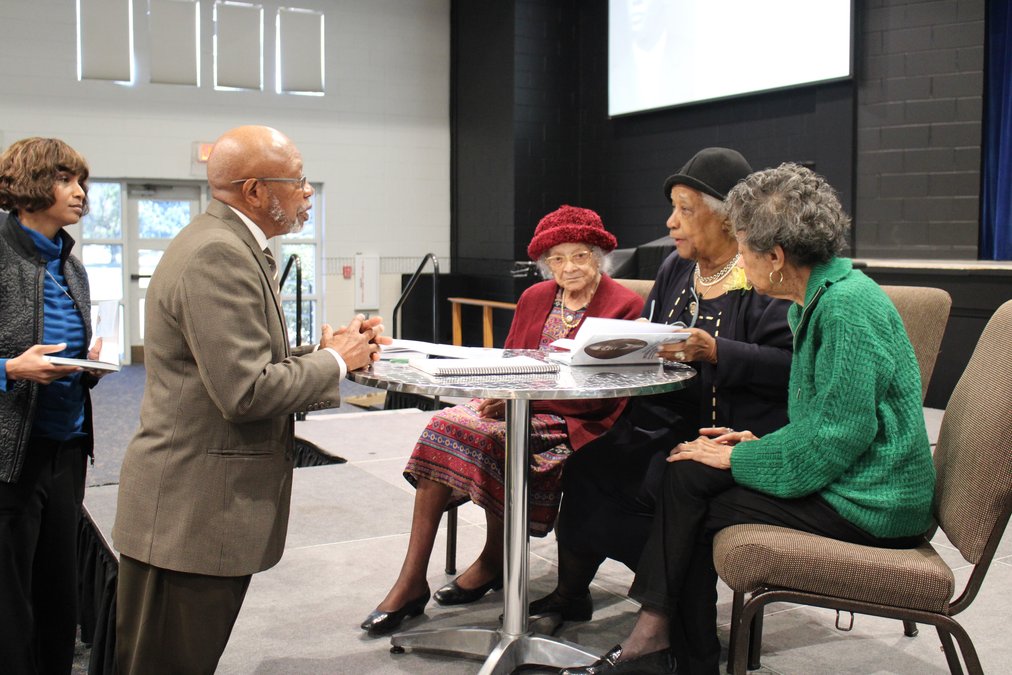
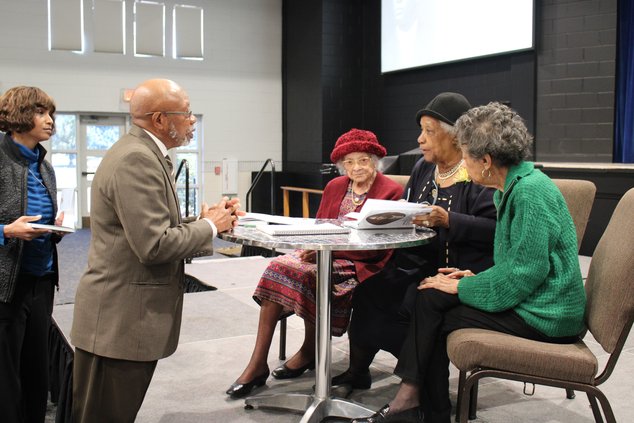
The Bulloch County Historical Society, over lunch on Monday, celebrated the publication of its new book about pioneering Bulloch County educator William James, 1872–1935, with the book's author, his granddaughter Dr. Carolyne Lamar Jordan. Historical Society members received their complimentary copies, many of which Jordan autographed.
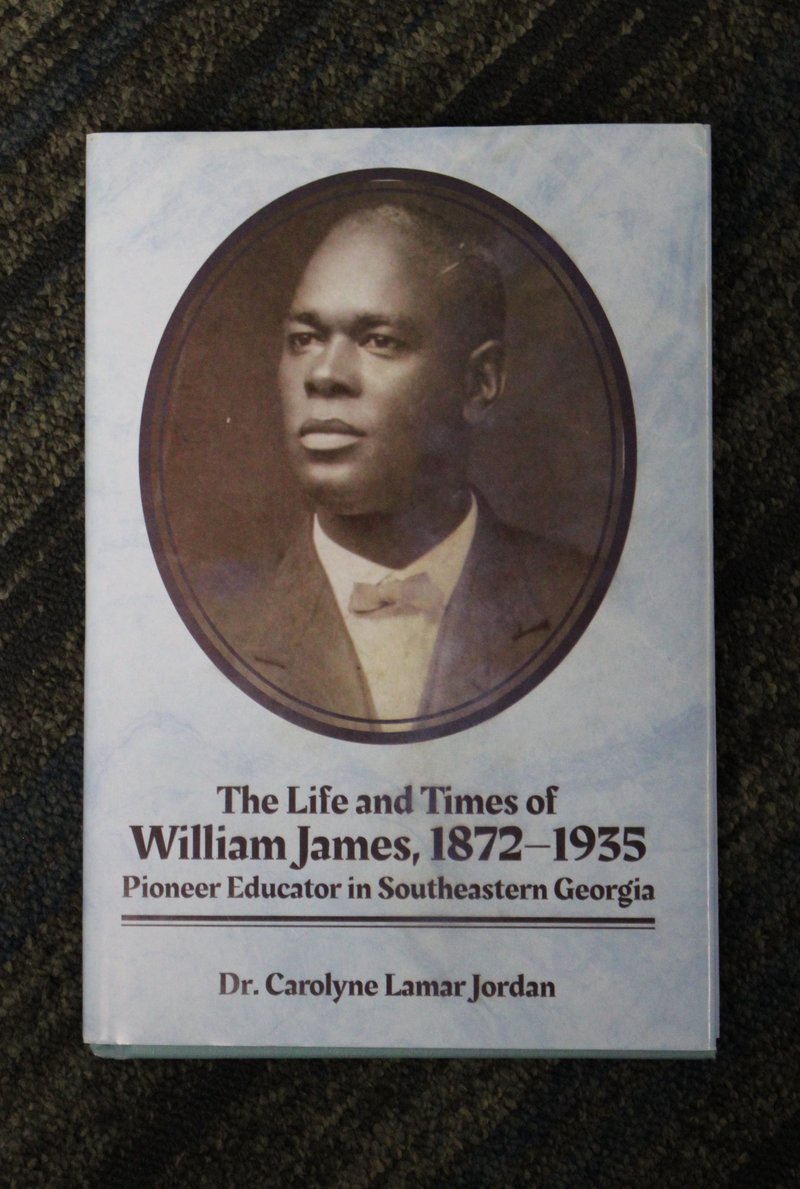
Additional copies of the "The Life and Times of William James … Pioneer Educator in Southeastern Georgia" will be available at the front desk of the Statesboro Herald office, 1 Proctor St., for purchase by the public at $25 each.
Monday's special luncheon program with Jordan speaking and several other descendants of Professor William James in attendance followed a Sunday afternoon dedication by the Historical Society of a historical marker across from Luetta Moore Park commemorating the Van Buren Sanitorium, the first hospital open to Black residents in Statesboro and one of the first in Georgia. School founder James and hospital founder Dr. Harvey Van Buren, 1879–1964, Statesboro's first known African American physician, were both members of Historical First African Baptist Church, on what was then Cotton Avenue and is now Bobby Donaldson Avenue.
Jordan was born several years after her grandfather died, and so never knew him directly. But growing up in Augusta — where her parents, Serena James Lamar and Peter Lamar, had opened their home to four of Serena's younger siblings — Jordan and her sisters heard stories from their mother, aunts and uncles about growing up in Statesboro and what their father had accomplished.
But Jordan traces her deep passion for learning more of the story of William James to a specific day, April 4, 1968, which happens to be the day that Dr. Martin Luther King Jr. was assassinated.
"I remember saying, 'We have lost a great leader,' and Mother said, 'There will be other great leaders, just as my father, William James, was a great leader. You will see,'" Jordan said.
Her mother then passed on a scrapbook her sister Elnora — Jordan's "Aunt Nora" — had assembled, containing a few family photographs and newspaper clippings about the school William James had founded in Statesboro.
Jordan would later apply her considerable professional skills as a researcher to expanding what is known about her grandfather and his schools for current and future generations of their family, the communities where he lived and the Bulloch County Historical Society. An accomplished developmental psychologist, educator and university administrator, now retired, she attained her bachelor's degree in music from Fisk University, her master's degree from the New England Conservatory, and a doctorate in human development, learning and cognition from Harvard University.
Another milestone, this one leading toward the current book, came in March 2019, when Carolyne Jordan, her husband Dr. Lawrence M. Jordan, and two other members of the far-traveled, high-achieving family — those particular members hailing from Boston, Massachusetts; Wilmington, Delaware; and Chicago, Illinois — visited Statesboro.
On that encounter seven years ago, they saw some of the Bulloch County Schools, including William James Middle School and the district's central offices in the William James Educational Complex, and had lunch at the home of the Bulloch County Historical Society's executive director Virginia Anne Franklin Waters and her husband, Bill Waters. Other leading members attended, and Jordan displayed what at that time was an expanded scrapbook.
Now, the society has commissioned and published Jordan's "labor of love" as a 135-page hardbound and dusk-jacketed book in its Clock Tower Series.
Statesboro High and Industrial
Born near Bartow, Georgia, in 1872, William James earned a degree from Atlanta Baptist Seminary, now Morehouse College. He first taught school in Washington County, where he married Julia Warthen, and then taught in Johnson County and Adrian County. In 1907, William and Julia James and the first three of their eight children moved to Statesboro, where he was recruited to take charge of what were then called the "colored" schools, at the time just three one-room buildings in Statesboro.
But he was also to help local Black citizens launch Statesboro High and Industrial School. It opened in its first building in 1908 and received instructional support from Tuskegee Institute.
James remained principal of the school until his death in 1935, and in 1948 it was renamed William James High School. That remained the name of Bulloch County's high school for African American students until desegregation.
Starting with her aunt's scrapbook, family stories and also sourcing some materials from here in Bulloch County, such as Statesboro News and Bulloch Times stories from the first decades of the 20th century, Jordan had carried her personal quest as far as the libraries of Harvard and Cornell.
The Howland letters
During a year as a visiting scholar at Harvard back in 1991, she had scoured books on "the history of Negro education in the South," and found barely a mention of her grandfather or his school, she wrote in the preface. But as she also recounted during Monday's presentation, on literally the last day of her year at Harvard, she found a reference in a bibliography to the "letters of Emily Howland." Then, searching the microfiche collection in the basement of Harvard's Widener Library, she shouted, "Oh, my!" breaking the silence, she recalled.
She had found a series of letters exchanged by William James and Emily Howland, the Quaker philanthropist and educator from Sherwood, New York, from 1913 to 1929, with hints that their correspondence began earlier. Several of these letters appear in the book.
Howland donated in support of Tuskegee Institute in Alabama and a number of African American primary and secondary schools. In appreciation for her contributions to Statesboro High and Industrial School, its dormitory for women was named Howland Hall.
Fire and rebirth
Not everything in the story is upbeat. The original wooden buildings of Statesboro High and Industrial School, in the area where Luetta Moore Park is now, burned down on Nov. 10, 1924, under what the timeline near the front of Jordan's book calls "suspicious, unconfirmed circumstances."
"Some speculated racially motivated arson, though the cause was never officially determined," she wrote.
But fundraising for a new campus began in 1925, and the school's new auditorium, seating 600–700 people, opened with an oratorical contest on July 12, 1926. A photograph taken at the event shows an integrated crowd for the time, with white residents seated in the back rows and some standing along the rear wall.
Violinist Joseph Douglass, a grandson of 19th century African American abolitionist leader Frederick Douglass, performed in that auditorium on March 9, 1927. In 1933, the year that Julia Warthen James died, George Washington Carver visited Statesboro, staying at William James' home and delivering a speech at South Georgia Teachers College, now Georgia Southern University.
Williams James "was a visionary who defied the nearly insurmountable social, economic and political conventions of the early 20th century to ensure that African Americans were able to obtain a quality education and live in a prosperous community," Bulloch County Historical Society President Dr. Brent Tharp wrote in a passage for the front fold of the book's dust jacket. "His example, exceptional for its time, remains inspiring and pertinent today."
Only one of the several extended family members present, William James' grandniece Geneda James Henley, now 95, remembers seeing him, and recalled him as her "Uncle Bud."
His great-great-grandson, Davis Alexander James, who is Jordan's grandson, contributed the final chapter of the book, "The Essence of William James," and viewed Monday's presentation by Zoom teleconferencing while in Tokyo, Japan.