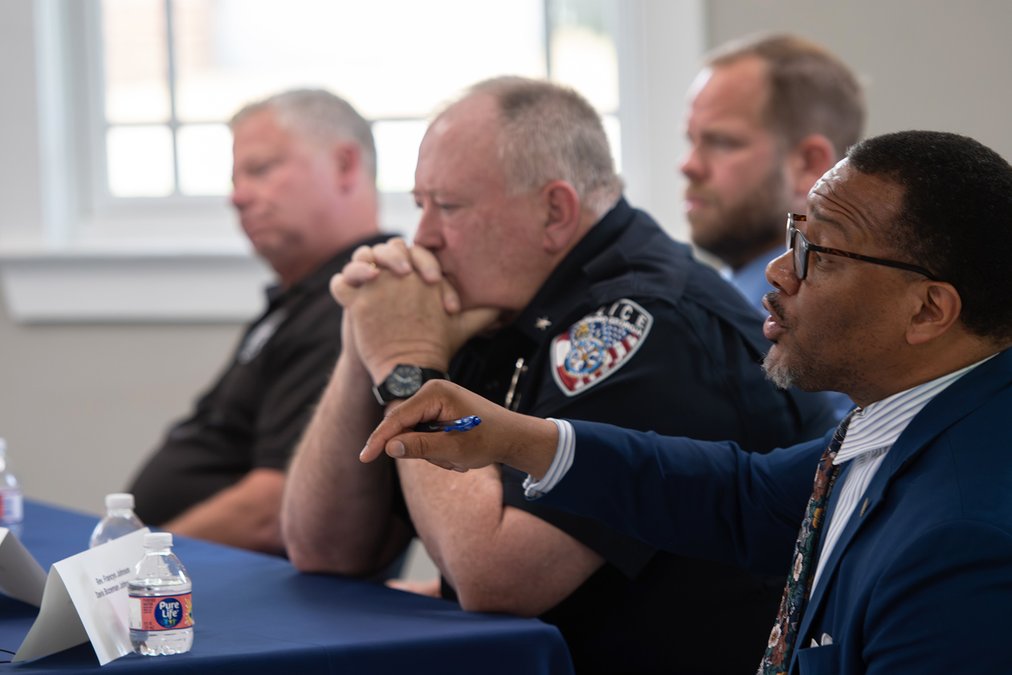
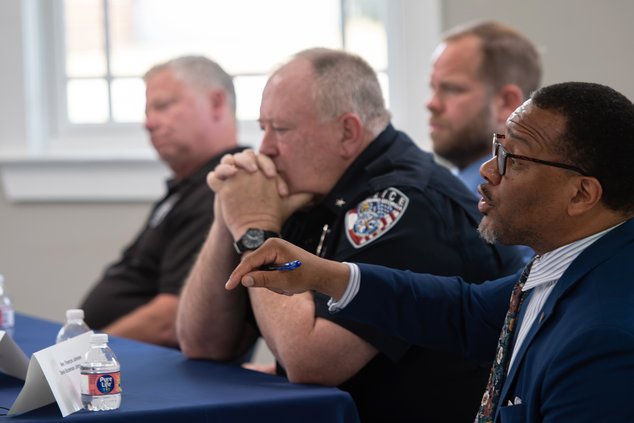
After video of an April 22 arrest in which the suspect, a young Black man, was bitten on the leg by a Bulloch County Sheriff’s Office patrol dog circulated online and was picked up by TV stations, the Bulloch County Branch of the NAACP hosted a criminal justice forum Wednesday evening, April 29.
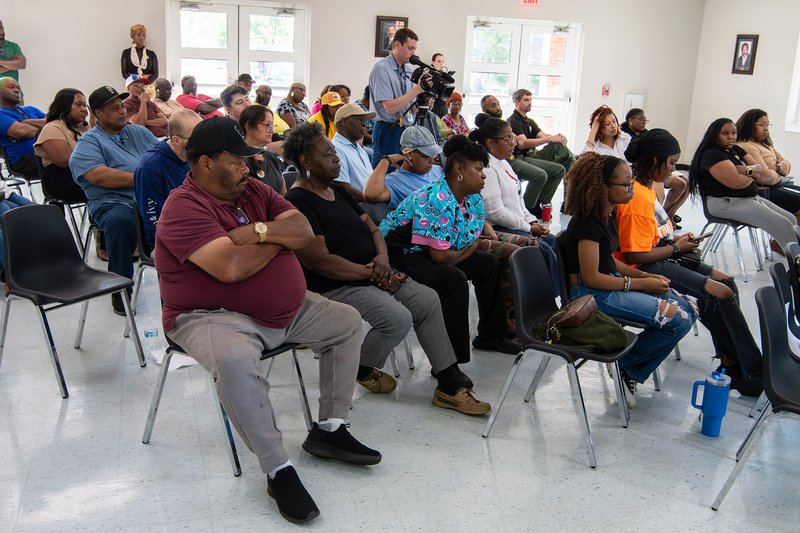
Specifics of the recent incident were not discussed during the forum, scheduled 5-7 p.m. in the community center at Luetta Moore Park and attended by 60-70 people. But the event did serve to vent anger and voice concerns over actions and attitudes of local law enforcement agencies, reveal information on the use of police canines – including that the Sheriff’s Office deploys “bite dogs,” while the Statesboro Police Department does not use dogs in this role – and offer a general discussion on officer accountability and the investigation of complaints.
At the conclusion, the organizers also made public a detailed written statement that Sheriff Noel Brown, who was not at the forum, had provided about the specific dog-bite incident.
Organizers stated that the forum was held by the NAACP in partnership with the National Conference of Black Lawyers. Statesboro minister and attorney Francys Johnson, of Davis Bozeman Johnson Law, was part of the discussion panel that also included Capt. Jim Riggs of the Sheriff’s Office, Chief Mike Broadhead of the Statesboro Police Department and Ogeechee Judicial Circuit District Attorney Robert Busbee. Akiv Dawson, Ph.D., criminal justice and criminology assistant professor and director of the Center for Africana Studies at Georgia Southern University served as moderator, asking the questions.
“We are here because our community has questions, we are here because our community has concerns, and most importantly, we are here because our community deserves to be heard,” Bulloch NAACP President Yevette McCall said in her welcoming remarks.
Before the panel discussion, the speaker’s lectern was offered to anyone who wanted to participate in a public comment session.
The first citizen to speak, and who also spoke briefly a second time a few minutes later, was Crystal Burney, who described herself as a white lady with biracial sons. When her sons were arrested by Bulloch County deputies in a September 2025 traffic stop, it was the third time family members had been stopped that week, she said.
The first time, she said, had been when she and her husband were pulled over, for supposedly excessive window tint while taking some trash off. Then, she said, her 18-year-old daughter was pulled over and searched “because of the (license plate) frame on the back on her car.”
“The very next day, my son was pulled over. This was three consecutive days of our family members being pulled over,” Burney said. “My sons were approached for blue lights on the back of his car. He didn’t know they weren’t legal.”
That encounter “got pretty intense,” she said, when one of her sons asked questions, including why deputies or officers were, in his mother’s words, “constantly harassing people on our side of town.”
“My sons were very calm, and respectful, which we practice this to our children in the minority community, or anybody’s children, really, to respect the law, and that’s just the way it’s supposed to be,” she said, “But the law is to preserve and protect you, but when you feel like you’re the target and you don’t feel protected, you’re scared of the police … You’re scared for your life.”
She was one of several speakers who talked about deputies or officers seeming to look for reasons to escalate situations in order to make arrests rather than de-escalate. The Statesboro Herald has not attempted to confirm the situations Burney and the others mentioned.
‘Reasonable’ force
Introducing the panel discussion, Professor Dawson said “as a little bit of the big picture about use of force” that it happens in about 1% to 2% of police encounters nationally.
“My students hear that and say, ‘Whew! 98 percent of the time it’s fine.’ But then I ask them, but what if you were in the 1 or 2 percent every single time. Would it still feel fine to you?” Dawson said.
She then led the panel in a discussion of “how force is defined and applied, how escalation decisions are made, how accountability functions across agencies and whether the system produces outcomes that the public can trust.”
One basic point, as city Chief of Police Broadhead first stated and civil rights attorney Johnson agreed, is that the guiding caselaw on reasonable use of force comes from the 1989 U.S. Supreme Court decision in the case Graham v. Connor and requires “objective reasonableness” in how much force is used.
“Objective reasonableness is supposed to be judged by through the lens of an experienced police officer when faced with the exact same circumstances as they were known to the officer when they chose to use force,” Broadhead said.
But he went on to say that police making arrests are allowed “to overcome resistance” and that de-escalation does not mean “from 100 to zero.”
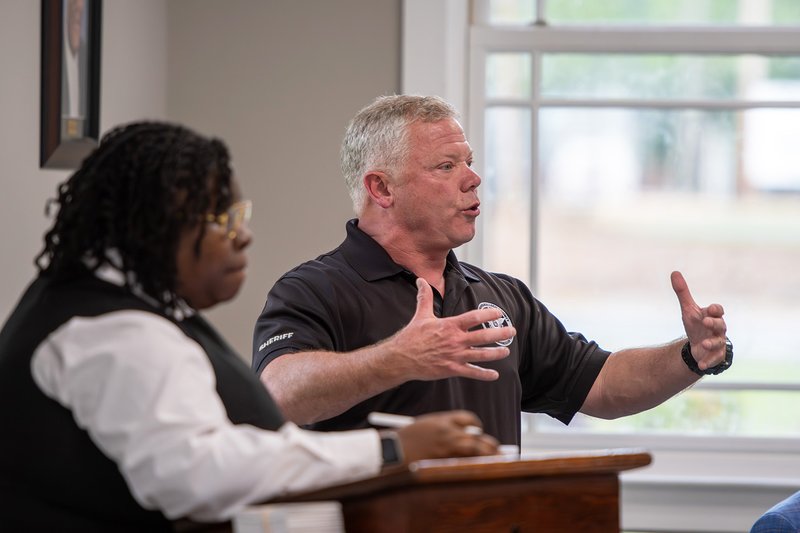
Riggs, commander of the BCSO Crime Suppression Team, said that, in simpler terms, reasonable force is, “the amount of force needed to affect an arrest, not going overboard, just what it needs to get there.”
‘Bite dog’ discussion; white suspect bit, too
Dawson later got more specific, asking “What is the purpose and when do you determine that it’s appropriate to use a canine?”
The Bulloch County Sheriff’s Office has “patrol dogs” which are “multipurpose dogs,” according to Riggs.
“They can track, taking a scent, they can sniff out drugs or articles if somebody threw a gun over in the bushes or whatever we’re looking for, the dog can go over there and help pick up certain things, and they’re also, for lack of a better term, a bite dog,” he said.
These dogs have successfully found some children who have gotten lost and some elderly people who have wandered off, Riggs noted, but he also acknowledged that the dogs have bitten some people in arrest situations.
“Somebody said you don’t remember when a white guy has got bit,” said Riggs. “How about last night? Last night they had to take him to the hospital. He had warrants … he was hiding from us, they went in there, the dog bit him last night – not the same dog, I don’t think.”
Riggs did not name this canine-bitten suspect from an unrelated case. But in the daily arrest reports with mug shots, a 40-year-old white man, booked Wednesday morning on charges of methamphetamine possession and misdemeanor obstruction of officers, appeared to match the description.
Using a dog in this way is not the first option but is considered less-than-deadly force, according to Riggs.
“And a lot of times, most of the time, just saying the canine’s out here and giving a command to bark, a lot of times that takes care of the problem,” he said.
He also referred to them as “high-strung dogs” and noted that deputies sometimes get bit during training.
Dawson asked if the Statesboro Police Department’s “escalation thresholds” are aligned with what Riggs was describing.
“We don’t use dogs for apprehension,” Broadhead replied. “We have two dogs, they’re narcotics detection dogs and used some for tracking, but we don’t use them for apprehension, so that so-called bite dog, we don’t have that.”
Video & sheriff’s response
Soon after than point in the forum, Johnson announced that the NAACP had “sent specific questions” to Sheriff Noel Brown “about the publicly commented video and the canine deployment and the sheriff sent back a detailed response.
“Our obligation in a forum like this is to not put people in a position where they have to make public comment about a case that’s still under active investigation and prosecution,” Johnson said.
As a defense attorney, he added, he would not want that to happen in a case where he had to defend a client.
“The sheriff has responded to that individual case, but we didn’t want to make a forum just about some videos, which is not all the evidence in that case,” Johnson said.
The brief videos circulated online are not bodycam footage or other Sheriff’s Office video but were shot by other people at the scene, probably using phones.
Four uniformed officers, apparently BCSO deputies, are seen struggling with and handcuffing one man who is seen from the back as he faces the front bumper of a parked patrol vehicle. At one point a deputy appears to grab the man’s long hair, and the dog is briefly seen biting the suspect on the lower part of his left leg as he lifts it and a deputy holds the dog’s harness. Several patrol vehicles are in the scene, which was in a parking area at an apartment complex off Lanier Drive.
The Sheriff’s Office on April 22 charged Jamal Demeico Hendrix, 25, of Millen, with two felony counts of obstruction of officers, as well as single misdemeanor counts of driving while license suspended or revoked, affixing materials that alter light transmission of windows or windshields and fleeing or attempting to elude.
In his two-page statement, Sheriff Brown states that Hendrix was warned multiple times and asserts that the suspect could have halted the escalation at five different points. The sheriff’s statement follows the version of this story posted at www.statesboroherald.com.
“I think the videos speak for themselves,” Johnson said after the forum. “I think they show police tactics that are highly suspect, and at the same time they show the real decisions that law enforcement has to engage in when people are not complying or are actively resisting arrest.”