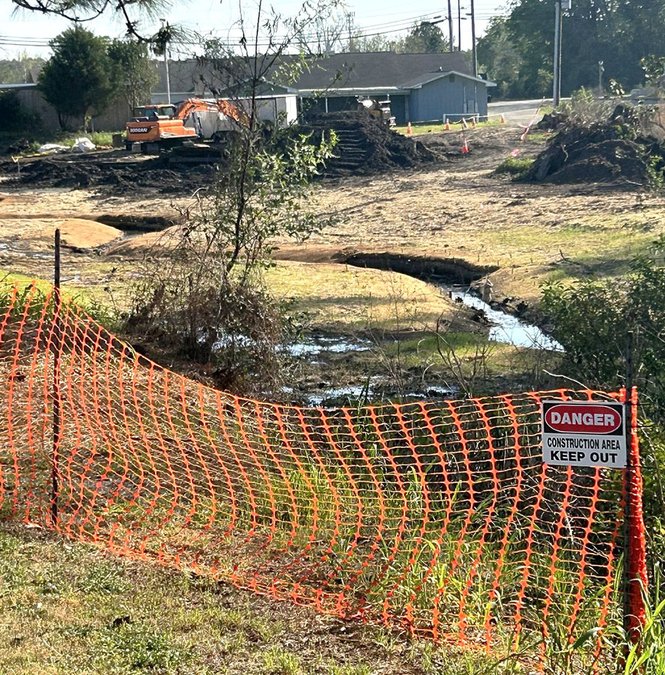
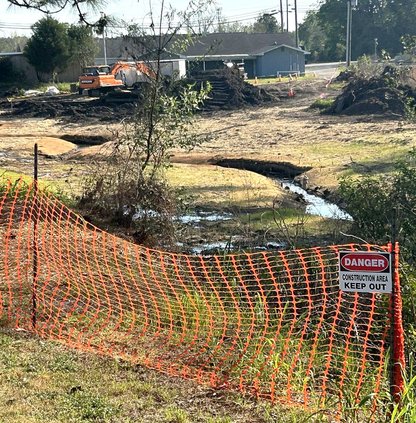
Because of stream restoration work, a popular segment of the Willie McTell Trail in Statesboro was closed to pedestrians and cyclists last Monday through Thursday, April 13-16, but reopened for Friday through Sunday. It will be closed again Monday through Thursday, April 20-23, but will be open again next Friday through Sunday, and so on probably until May 13.
The city government announced the periodic April 13-May 13 closures of the trail from East Grady Street to East Jones Avenue as necessary to complete the McTell Trail Stream Restoration Project. This project is intended to improve water quality, control erosion and better manage stormwater runoff in the stream, a partly natural but much human-altered Little Lotts Creek tributary that runs alongside the trail.
To fund the project, the city obtained a federal Clean Water Act Section 319(h) grant, which was originally for $381,715, through the Georgia Environmental Protection Division. The total funding amount was actually upgraded to “an even $400,000” before the work began, said Assistant Director of Public Works Marcos Trejo Jr., who doubles as Statesboro’s stormwater program manager.
“The construction cost (bid) came in very close to the budget amount. That’s the reason why we gave it a little extra breathing room in case there were any contingencies or any changes that were unforeseen by the consulting engineer,” he said.
The February grant amendment also increased the city’s matching funds requirement for the grant by $18,285, to a total of $248,040. This was to be supplied by a combination of city staff labor costs applied to the project and stormwater fee funds used to pay design costs.
The city retained Goodwyn Mills Cawood as its design consultant firm on this, as for a number of other projects and studies. The construction contract was awarded to Mid-Georgia Property Enhancements, a Macon-based company that Trejo said specializes in stream restorations and other stream-related projects.
‘Natural’ test run
One seemingly ironic purpose of this project is to use planned interventions to make the stream – which currently resembles a drainage ditch in some places and a bushy bog in others – look and function more “naturally.”
“The major concerns are some of our streams are overgrown with invasive species, we have a lot of erosion, and just really unsightly areas,” Trejo said. “This project is basically almost a test run for stream restorations to where we can maybe make these tributaries and canals a little bit more aesthetically pleasing, more natural, improve water quality with waterways and try to cut down on maintenance costs.”
No, the project does not involve deepening the channel, he said. Instead, the contractor is using plant-based materials in what Trejo considers “best management practices” to reduce and control erosion.
“Log vanes,” which he described as “basically a tree root-ball with a trunk” are being buried horizontally at some bends in the stream to build up the streambank and fortify against erosion. Additionally, “live stakes,” or plugs of “certain species of water-loving plants” are being transplanted to some areas.
“These stakes will eventually sprout and grow and create a root mass underneath the banks so whenever all the wood structures that they replace rot or decay, we’ll have a root mass holding the bank in place,” Trejo said.
That, he said, is one of the ways the project should help reduce the future need for maintenance work.
Erosion-control matting made of coconut husk fiber, which he said will eventually decay, is also being installed to help hold the streambanks in place until that root mass develops.
“Then behind there, we’ll have trees that are going to come in,” Trejo said. “It’s a multi-phase process. It takes many years, but eventually we’re trying to make these things look more natural, like when you see a natural stream in the woods.”
As will be explained in a moment, a later phase involving trees is planned for this fall.
But another major feature of the springtime work, now underway, will be the creation of a small flood basin and “bioswale” near Grady Street to help manage stormwater runoff.
A bioswale is a channel designed to concentrate runoff and filter out debris.
What about trees?
After a notice about the cyclical trail closing was posted on the “City of Statesboro Government” Facebook page, a citizen asserted in the comment thread that more trees were being removed and commented, “what a shame.”
City Public Affairs Manager Layne Phillips then posted a response, stating that city engineering staff had worked “closely with the design engineer to minimize tree removal” but that approximately five trees had to be removed “to complete the restoration work safely and effectively.”
“It is important to note that the overarching goal of this project is to create a more natural environment along the creek corridor — and that includes a significant tree planting effort,” Phillips continued. “Native species including maples, birches, oaks and cypress will be planted along the channel to provide shade for wildlife and stabilize the banks against erosion during heavy rainfall.”
Autumn tree planting
When interviewed by the Herald, Trejo said that the planting of trees will be part of the current project, covered in the maximum $400,000 overall price tag.
“But the contractor asked if he could postpone the tree planting until maybe closer to November,” he said. “That’s the growing season, and there will be more possibility that they’ll live versus die when it’s too hot. … So, it’s going to be two-phase.”
He said he didn’t have an exact count of the number of trees to be planted but thinks there will be 20 or 30 or more.
Trejo also said that if the contractor finishes the current phase of the work before May 13, the cycle of trail closings will be ended early.