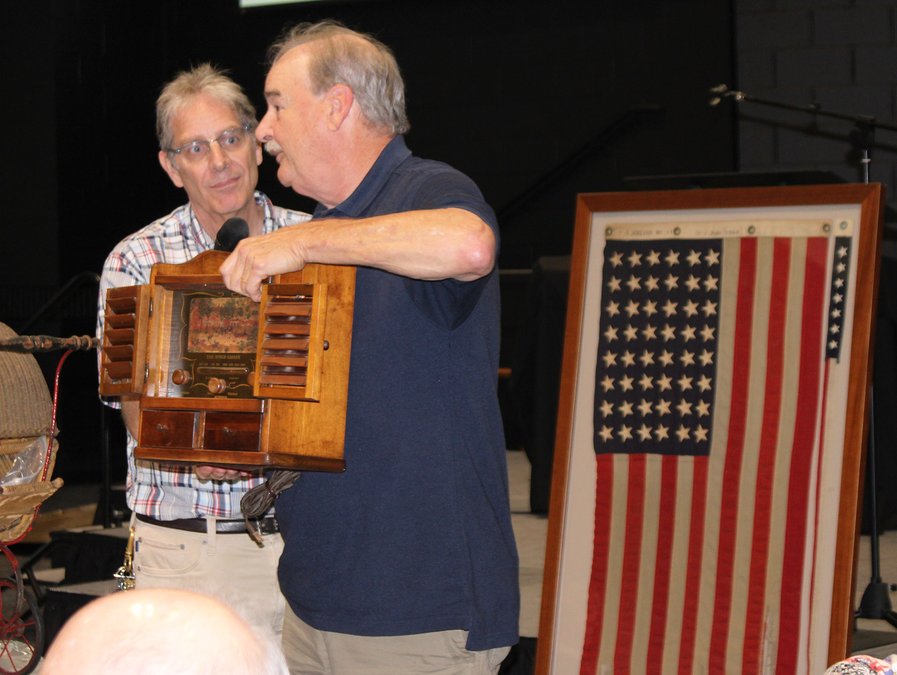
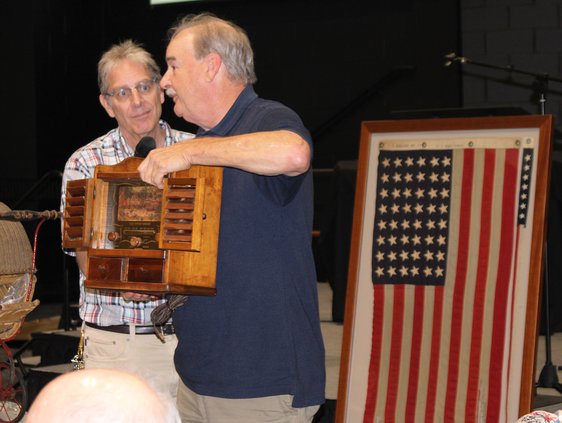
Among the Bulloch County Historical Society's monthly programs, a perennial favorite is the recurring local "Road Show" of antiques. Members and guests lined the long arrangement of show tables Monday with dozens of objects, ranging in date from mid-20th century to 5-10 million years ago.
"Great pieces, all," Historical Society President Brent Tharp said when it was over. "Thank you, everyone. … Artifacts are extraordinarily vital … You can read an artifact. Both how someone made it, how someone used it, how we keep it and what we remember from it tells us a great deal."
He had filled the role of emcee, or some said "appraiser," but this little local "Road Show" held in a church social hall doesn't assign a dollar value to any object. Tharp uttered words such as "fantastic" a few times and would have rated the stories priceless.
Starting at the far end of the table, there were school books and an encyclopedia from the 1890s through 1920, a Tiffany and Co. silver picture frame, a stamp collection, some jewelry passed from a grandmother to a mother to a daughter.
Jack Henry brought a little cast iron pug dog once used as a doorstop. Such things were important for keeping doors open in Southern summers "back in the days before air-conditioning," he said, and noted that flatirons had been used less decoratively for the same purpose. His wife, JoAnne Henry, picked up what at first glance looked like a blackened slingshot handle, but was in fact an iron of a different sort from the early 1900s.
"You know what this is?" she asked. "A curling iron. When my mom was a young lady, she had beautiful, long hair and she curled it. … I'm not altogether sure how she heated (the curling iron). I hope it wasn't on the coals in the fireplace, but it might have been one of those big, old wood-burning stoves."
Ancient sharks under I-16
In this localized tribute to PBS's "Antiques Roadshow" — now 30 years on the air — and Britain's even older namesake series, many of the stories told are family stories, often extending back just one or two generations.
That was also the case with the oldest object shown Monday, which also involved a family story and the construction, which began in the 1960s, of the interstate highway through this part of Georgia.
Bill Waters picked up a giant shark's tooth roughly the size of his hand.
"I guarantee you that I have the oldest item here by far," he asserted. "When my daddy started working with Shepherd Construction Company, building I-16 out of Savannah, the very first parts of it, 60 feet below the surface was where they had enough foundation materials to start.
"Dad would come home with these megalodon teeth in a five-gallon bucket, and this a specimen of a megalodon that lived five to 10 million years ago," Waters explained.
He put the tooth back on the table near a pair of soldier's boots brought in by his wife, the Bulloch County Historical Society's executive director, Virginia Anne Franklin Waters.
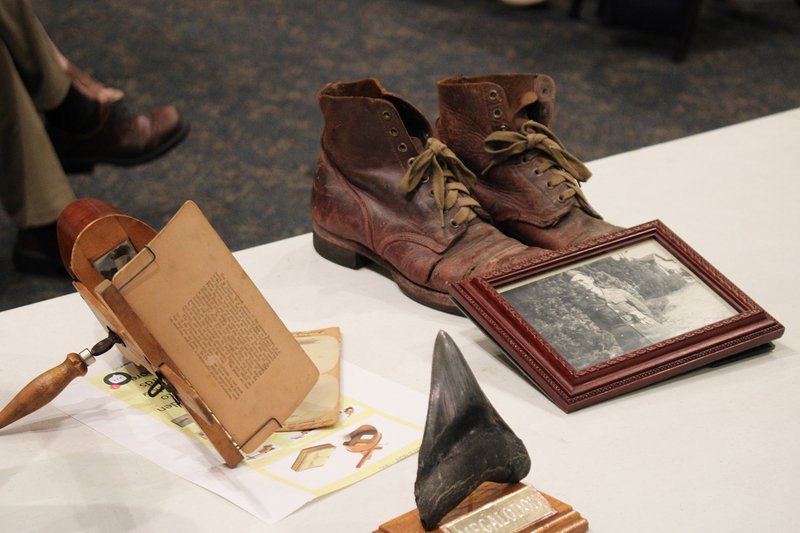
Those boots were issued to her father, the late Paul G. Franklin Jr., who was drafted into the Army during World War II. He was over 30 years old, "old to be drafted for a war," and others in his unit were sent to the Philippines where they became victims of the Bataan Death March, she said.
"Before they were sent in the Pacific, they had to have a physical, and Daddy had his physical, and when he took off his shoes, the metal plates fell out," she said.
After the Army doctor found out her father was "flat footed," he was discharged at Yuma, Arizona, and came home, "Thank heavens," Waters said. Her father had a long career as a pharmacist and drugstore owner in Statesboro.
Hatboxes and Ivory soap
Tyson Davis bought in a hatbox from Tillie's, a downtown women's clothing boutique that thrived in Statesboro for decades in the 20th century. Both his grandmother, Edna Brantley Tyson, and her sister, Nora Brantley Hart, had worked there in the 1960s, and the hatbox was discovered in his grandmother's house when she moved in the mid-1980s and the family cleared items out.
He also displayed a bar of Ivory Soap, still sealed in its box, that was manufactured in 1940 or not long after but discovered his grandmother's Statesboro home during the downsizing.
Nobody else brought antique soap. But Tharp provided a hatbox from another locally owned downtown Statesboro retailer of the past, Minkovitz and Sons Department Store, and noted that Virginia Anne Waters has one from a Tillie's competitor, Henry's.
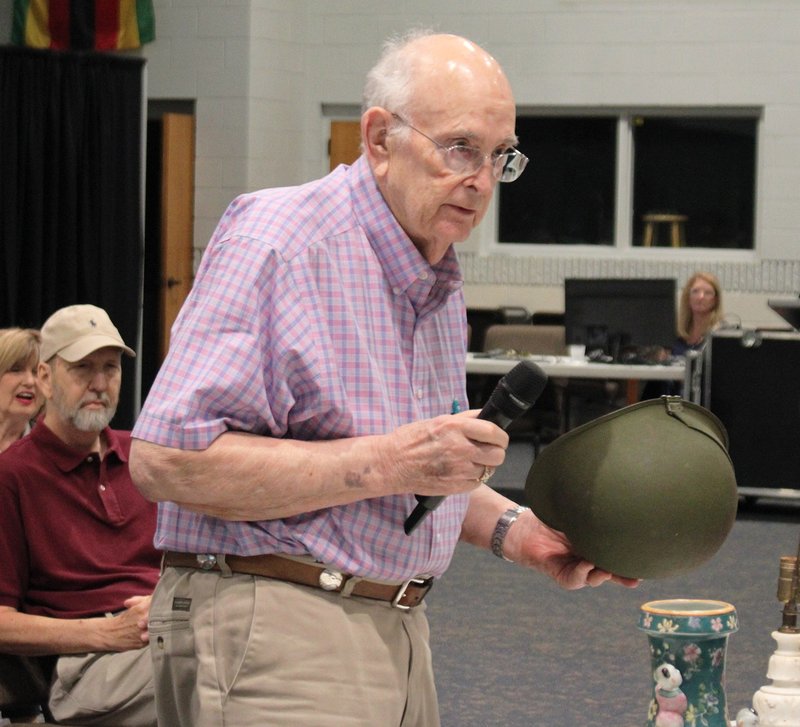
Historic home, recent loss
Two sisters, Nancy Deal and Lisa Akers, brought strikingly different antique items but shared a story of the very recent loss of a landmark of their family's history.
Deal displayed a butter press — not the only one on the table — that had been in the home of her grandparents, James Lafayette Deal and Mabel Cannon Deal. The press would have formed a mound of butter into a starlike shape.
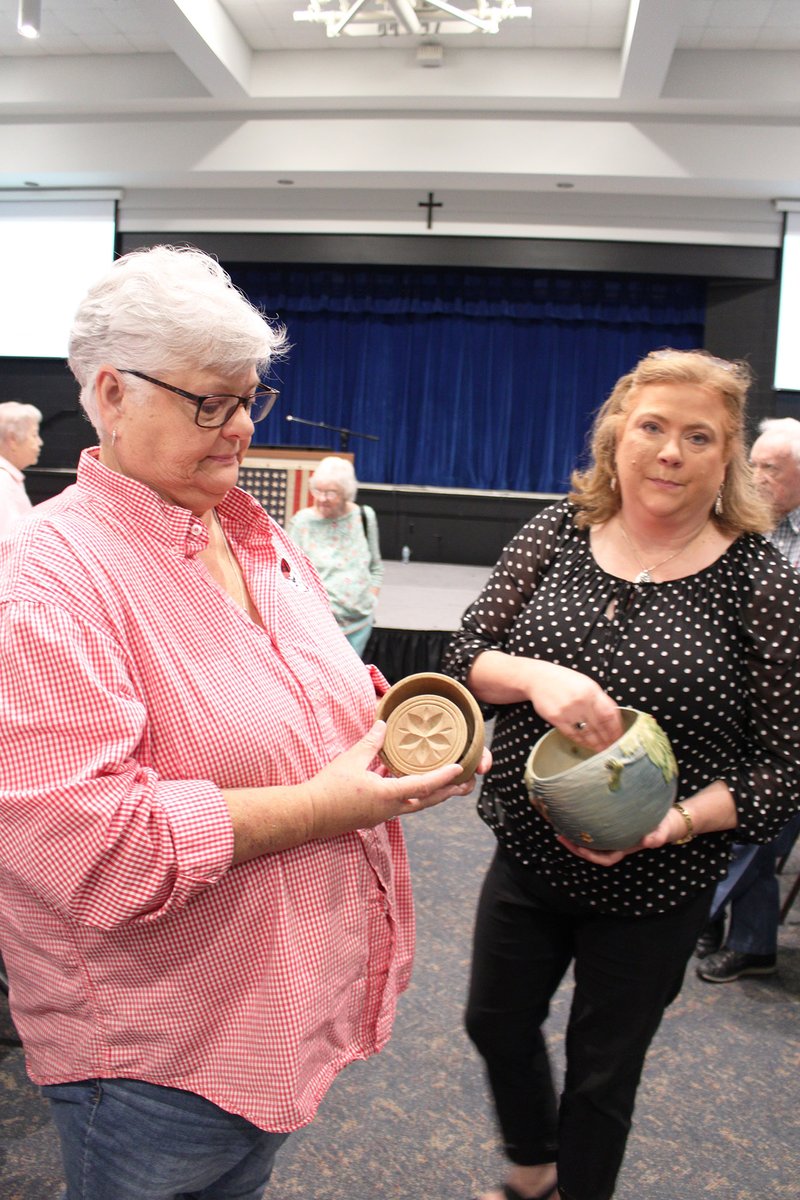
"It's even more poignant to me because the homeplace burned Saturday night," Nancy Deal said.
The house in the Middleground community — dating from before her grandparents moved there in 1930 —was within sight of Deal's own home and had remained in the extended family. Originally a "shotgun" type simple wooden house, it had been added onto, they said.
In fact, Akers previously owned it and rented it out, but their cousin Jeff Deal had purchased the house, and renovations were being completed for his son and the son's fiancée to live there, according to these cousins.
"They were ready to move in next weekend, and it's gone," said Nancy Deal. "It's one of those things that, the memories that popped up as I cried."
A neighbor had phoned her with the news that the place was on fire, and Deal ran out and saw it and called Akers and they both cried, they said.
Akers' Road Show antique wasn't from Middleground, but a Roseville art pottery bowl that belonged to her husband's grandmother.
That flag up front
One of the last objects described in the show was the 48-star United States flag that had been displayed vertically, framed at the front of the Pittman Park United Methodist Church social hall through Monday's luncheon event.
Imprinted with "1943" at the heading edge, this flag was flown on YMS-89, a U.S. Navy "yard minesweeper" which Richard Harwell commanded for several months during World War II. A wooden ship just 135 feet long, with two diesel engines and crew of 35, YMS-89 served at Okinawa during the 80-day battle for that Japanese island.
"The flag and pennant framed here were given to him by the crew after the battle of Okinawa, so this piece survived the Battle of Okinawa," Tharp said. "These minesweepers were under constant fire, they were small patrol boats. … They were constantly on duty, so you just switched crews and somebody else rolled into your space."
Having already attained a university degree and begun an academic career, Richard B. Harwell held the rank of lieutenant, junior grade, when he skippered the YMS-89 in 1945.
Later culminating his civilian career as a college librarian and historical author, Harwell served as library director at Georgia Southern College, 1970-75, and then worked for the University of Georgia until his retirement in 1980. He died in 1988, and his niece donated the flag to the Georgia Southern University Museum, of which Tharp is the director.