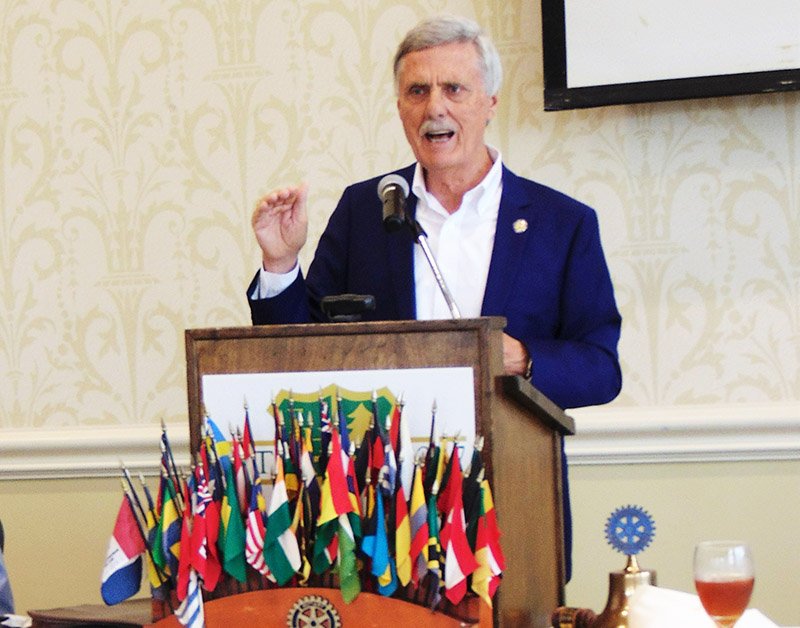
State Sen. Billy Hickman acknowledged in remarks to a Statesboro club that the Senate District 4 he represents going into the next term has been altered significantly from its past boundaries. He also noted that high poverty rates remain a concern for Bulloch and some neighboring counties.
“Our Senate district has changed, not right now, today, but one, one, twenty-three (Jan. 1, 2023) …,” Hickman told Rotary Club of Statesboro members and guests Wednesday. “But we’re very fortunate. We have grown. Our communities have grown.”
He went on to note that this is not true for all of southern or rural Georgia, where many counties lost population and the whole region lost ground proportionally to metro-Atlanta’s continued growth. It also wasn’t true of all counties previously included in Georgia Senate District 4. Despite growth in the district as a whole, with the redistricting the Legislature approved earlier this year, Hickman’s district gave up some of its traditional rural areas to help rebalance the population of neighboring districts.
Lost Tattnall, gained Pooler
Hickman, a certified public accountant and Republican from Statesboro, was first elected in 2020 to succeed long-serving Sen. Jack Hill, who had died suddenly that April. Hickman is unopposed for re-election this year.
But after the Legislature redrew district lines in response to the 2020 census, Hickman’s District 4 for the 2023-2024 term will no longer includes any of Hill’s home county of Tattnall or any of Emanuel County. Instead, the district was redrawn to include about 27,000 residents of Pooler and Godley Station in Chatham County.
“You know, you hear so many people say that the state of Georgia is now 10.7 million people and that we’ve grown a million people (in the past decade),” Hickman said. “Well, that’s not really true. South Georgia lost 200,000 people, and North Georgia grew 1.2 million people.”
So southern Georgia lost one state Senate district and three state House districts.
“We lost one Senate vote and we lost three House votes. … If we continue not growing and losing population, you can take that and move it 10 more years, and we’ve lost another one and three,” Hickman said. “So, you can see how important it is for us to have growth and provide opportunities in South Georgia so that people choose to live here.”
Senate District 19, represented by Sen. Blake Tillery, R-Vidalia, had lost around 10,000 or 15,000 people, as did District 23, represented by Sen. Max Burns, R-Sylvania, Hickman said. Meanwhile, the census results made the new target population for each of the 56 Georgia Senate districts about 191,000, and each had to come within 1% of that.
So Hickman’s district was redrawn to give up its last portion of Tattnall County to District 19 and the portion of Emanuel County to District 23. It now encompasses Bulloch, Candler, Evans and Effingham counties and dips into northern Chatham for the Pooler area.
“I think that’s very good for us. As we well know, that’s a lot of what’s going on …,” Hickman said, alluding to growth in western Chatham County and the Hyundai electric vehicle plant announced for the Mega Site in northern Bryan County.
“We feel the tsunami of all this rolling forward for us will also be good, because we’re already recognized as part of the Chatham County delegation,” he said.
He had spoken to Pooler City Council earlier this week and noted that the Pooler area now has two state senators instead of just one and that he becomes a third senator for Chatham overall.
Poverty concern
But later in his Statesboro Rotary remarks, Hickman expressed concern for high poverty rates and low household incomes in Bulloch and neighboring, rural counties such as Candler and Evans.
“Let me mention something that’s really heavy on my heart,” he said. “We all believe in this room that we live in the greatest community in the world … But you know what, we’ve got a lot of things that we could do better in our community, and it’s up to us as leaders in this room to make things better.
“We’ve got a huge opportunity with the Aspen (Aerogels) plant coming here and the Hyundai plant coming here of really changing people’s lives in our community,” Hickman said.
He cited the poverty rate in Bulloch County as 22%, meaning that almost one in four Bulloch residents get by on incomes below the federal poverty level. He said that means a family of four living on about $26,000 a year or less. The poverty line varies with the number of people in a household.
“Now you take that and put that in your situation in your family and ask if you could live on $26,000 or less,” Hickman said. “That’s what poverty is in Bulloch County, and we’ve got an opportunity to make some life-changing situations.”
He cited poverty rates of roughly 25% in Candler County, 24% in Emanuel County, 23% in Evans County and 21% in Tattnall County.
“The one that will surprise you is Effingham, 7 percent,” Hickman said.
One of his sources was Georgia Trend magazine. Asked after the meeting, Hickman said he had also drawn from a Development Authority-commissioned study that removed college student incomes from the equation and still showed Bulloch with a per capita income significantly lower than the state average.
The Georgia median per capita income he cited was about $42,000, compared to $36,000 for Bulloch County.
He also noted a Georgia Department of Labor report that ranked the counties from 1 to 159 based on average weekly pay, limited to each county’s residents who work within the county.
“Out of 159 counties in the state of Georgia, we were ranked number 97,” Hickman said. “We’re in the bottom one-third.”
Effingham was ranked 44th.
The U.S. Census Bureau’s survey estimates gave Georgia’s average poverty rate for 2016-2020 as 14.3%, compared to 20.7% for Bulloch County and 8.1% for Effingham.