BRUNSWICK – Georgia’s nesting season for loggerhead sea turtles began this past weekend and a nest each was found on Wassaw and Jekyll islands, plus two on Blackbeard.
“It’s like clockwork,” Georgia Sea Turtle Program Coordinator Mark Dodd said of the turtles’ annual return to lay eggs on beaches along the Southeast. “They’re usually right around the first of May.”
Daily nest monitoring on all Georgia beaches starts in mid-May. But the first nests were reported over the weekend by the Caretta Research Project on Wassaw, the U.S. Fish and Wildlife Service on Blackbeard and the Georgia Sea Turtle Center on Jekyll. Blackbeard and Wassaw are national wildlife refuges.
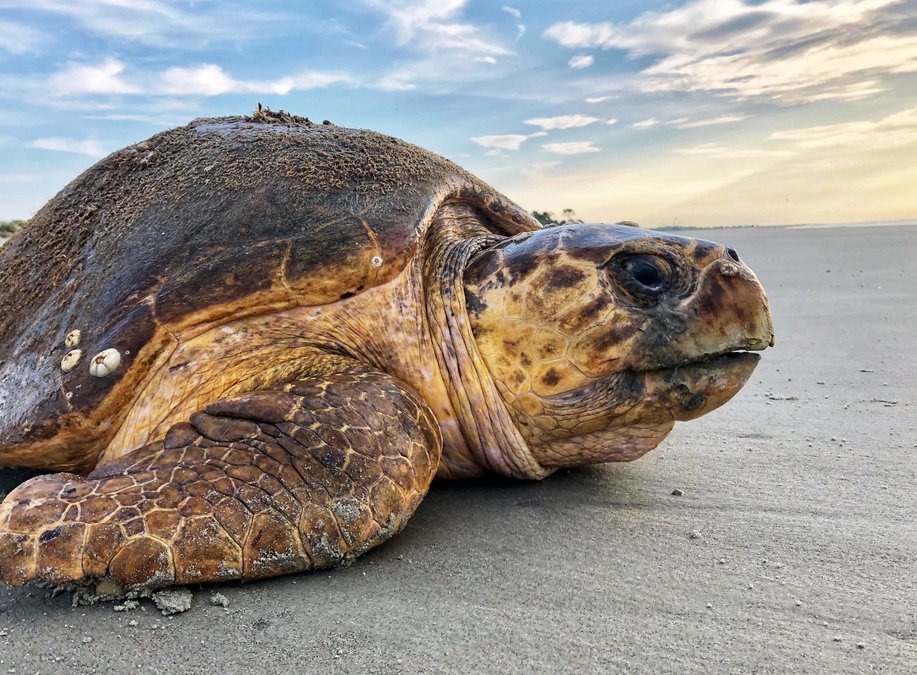
The loggerhead is the most common sea turtle on Georgia’s coast. It is one of the world’s largest turtles, topping 350 pounds and sporting a shell up to 44 inches long. How long loggerheads live is not known.
Predicting how the season will go for the state’s primary nesting sea turtle is anyone’s guess, according to a release from the Georgia Department of Natural Resources. But computer modeling shows nesting following a three-year pattern in the region, which suggests low to medium productivity this year, according to Dodd, a senior wildlife biologist with the DNR.
That was also the expectation last year, too, Dodd said, but loggerheads totaled 3,431 nests in Georgia in 2023, which was more than twice the 35-year average. Although 2023 was a drop-off from the record 4,071 nests in 2022 – the most since comprehensive surveys on all of the state’s barrier island beaches began in 1989.
Dodd said the hope is always for a “recovery” goal of 2,800 nests a year – a target set in the National Marine Fisheries Service/U.S. Fish and Wildlife Service recovery plan for the federally protected turtles. Last summer’s nests included more than 290,000 eggs and yielded some 159,000 hatchlings.
The loggerhead population has been increasing at approximately 4 percent annually since the early 1990s, the DNR release said. However, a population model developed by the University of Georgia and the U.S. Geological Survey using nesting and genetics data indicates the population will plateau at current levels for about the next 15 to 20 years, its progress hindered by low recruitment during the early 2000s, Dodd said.
If current protections remain in place at least through that period, the model suggests loggerhead numbers would then start to increase again, possibly reaching levels not seen since the late 1950s.
Supporting that rebound is the goal of the Sea Turtle Cooperative, a DNR-coordinated network of about 200 volunteers, researchers and agency employees who patrol beaches daily during nesting season. Working under a federal permit, members mark, monitor and protect all loggerhead nests.
The effort not only eases predation and increases the number of young that hatch, the data is critical to analyzing loggerhead populations, assessing threats and informing management, the DNR said. The program has been in place on Georgia beaches for more than 30 years.
“Just like the turtles, we’re here every year,” Dodd said. “We’re relentless just like they are. But seriously, to monitor wildlife populations you often need a long-term data set to figure out what’s going on. The more data we have, the better we understand the issues.”
The cooperative's work surveying each barrier island beach daily has helped the massive turtles’ slow recovery.
“We started out averaging about 850 nests a year and in the last five years we’re right at 3,000 nests,” Dodd said.
Like other marine turtles, loggerheads – named for their large heads – crawl ashore on barrier island beaches, dig a hole at the base of the dunes and lay their eggs, usually at night.
An egg from each nest – less than 1 percent of the average clutch size – is collected for UGA genetic analysis documenting the number and relatedness of loggerheads nesting in Georgia. The nest is then covered with a screen to protect the eggs from predators.
DNR’s Wildlife Conservation Section works to conserve sea turtles and other wildlife not legally fished for or hunted, as well as rare plants and natural habitats. The agency does this largely through public support from fundraisers, grants and contributions.