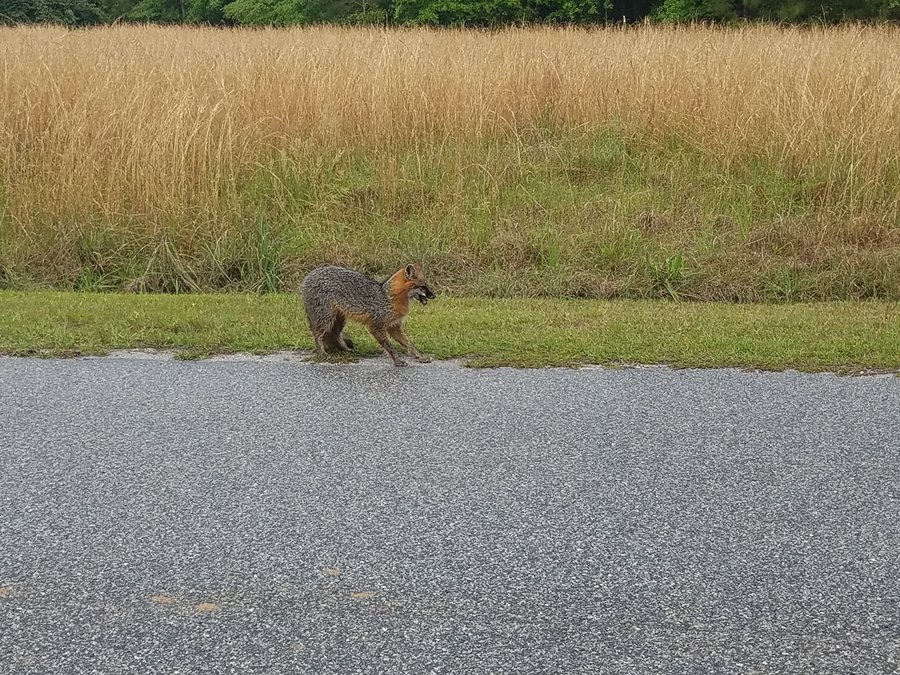
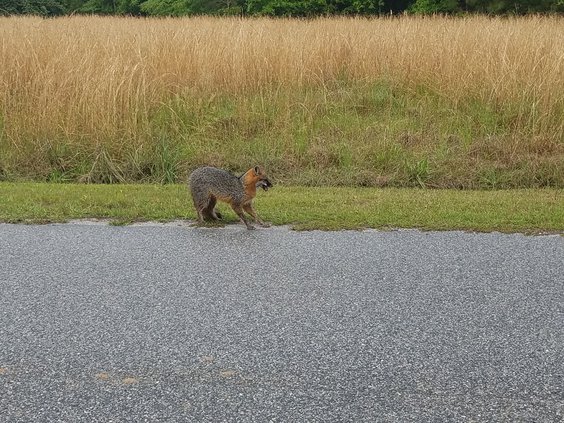
A frightening encounter between a fox and a local woman Monday serves as a reminder that rabies is present in Bulloch and surrounding counties.
Bulloch County Sheriff’s Sgt. Jody Deal and Bulloch County Humane Enforcement Officer Stephen Mixon were called to a Shiloh Drive home Monday, where a woman told them a gray fox chased her into her house, according to sheriff’s incident reports.
The fox had not bitten anyone, but displayed strange behavior that led Deal and Mixon to believe it was rabid. In his report, Deal stated the fox “definitely” showed signs of rabies, and based on the fox’s demeanor, he killed it.
Kristie Dowd said she was watching her grandson when she spotted what she first thought was a dog. After going outside for a closer look, she realized it was a fox, and started taking pictures. That was when the animal “made a beeline for me,” she said. She ran inside and closed her door, peering out the window at the oddly-acting creature.
Frightened, she watched the fox run in circles, pacing in her yard, with its head shaking and foam coming from its mouth. After a call to her husband, they contacted humane enforcement and sheriff’s deputies for help.
Mixon said when he arrived at the scene, the fox “just wasn’t acting right and didn’t seem to have its right senses. Its head was shaking, and he seemed to have lost his sense of direction.”
Dowd said while waiting on help to arrive, she stayed indoors but was concerned with people stopping to take pictures of the fox. One child rode past on a bicycle, she said.
Bulloch County Humane Enforcement Supervisor Joey Sanders said it is protocol to send animals for rabies testing only if they have attacked or bitten a person or a pet. In this case, although it was obvious the fox suffered from some sort of illness that appeared to be rabies, it was disposed of and not sent for testing.
Testing would only serve to establish the fact that rabies is present in the area, and “we already know that it is,” he said.
Brad Wiggins, Environmental Health director for the Southeast Health District, said Tuesday that while there has not been official confirmation of rabies in Bulloch County since March, 2018, the disease is known to be present in the area.
That is why people need to have their pets vaccinated, he said.
A feral animal that doesn’t act wild could very well be rabid, he said. Signs of the disease include “not eating or drinking, foaming at the mouth, walking strangely, and can be violent,” he said.
According to the Center for Disease Control website (www.cdc.gov), rabies is a “preventable viral disease of mammals most often transmitted through the bite of a rabid animal.
Rabies “infects the central nervous system, ultimately causing disease in the brain and death,” the site said. Early symptoms of rabies in people include fever, headache, and general weakness or discomfort. “As the disease progresses, more specific symptoms appear and may include insomnia, anxiety, confusion, slight or partial paralysis, excitation, hallucinations, agitation, hypersalivation (increase in saliva), difficulty swallowing, and hydrophobia (fear of water). Death usually occurs within days of the onset of these symptoms.”
Wiggins and Sanders both urged people to vaccinate their pets every year and to be watchful when encountering wild animals.
Dowd said the experience was “scary” and was concerned that a wild animal with possible rabies was loose in a “neighborhood with a lot of kids.”
If you spot an animal acting strangely, contact Bulloch County Humane Enforcement at 912-489-6911.
Herald reporter Holli Deal Saxon may be reached at 912-489-9414.