Cotton growers in the Statesboro area, facing increased costs of inputs such as fuel, fertilizers and pesticides but low prices for the crop, and hoping for more help in federal support programs, heard a detailed report Monday from the National Cotton Council.
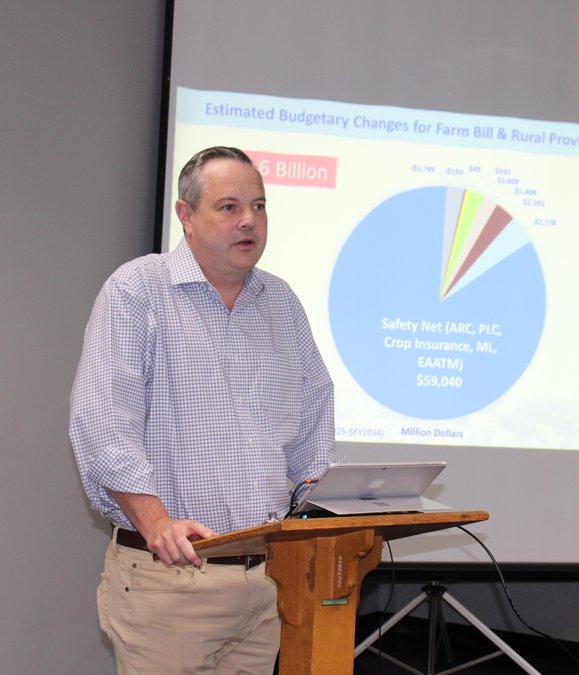
Robbie Minnich, the NCC's vice president for Washington operations — in other words a leading lobbyist — gave a presentation on 2025 Farm Bill provisions of the One Big Beautiful Bill Act at the Bulloch County Center for Agriculture. "One Big Beautiful Bill Act" is the name indexed at www.congress.gov for what was otherwise House Resolution 1 of the 119th Congress. The complex, 870-page tax and spending legislation was signed into law by President Donald Trump on July 4.
"It really from a Farm Bill perspective has pretty much everything that we care about included, when it comes to farm programs," Minnich said.
The Farm Bill has traditionally been a separate piece of legislation, enacted for around a five-year span, covering programs funded through the U.S. Department of Agriculture such as the Supplemental Nutrition Assistance Program, or SNAP, and the school lunch program, as well as those directly benefiting farmers. But the last traditional farm bill was passed in 2018.
Speaker of the House Mike Johnson in January used the term "one big, beautiful bill" to characterize Trump's desire to enact many different tax and spending policies within a single piece of legislation, and the name stuck. Meanwhile, farming lobby organizations such as the National Cotton Council set to work.
"We knew the safety net had to be increased, but to increase the safety net costs money, and so we started building the case of why farmers needed more money, why Congress had to invest more money into the Farm Bill in order to build that safety net up," Minnich said.
Adds $65.5 billion
The final bill, now law, adds roughly $65.5 billion "in new money" for farm programs.
The "vast majority of that, about $60 billion" is going to "safety net" programs, said Minnich.
The safety net elements of interest to row-crop farmers, such as cotton growers, include PLC and ARC payments, crop insurance and marketing loan assistance. None of these are entirely new programs, but the Big Beautiful Bill changes some of the rules and adds more funding.
When the prices farmers receive for common crops or "commodities," such as cotton, corn and soybeans, fall below certain "reference prices," growers are eligible for payments through the Price Loss Coverage, or PLC, and Agriculture Risk Coverage, or ARC, programs. But a farm must have an established "base" acreage of a particular crop from past growing seasons to qualify.
"Whenever you look at the cotton industry's priorities, every priority was addressed in some fashion," said Minnich. "We were able to increase the reference price. Payment limits were increased and indexed to inflation, and we had to fight to keep that."
Sen. Charles "Chuck" Grassley, R-Iowa, opposed the increase in payment limits. The Cotton Council, with support from growers through their contacts with Cotton Belt senators, "fought really hard" to get Grassley to withdraw an amendment that would have counteracted the additions for cotton, Minnich said.
The new law increases the payment limit for the PLC and ARC programs from the previous $125,000 to $155,000 "per person or legal entity" this year, and it will increase with the inflation index in subsequent years. For this year only, farmers will receive the higher of either the ARC or PLC payment. Going forward, they will need to choose one of these programs.
Minnich devoted more time to talking about PLC because it is, as he showed with a chart, the support program more likely to benefit cotton growers when prices are low, as they are now, but crop yields relatively good.
"The only time you should choose ARC is if you think that you're going to have above-average prices and below-average yields," he said.
$86 more an acre
For PLC, the reference price — based on seed cotton rather than lint prices — has been increased under the new law from 36.7 cents to 42 cents a pound. In 2025, with the actual seed cotton market price just over 34 cents and the lint price, as of August, 64 cents and given an average yield, the new 42 cent reference price would result in a PLC payment of about $127 per acre, compared to a payment of only $41 under the old reference price, according to a calculation Minnich displayed. That's an $86-an-acre increase.
With all of this, he cautioned that his information was solely based on the National Cotton Council's "interpretation of where things stand, just reading the law and how USDA typically implements it." But until the USDA's Farm Service Agency publishes implementation guidelines, details remain uncertain.
He also talked in some detail about crop insurance options, including how the relatively new SCO, or Supplemental Coverage Option, has been made to "look a lot more like" the older STAX, or Stacked Income Protection Program.
"With all of these insurance changes, they're pretty profound, whenever you look at the premium subsidy increases, the options that you now have," he told farmers. "So, I really encourage everyone to don't just talk to your crop insurance agent and say, 'I'm going to do what I did last year.' Really work with them to try to figure out what works best."
'Buying American Cotton'
Beyond the Big Beautiful Bill, Minnich talked about the NCC's efforts to increase market share for American-grown cotton. These include lobbying for a proposed "Buying American Cotton Act," which so far has only been introduced in the Senate.
This legislation would authorize tax credits to American companies — he used the example of retailer The Gap Inc. — that sell clothing, home textiles or other products that contain U.S.-grown cotton. To claim the credits, companies would have to demonstrate proof of their product's cotton content "through a trustworthy supply chain tracing system," according to the National Cotton Council's summary slide.
"Right now the U.S. consumer purchases about 20 million bale equivalents of cotton a year. … We're only growing 12 million bales, so the U.S. consumer is buying more cotton than we grow, but when you look at that 20 million bales and say how much of that is U.S. cotton, it's only about 4 million," Minnich said.
In other words, the United States is exporting most of its cotton but importing more, including in finished products such as clothing, sheets and towels, than it exports.
The council argues that by spurring demand for U.S. cotton, the tax credit could drive the price paid to farmers up, resulting in savings on other Farm Bill programs.
Another NCC effort, launching this week, is a "campaign against synthetic microfibers," promoting the fact that cotton is, after all, a natural fiber and arguing that synthetic fiber use contributes to microplastic pollution. A slide in the presentation noted media reports and scientific studies about microplastic infiltrating the oceans, seafood and the human body.
Bulloch County farmer Lee Cromley, who along with his brother grows cotton and peanuts in the Brooklet area, said he sees some needed positives both in the enhanced "safety net" provisions and the efforts at restoring market share.

The Cromleys are now tending about 1,300 acres of cotton, down from about 2,200 acres five or six years ago.
"Our acres have gone down some because it's not a sustainable situation with prices where they are," he said.
As noted, the recent market price for cotton is about 64 cents per pound, but Cromley cites a cost of production is in the "mid-80s."
"Our safety net had become obsolete because of increased cost of production. … So these updates put us back in a situation where our safety net becomes more effective," he said. "In a situation like this where prices are way below cost of production, that's where we need that safety net."
But he added that farmers would rather make a profit from their cotton than have to rely on government supports.
"The answer for us in the long run is demand," Cromley said. "We've got to bring demand back up."
He said he's especially interested in marketing related to the microplastic issue, and had seen a report indicating that textiles are responsible for about a third of the plastic waste in the oceans.
"We sell a natural product, and biodegradable, and we can be an answer to this microplastic issue, not the whole answer obviously, but we can have an impact," Cromley said. "If we can get our market share back from 25 percent to 35 or 40 percent, we'd be great."