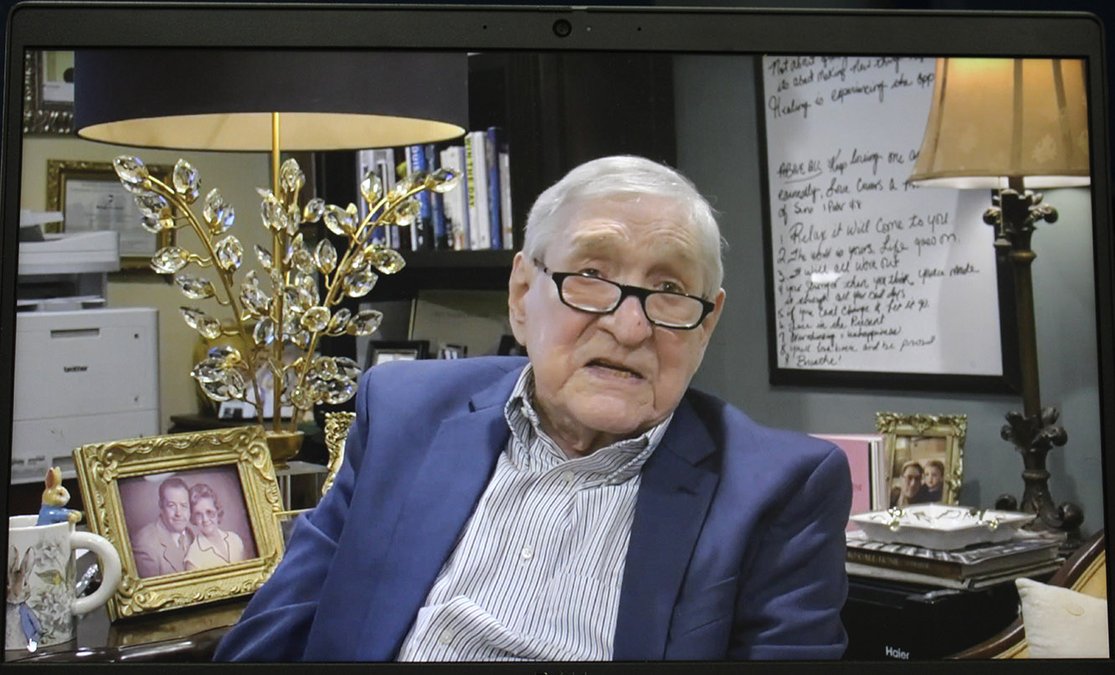
When the Bulloch County Historical Society made Roger G. Branch Sr., Ph.D., the subject of one of its oral history Legends Series videos, the result was bound to provide historical insights into more than just his life as an individual.
Branch is a Georgia Southern University professor emeritus of sociology and a retired pastor with a background in journalism, roots deep in rural Southeast Georgia and — as seen in his column which ran in the Statesboro Herald for decades — his own research-fed appetite for regional history. Now 91 and residing in a local retirement home, Branch was interviewed by Historical Society President Brent Tharp, Ph.D., for the video produced by the organization's Vice President Tyson Davis.
Members and guests then saw the debut during the Historical Society's April 27 monthly luncheon meeting in the Pittman Park United Methodist Church social hall.
The first colorful storytelling in the video has Branch taking his interviewer and audience back to some experiences of his ancestors during the early post-Revolutionary War period, when portions of Georgia to the north and west of here were still the homeland of the Creek tribes, and violence erupted between them and white settlers.
"My great-great grandmother — add another 'great' or two — was hit in the head, scalped and left for dead. …," Branch said. "She wrapped her head … and poured a bottle of rum over it, walked six miles to the fort, and survived along with her mother and two brothers."
This matriarchal ancestor later moved to Tattnall County where she married a widower and prospered, Branch said. She was reported by one historical visitor to have worn a colorful handkerchief to cover the "bald" spot, or in family lore to have used a skullcap for the same purpose.
History in context
Speaking slowly but with evidently undiminished recall of dates and details, Branch repeatedly placed such particular details in broader context. So he alluded to actions carried out against the Native American peoples of the Southeast by Andrew Jackson, first as a military officer and then, from 1829 to 1837, as the president.
"Georgia was on the frontier until Jackson removed the last of the Creeks," Branch said. "That's as sad a story as his removal of the Cherokee, another Trail of Tears."
Then he spoke of some of his other ancestors, the Williamses, as having settled in Bulloch County after the Revolution, becoming namesakes of Williams Road and Williams Landing, before one moved on to Tattnall County.
Child of the Depression
Roger Branch was born in October 1934 to parents Oscar and Juanita Branch at the home of his maternal grandparents, Rudy and Ella Collins Williams, near Cobbtown in Tattnall County.
"Obviously I was born in the middle of the Great Depression, and it affected my early life as it affected everyone," Dr. Branch said. "The times were hard, people were losing their farms, their homes. It was the era of flight to Florida as they became citrus workers, very much like the Latinos that gather the onions here today."
But he added that as a child he was "not so aware of the hard times," knowing that his family lived off the land, "but that was normal." The situation grew more serious when his father had a serious illness and lost his farm, then having to rent land.
A brief sidebar "chapter" in the video has Tharp asking Branch about his love for the artwork of Billy Morgan, a sharecropper's son. The video features some closeup details from Branch's favorite of Morgan's paintings, "Left Behind." It shows a partially open door and steps coming down from a kitchen, with baskets, rusting pots on the steps, other small household objects.
Such things were "left behind" because sharecroppers often had to move after a year or two, "forever poor and forever on the move," as Branch put it.
Commitment to education
Another chapter is called "A Commitment to Education." Branch started his in a two-room country school at Cobbtown, then went to Lyons High School, in Toombs County, for grades 4-12.
"I did finish, with complete maternal pressure. Dad encouraged; Mother demanded," he quipped, "and I was the valedictorian."
Then, with an early interest in writing, he decided on the school of journalism at the University of Georgia, where Branch served in several positions, including editor, on the student newspaper, the Red & Black, "one of the most honored in the nation" as he noted still.
Meanwhile, Remer Tyson, from Bulloch County, had started at Georgia Teachers College (now Georgia Southern University) where he edited the George-Anne but was encouraged by an instructor to transfer to the University of Georgia. "Two South Georgia boys bonded very quickly," said Branch.
Tyson, who would go on to a distinguished career with the Atlanta Journal Constitution, became his best friend on the Red & Black's staff and, a year or so later, best man at Branch's wedding.
Ministry and teaching
Within a few years, three most significant things happened in Branch's life, he said, "a conversion experience, acceptance of a call to the ministry, and Annette."
He went to Southeastern Baptist Seminary for his Bachelor of Divinity and Master of Theology. His call to ministry took them to "a village church" at Ailey in Montgomery County, where he also taught at Brewton-Parker College, now Brewton-Parker Christian University, in neighboring Mount Vernon.
Then he was hired as associate editor for The Biblical Recorder, the Baptist State Convention newspaper in North Carolina. The Branches remained there about two and half years, but one day his young wife Annette said, "Something's wrong. … what you like to do is teach, and that's your next calling," he recalled.
So Branch went back to the University of Georgia and got his Ph.D. and came to the burgeoning, renamed Georgia Southern, where he taught under the leadership of Dean Jack Averitt.
"He was a liberal-arts person, a historian himself," Branch said. "He believed that the region needed it to be more than a teacher's college."
Other brief chapters in the video are entitled "Integration" and University status," as Branch talks about other phases in institutional history.
He taught sociology at Georgia Southern for 30 years, 1970-2000, serving as chair of the Department of Sociology and Anthropology for 18 years. He credited Professor Sue Moore and Professor Richard Persico for growing the graduate degree programs and contributing to artifact collections that gave rise to the Georgia Southern University Museum.
Tharp, now set to retire June 30 as the museum's director, described Branch as "part of the core group" that had been dedicated to establishing the museum.
A matriarch remembered
A final chapter is "Honoring the Matriarch," meaning his late wife, Annette Slater Branch, who was also from Tattnall County. They had been married 58 years when she died in 2013 at age 76. He talks about how they met and their courtship, and how she never complained when they struggled financially.
"I ain't going to say she was perfect … but God, I miss her," he said.
From a family with a commitment to education, their son, Dr. R. Gary Branch Jr., is a medical doctor, and their daughter, Elizabeth Branch, is an attorney.
The video can be found online at https://www.youtube.com/watch?v=RvF9qf5muMg.