
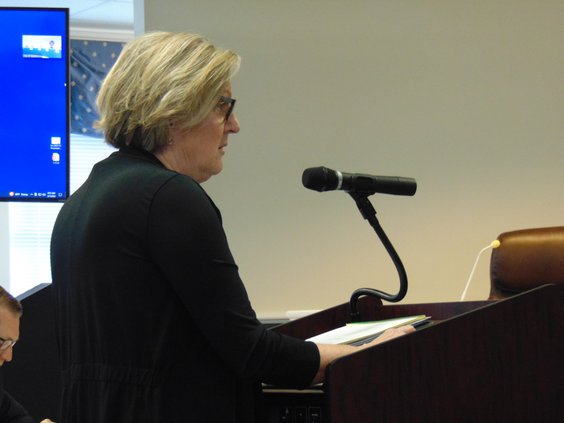
Susan Riley, as a neighborhood resident and spokesperson for others concerned, addressed Statesboro City Council on Tuesday, Feb. 7, and asked that the city rescind its Jan. 17 annexation of a 41-acre tract on Beasley Road.
Riley, a nurse practitioner who previously served on the Bulloch County Board of Education, pointed out several things she said were errors in the city’s annexation procedure.
“The very confused procedure of annexation that was done on 1.17.23 violates the very essence of the Georgia law called 36-66-4,” Riley said.
The section of state law she referred to sets out procedures for hearings in zoning decisions. It mentions situations where property to be annexed is also to be rezoned.
During the January 17 meeting, city officials, particularly City Manager Charles Penny, said they were separating the annexation from the property owner’s request to change the zoning from R-40 to a higher-density classification. Unless a further zoning change is approved at the time, when new areas are annexed, they automatically come in zoned R-40, Statesboro’s lowest-density residential classification, requiring lots no smaller than 40,000 square feet, or about ninth-tenths of an acre.
Originally, Smith Family Homes developer Lamar Smith’s concept for the Beasley Road tract was to create a subdivision for up to 212 townhouse units, requiring a zoning change to R-2, the new classification city officials added last year specifically for townhome developments. The application for annexation, and originally also an application for the zoning change, were submitted in the name of the property owner, Bel-Air Estates Inc., and its CEO, state Rep. Lehman Franklin III.
This proposal for a much-higher density housing development drew opposition from community residents first at a Jan. 3 meeting of the appointed city Planning Commission, which voted 4-2 to recommend denial of the annexation request. Riley was also the speaker who made the most detailed remarks in opposition to the annexation at the Jan. 17 council meeting. But there were a couple of other opposition speakers, and one or two in favor. Dozens more people stood up to indicate opposition, and an informal petition was presented.
During that meeting, Penny recommended changing the city’s practice on annexation proposals so that they will be researched by city staff members who submit a recommendation directly to the elected City Council, taking the appointed board out of the process. The planning board’s involvement had been a practice but not a legal requirement of the city government, Penny said.
He and Mayor Jonathan McCollar said they felt that, when an annexation draws controversy, the appointed planning board has been put in an awkward position, since only the elected council has authority to annex.
Already annexed
So, without acting on the zoning change request and without it being presented to the mayor and council, the council voted 4-1 on Jan. 17 to annex the Beasley Road property, and Penny and City Attorney Cain Smith said the annexation took effect immediately.
Nothing having to do with the annexation or the tract’s proposed development was on the agenda for last week’s, Feb. 7, council meeting. But Riley signed up and spoke during the general public comments time.
In addition to the law she cited above, Riley referred to what she said was a requirement, in a different section of state law, for a detailed report to be made available to the public 10 days before an annexation. The report was “not there, not there for you, not there for us,” Riley told the four council members present.
She asserted that another requirement, contained in the section of law identified as OCGA (Official Code of Georgia, Annotated) 36-36-111, to notify any school system affected by an annexation, also wasn’t met.
It states: “Within 30 days of a municipal corporation's acceptance of a petition of annexation, the municipal corporation shall notify the governing authority of the county and any impacted school system in which the territory to be annexed is located by verifiable delivery. Such notice shall include a copy of the annexation petition which shall include the proposed zoning and land use for such area. The municipal corporation shall take no final action on such annexation except as otherwise provided in this article.”
Admitted oversight
Penny and the city attorney acknowledged this one oversight, that the city did not inform Bulloch County Schools officials of the Jan. 17 annexation before it was approved. But they also noted that this is a new clause in the law, enacted by the Georgia General Assembly in the 2021-2022 session and in effect only since July 1.
“That was a new wrinkle in the law, but it was an oversight,” Penny said after Tuesday’s meeting. “We received no objections from the county, and the school board wouldn’t have any action, they could just give their opinion.”
He called it “more of a courtesy notice” but said he understands school officials need to know about residential developments for planning purposes.
In a phone conversation later Tuesday, Smith, the city attorney, said that other points Riley raised were from portions of Georgia’s annexation laws that do not apply to this type of annexation. It was an annexation by the 100% method, with the owner of all 41 acres, Bel-Air Estates Inc., having requested that the land be annexed into the city.
In regard to “a report not being compiled and not being made public, there’s very good reason for that, and the reason is because that (requirement) is only under the 60% method of annexation,” Smith said. “This is a 100% annexation. That’s why we didn’t do it. It’s not applicable.”
During the Jan. 17 mayor and council work session, Smith noted that the 100%, or completely voluntary method, is the only type of annexation Statesboro has done in recent years. The 60% method would be for an annexation in which not all of the landowners in an area necessarily agree to be have their property brought into the city limits.
“The 60% method involves involuntary annexations so there are more protections involved; 100% annexation is 100% voluntary and does not have those notice requirements,” Smith said Tuesday.
With a 100% annexation, the county government does have 45 days to object on “very particular” grounds, and was notified and did not object, he said.
As for the oversight regarding the school district, the city’s attorney said Bulloch County Schools officials were now “quite aware of the fact” that the city failed to notify them.
“They do not have opportunity to object to the annexation anyway, and we do not foresee them attempting to do so at this point,” Smith said.
He said the city contends that the failure to notify the school board is “harmless error.”
“And moving forward, what we’re going to do is we’ll notify the school board not only of any annexations but also zoning map amendments and subdivisions as well,” Smith said.
For now the land is zoned R-40, which Smith said is not an effective classification because the city has no standards for it.
“A zoning map amendment will be necessary prior to development or issuance of any permits,” he wrote in an email. “This isn't an oversight or error.”
Smith said he has heard that the landowner will request a designation denser than R-40 but less dense than R-2. The notice to the county included the originally proposed R-2 designation, so a requirement that a year pass before the city could change the annexed land to a higher density zoning would not apply, he said.
Riley’s request
In her remarks, Riley said that, from what she could determine, City Council had approved in the last six months rezoning from lower-density to higher-density classifications that allow for planned construction of 1,100 housing units, with another 100 on this week’s agenda.
“So, my questions: Is anybody really counting?” she said. “Is there a formula to go by, to see how many more housing unit it takes to need more EMTs, more police, more hospital beds, more classrooms and more teachers?”
She asked the council “to void the vote” on the Beasley Road annexation and to “step back and slow down zoning requests and annexation till they’re fully researched.”
But the council took no action on her request and did not revisit the annexation.
Asked after the meeting whether citizens opposed to the annexation will file a legal challenge, Riley said, “I don’t know. I have to discuss that with the group. I’m just the spokesperson, so we’ll see.”