At the heart of the Evans County Community Center, on the north end of Church Street in Claxton, volunteers and donors have established the Evans County African-American Archive Museum.
The place itself is a cherished part of the county’s Black community and its history, as well as a repository for artifacts and stories.
Carefully curated with topical sections, the museum fills and has expanded a little beyond the large room that was the library, or later the media center, of the historic Evans County High School. Before that building and name, the Evans County Training School operated on more or less the same campus. Under those names, this was the county’s high school for African-American students in the final four decades of segregated public education.
Being a volunteer-led effort, the museum so far isn’t open to the public on a regular basis.
“Right now it’s ‘contact us and we’ll give you a tour,’ but we’re going to set up a schedule for tours, especially for our schools,” says the archive’s current curator, Patricia Milton, a 1968 graduate of Evans County High. “We want the school children to come in and see what they don’t get at school.”
In fact, the oldest portions of the extant ECHS complex were built in 1954, the same year the U.S. Supreme Court in Brown v. Board of Education of Topeka ruled that the “separate but equal” doctrine used to justify racial segregation was unconstitutional.
Georgia and a number of other, mostly Southern states then belatedly attempted to establish more nearly “equal” but still separate school facilities for Black students. So the steel-trimmed, concrete-block and brick building, with the library and some classroom doors opening to the outside along a breezeway, is a typical “equalization school.”
The earlier “Training School” building was a white-painted wooden “Rosenwald School,” built at local initiative but with help from the charitable Rosenwald Fund. It faced Church Street and can be seen in some photos inside the museum, one from 1938.
Lettering Longhorns
The back-facing side of the front row of exhibits, the end wall and the front-facing back wall of the library form a half-room devoted mostly to the history of local education and these schools. One area, with a trophy case, is dedicated to the sports teams. Alumni-donated letterman jackets show the big “E” for Evans County.
Also prominent there, and in a couple of other examples around the museum, are sets of Longhorn cattle horns. On the court and the on field, generations of young athletes competed as the Evans County Longhorns.
Across the half-room, another exhibit notes the success of ECHS students in annual science fairs, held mostly at Fort Valley State College (now University). At least two students advanced to the national fair.
‘In the News’
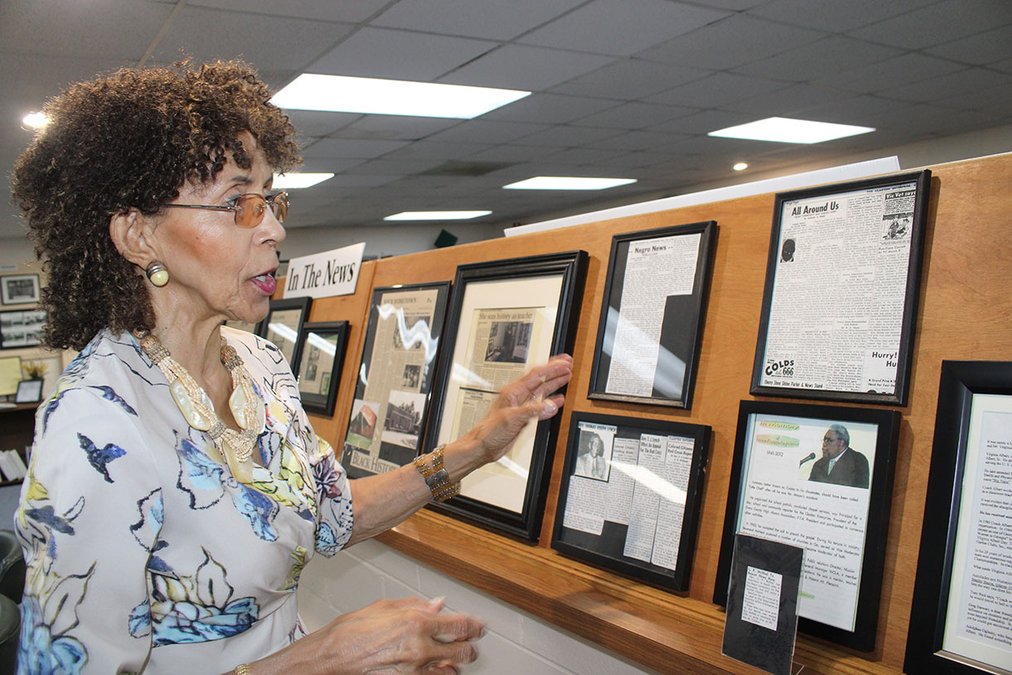
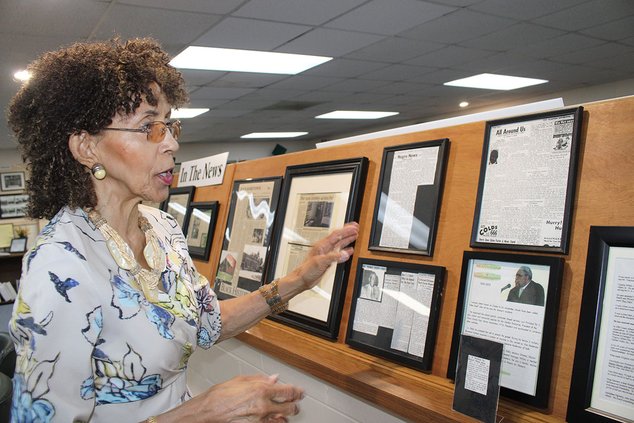
Up front, the first display board – a polished-wood, wall-length easel supported by a lower cinderblock wall – features an “In the News” display with framed clippings, mainly from the local newspaper, The Claxton Enterprise, about events in the Black community over the years. Additionally, there are large ring-binder scrapbooks holding collections of other news clippings and photographs.
One section highlights the lives and work of three influential Black men who contributed both as newsmakers and writers.
The man Milton called “our first reporter,” was the Rev. Thomas Joseph Lynch (1891-1974). The second man was Solomon E. Bonds Jr. (1926-1998) a social studies teacher, ECHS assistant principal and Claxton Enterprise columnist. The third was the Rev. Dr. L. Perry McNeal, (1941-2012) well remembered by the reporter of this story.
Around in the “School Activities” area, archive visitors can find another tie-in between the school and the local paper. With a student-designed, hand-drawn masthead atop the front page, The Long Horn’s Moo was a one-off Evans County High School student newspaper, published by the Claxton Enterprise in the spring of 1956 but highlighting events back to the Halloween carnival of Oct. 31, 1955, as well as through a Leap Year Ball at the Wagon Wheel Café in mid-January.
Principal & First Lady
At the end of the display wall toward the museum entrance, a compact exhibit celebrates the lives of Mr. and Mrs. Raleigh Macon.
“They were pillars of this community, and their estate donated all of this,” Milton noted.
Raleigh Macon, 1912-1991, was a teacher and coach at Evans County Training School from 1940, then after three years away “in an essential war support position,” during WWII became its principal from 1946, according to his obituary. He remained when it became Evans County High School and was principal for 27 years, serving as co-principal of the then-integrated Claxton High for two years before retiring in 1974.
“He was the only principal that we had,” Milton said. That was certainly true during the time that the name was Evans County High School.
But his wife, Bernice G. Macon, 1914-2005, had served as Training School principal while a teacher in 1944 and returned to the classroom “solely as a teacher of English, Civics and Georgia History in 1946,” according to her obituary. She retired as an educator in 1976.
Archive committee
Although several men recorded news of the school and community in decades past, women have taken the lead in creating this archive. The five members of the Archive Committee who met the reporter during a visit were Milton, curator emeritus Louise Wilkerson, Elizabeth Porter, who is president of the Evans County Community Center board, Rosalind Ivey, who also serves on the board, and the Rev. Vivian Byrd, whose church, Hagan Chapel Missionary Baptist, is one of several featured in the archive’s church history collection.
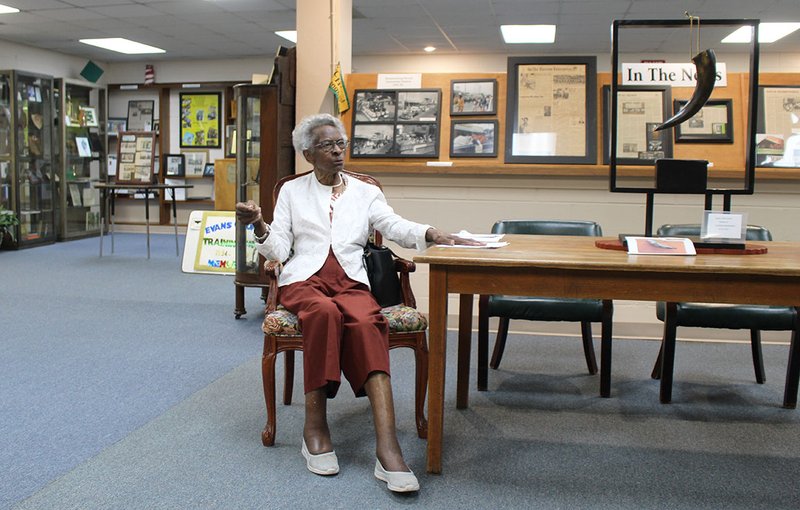
Wilkerson, a 1958 graduate of Evans County High, earned her degree at Savannah State (then College, now University), and returned to ECHS in 1961 to serve as both the librarian and an eighth-grade teacher. The library was also her classroom, and she continued working there after the last Evans County High School class graduated in 1970 and the building became the first integrated Claxton Middle School.
“Just this was the library/media center at the time, and the students, all of them said, ‘Mrs. Wilkerson’s room.’ So I guess it is,” she said this week. “But I’m proud of what we have and what we have accomplished and what we have been able to preserve and share.”
Wilkerson started the work toward creating the archive by preserving things that were already in the old school, and Milton began researching archived newspapers “all the way back to the 40s.”
“We started collecting this history a long time ago, she and I. …We work together,” Milton said.
Property of alumni
Alumni, some still around Claxton, others much farther afield, had relaunched the Evans County High School Alumni Association in 1990. But it was 2010 before members learned that the Evans County Board of Education would release the building, no longer used as a school, for public sale. The association sealed the deal in 2011.
“It was by the grace of God because nobody else submitted a bid except us, and it was meant for us,” Milton said. “We paid $5,000 to get this building and our campus, about 13 acres.”
As a community center, it serves several other functions. These include hosting a Head Start preschool, an after-school program, Ogeechee Technical College GED classes and the Rosebud Garden Club.
Ironically, the museum was set in its current configuration during the COVID-19 pandemic, when nobody was coming to see it.
“In 2020 everybody was sheltered in. We were down here for six months working and putting it all together,” Milton said.
A long, relatively narrow room to the right – the former typing lab – holds the Farm and Homelife collection.
Besides things you might expect, such as a hand pump for a well, a small wood stove and a display about cotton, this room contains a wall-mounted map of the “Church Street Corridor and Extensions.” It is marked with the locations of businesses from a bygone era.
“Most of our young people don’t know that Church Street, during segregation, was a place where there were all types of businesses,” Milton said. “We had laundromats, we had a grocery store, we had service stations. There was a store here, off campus, where students used to buy their little cookies and drinks.”
Funeral programs
At the left front of the library, a smaller room holds the archive’s genealogy collection and various magazines and books. A computer there provides access to the archive’s digitized collection of printed programs from funerals of African American residents of the area. This was created with assistance from an Evans County Historical Society volunteer and the University of Georgia.
“We did approximately 600 or more funeral programs, and they’re all on a computer in this room, and anyone can log on to view those funeral programs,” Wilkerson said. “Actually, they provide information for families.”
At least some of those programs can be accessed from anywhere through the Digital Library of Georgia. See https://dlg.usg.edu/record/eccca_aafp-ec. All obituary information and life dates above are from that source.