Statesboro City Council recently accepted both a $1.4 million state grant through the Georgia Department of Transportation for engineering of the Creek on the Blue Mile Trail project and an unrelated, roughly $800,000 agreement for continued operation of the city’s bus system.
The funding for the “preliminary engineering phase” of the creek-side, multi-use trail is a Transportation Alternatives, Congestion, Mitigation and Air Quality Improvement grant through the GDOT. A 20% funding match, or $350,000, is required from the city, with the local source being T-SPLOST, the transportation projects sales tax.
Back in 2023, Statesboro’s city government was awarded a $2.12 million Transportation Alternatives grant for the construction phase of the creek trail. So some construction funding, not enough for the entire cost, was available before the preliminary engineering money, and the 2026 grant pushes the total state funding for the trail portion of the project to over $3.5 million.
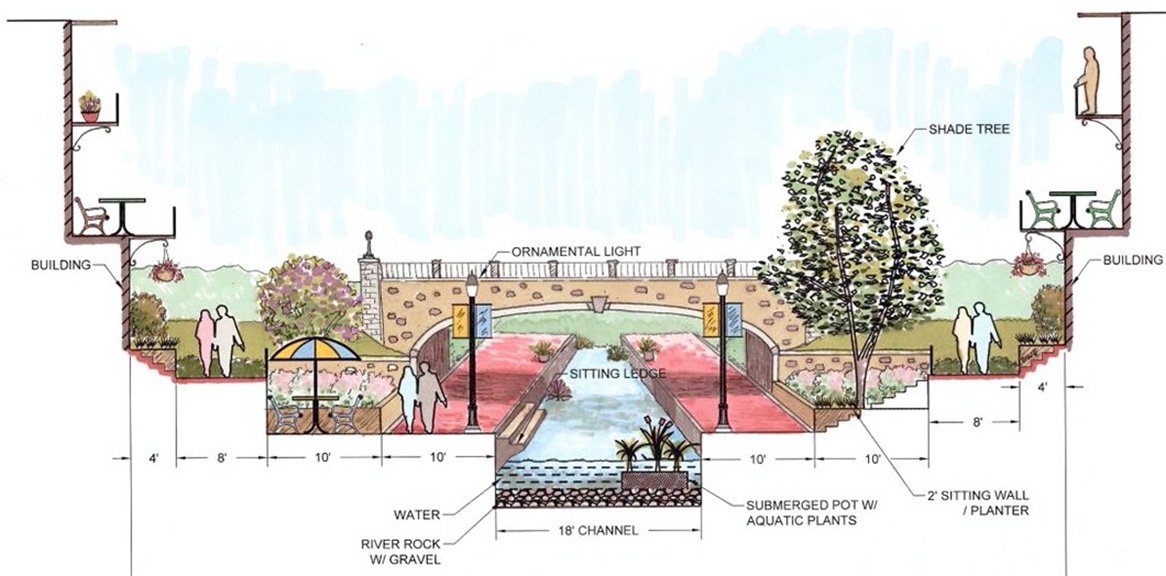
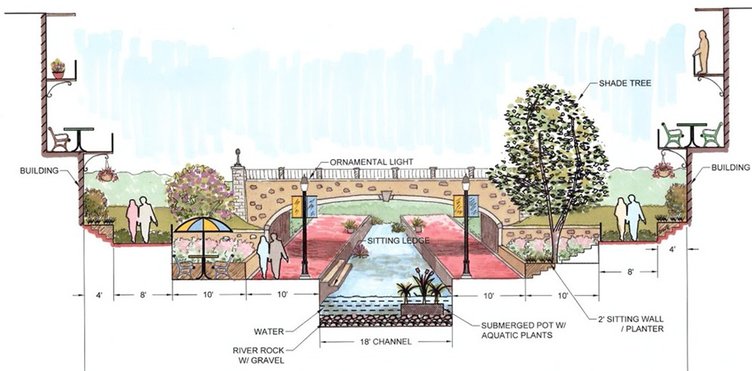
The grant application describes the trail as “a creek-side pedestrian promenade and linear park with … channel improvements” along Little Lotts Creek from the South Main Corridor. Cross-section concept illustrations have been available for several years.
As also noted in the application, the estimated total project cost for the trail and linear park is a little over $25 million.
City Council agreed to approve the latest, $1.4 million, engineering phase-only grant application and simultaneously accept the award by a 4-0 vote during the July 21 evening meeting. Mayor Jonathan McCollar and Councilmembers Tangie Johnson of District 1, Ginny Hendley of District 3 and Shari Barr of District 5 were present in person, and District 4 Councilmember John Riggs attended via teleconferencing. All votes were unanimous at 4-0, with the District 2 seat currently vacant.
Bus agreement
Also during that meeting, the council unanimously approved the annual service agreement with the Coastal Regional Commission, or CRC, for operation of the city’s small-bus public transit system, Statesboro Area Transit. This agreement also involves the GDOT, as well as the U.S. Department of Transportation, and specifically its Federal Transit Administration, or FTA.
“Federal and state guidelines require 50% match for operational expenses and 10% match for capital expenses, estimated by the CRC to be $383,779 and $3,000, respectively,” as stated in the summary memo provided to City Council.
In other words, federal revenue through the FTA covers half of the expense, other than the small amount paid as fare by riders, of operating Statesboro’s bus system. The estimated budget shows $383,779 coming from the federal government plus $383,779 local revenue from the city and just $16,000 projected “farebox” revenue, for a total of $783,558 to cover administrative and operating revenues for the system during fiscal year 2027.
Additionally, the federal government in its Rural Transit Program also provides an even larger portion of funding for approved capital expenses, such as bus and equipment purchases and preventative maintenance. For fiscal 2027, the Statesboro Area Transit budget shows $24,000 federal funding, $3,000 state funding and $3,000 city funding in that category. So that’s where Statesboro’s 10% “capital” match comes in, with the state and federal governments providing 90%.
But on the expenses side, the year’s “capital” budget shows the $30,000 going entirely for preventative maintenance, with no added bus purchases.
However, the estimated budget also shows $15,000 for vehicle repairs as part of the annual operating costs, not considered “capital.” The system’s largest single budgeted operating expense is $318,599 for salaries, including those of drivers, and $163,123 for fringe benefits. The budget includes $100,000 for gasoline, $130,976 for “indirect costs” and $45,000 for vehicle insurance.
The total of the federal, state and local shares in the operating and capital spending budgets is $797,558.
The estimated rider fares make the total budget $813,558.
SPD vehicles
In another 4-0 action on July 21, City Council approved the purchase and equipping of eight new patrol vehicles for the Statesboro Police Department at a total cost of $696,528. For this, the source is the non-transportation SPLOST.
The eight vehicles — seven hybrid and one Ecoboost 2025 Ford Police Interceptors — were purchased through a state procurement contract from Wade Ford for $413,265. They were to be equipped through purchases or contracts with three other companies (amounts rounded to dollars): $50,947 to Patrol PC for mobile data tablets and stands, $72,173 to Motorola for in-car camera equipment, and $160,143 to West Chatham Warning Devices for the up-fitting work.
The Police Interceptor is a slightly lower-slung variation of the Ford Explorer designed for law enforcement use.