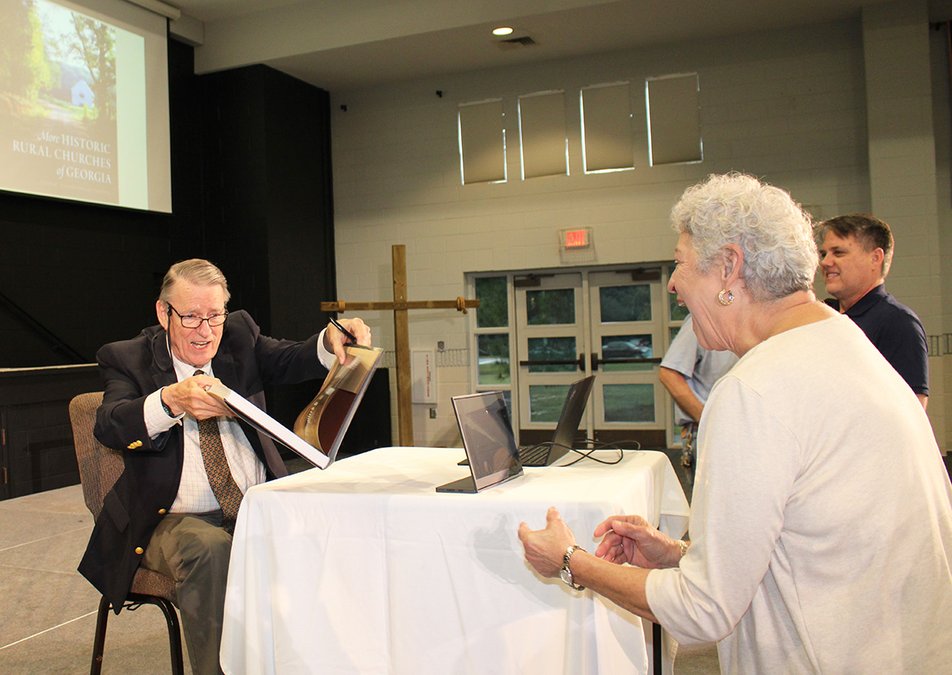
For the Bulloch County Historical Society’s last monthly meeting of 2025, author Sonny Seals came to talk about his new book, “More Historic Rural Churches of Georgia,” which was released Oct. 1, and the burgeoning effort to create a Georgia Historic Rural Church Trail.
Seals co-authored, with George S. Hart, the original “Historic Rural Churches of Georgia,” published in 2016. Both books include art-quality photographs of the historic churches and related buildings, including interior and exterior shots by photographers covering different areas of the state.
The 2016 book, now in its fourth printing, featured 47 historic houses of worship, with eight photographers credited, plus an introduction by John Scott Thomas and a foreword by then-thriving former President Jimmy Carter. Now available from Amazon.com and elsewhere, the 2025 book showcases 50 more churches, with more than 250 images credited to 13 photographers, plus a foreword by Ambassador Andrew Young and an introductory essay by Doug E. Thompson and Noel Leo Erskine.
Seals and Hart had first established, in 2012-2013, a nonprofit corporation, Historic Rural Churches of Georgia Inc., whose website, www.hrcga.org, features more churches than either book. The site includes 450 churches, according to Seals.
What’s rural, historic?
Even for that large a selection, the organizers had to set some boundaries.
“The criteria we set for qualification of the website was set a long time ago, but I think we got it pretty much right. … ” Seals said. “To qualify, you need to have a congregation that was organized prior to 1900. We’re all about 18th and 19th century Georgia history. The location needs to be rural, and how do you define ‘rural’? Well, we define ‘rural’ as being in the country, or a town of less than 2,000 people, and that’s pretty rural.”
Speaking to the Historical Society members and guests during their Oct. 27 meeting in the social hall at Pittman Park United Methodist Church, Statesboro, Seals did not talk about Bulloch County churches specifically. Instead, accompanied by a slide show, he described the broad historical currents reflected in the new book, highlighted mainly by examples of specific churches from Coastal Georgia though the Wiregrass region to the lower Piedmont.
Georgia’s ‘rice kings’
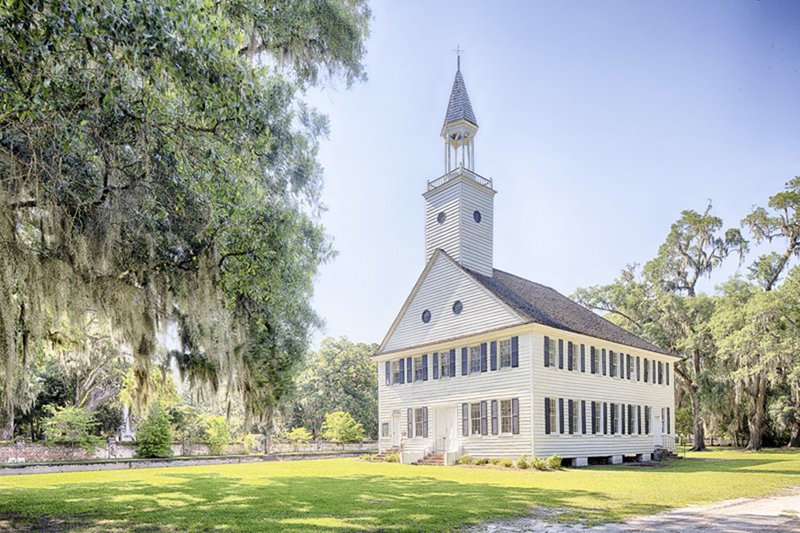
Beginning with the colonial settlement of Coastal Georgia, where plantations were first established for growing rice, he highlighted a chapter called “The Rice Kings” with examples of stately structures such as Midway Congregational Church (established in 1752, present building from 1792) in Liberty County. But that was also the time of the introduction and early growth of slavery in Georgia.
Through the early 19th century, the enslaved Black residents of Georgia often had worship services the same churches, at different times from, the white membership, Seals said. His history of the period does not shy away either from slavery or the taking of Native American lands and forced migration of the native people out of Georgia before and after passage of the federal Indian Removal Act of 1830.
Another segment of his slideshow, “The Uplands and the Rise of King Cotton,” outlined the period that followed the invention of the cotton gin in 1793. He particularly focused on the development of an area called “Prosperity Ridge,” around the Oconee River northeast of Macon and south of Athens.
In that region, Penfield Baptist Church, established in 1839, was originally the chapel for Mercer Institute, established 1833, which was renamed Mercer University and later moved to Macon. The extant church building, completed in 1845-1846, is an elegant Greek Revival-style structure amid ruins of other buildings and the cemetery, including the recently identified slave cemetery, in Penfield, a ghost town in Greene County.
Walker Grove, Newington
African American residents of rural Georgia began to organize churches of their own just before and after the Civil War, and after emancipation often created church-affiliated schools for their children. One example Seals included in his slideshow was Walker Grove Baptist Church and School, organized in 1895, whose white-painted church and raw wooden school building still stand in the Newington area of Screven County.
The historical brief on the Historic Rural Churches of Georgia website traces the Walker Grove congregation back to Middle Ground Baptist Church, “constituted in 1827” which “became the mother church of Cypress Pond Baptist, organized in 1867 by newly freed African Americans.” Then, “from Cypress Pond came Walker Grove Baptist,” description states.
Five Bulloch churches
Again, Seals didn’t single out Bulloch County churches, but the website, www.hrcga.org, features five churches in Bulloch. The site contains a map and is searchable by county.
Just one of the Bulloch County churches, the oldest, Union United Methodist, dating from a congregation organized in 1790, is featured in the new book. Union Methodist is described on the website as “one of the oldest churches in Georgia’s backcountry to remain in continuous use at its original location.” It was first established in the home of Revolutionary War veteran Joshua Hodges. But the current building was completed in 1884.
The website cites Union Methodist’s rolls as listing “five white men, fifteen white women, and five Black members” in 1844.
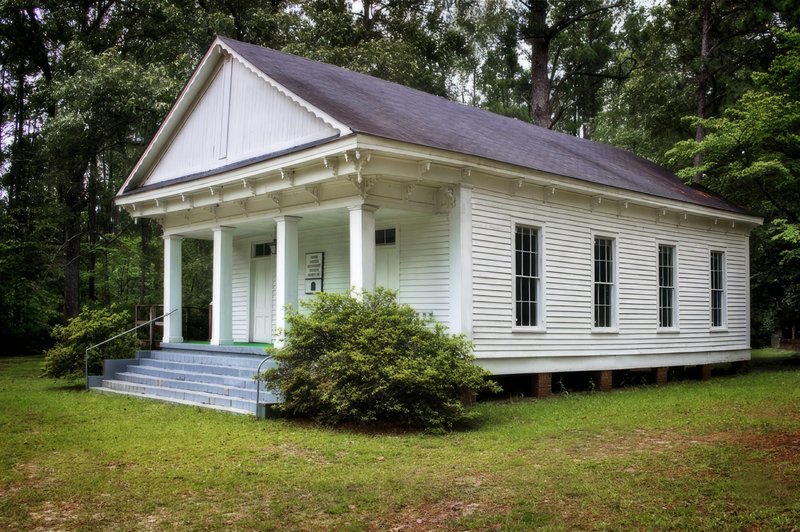
Upper Lotts Creek Primitive Baptist, second oldest Bulloch County Church pictured on the website, was established in 1832 as Parrish’s Meeting House. But after a fire destroyed the original building in 1841, the church was rebuilt with the new name. The current building dates from 1881.
Mount Pisgah Primitive Baptist Church, organized in 1883, is also known as Fish Trap Primitive Baptist, and continues its traditions as one of the oldest extant African American Primitive Baptist churches in Georgia. Elder Aaron Munland, born enslaved in South Carolina and relocated by sale to Bulloch County in 1856, was barred from preaching in white congregations. But encouraged by a white minister to found a separate congregation after emancipation, Munland with family members and friends founded Banks Creek Primitive Baptist in 1879. This was followed by the founding of Bethel Primitive Baptist in 1882 and Mount Pisgah a year later.
Other Bulloch County churches featured at www.hrcga.org are Pleasant Hill Methodist, founded in 1879, and New Hope Methodist, organized in 1807 but with its current building dating from 1908. Like Union Methodist, New Hope is shown by church records to have had both white and African American members prior to and immediately after the Civil War. But “after 1870, Black members were assisted in establishing their own church,” the website states.
Blazing a trail
Seals “has done much more for Georgia than author two fascinating and historical books,” Virginia Anne Franklin Waters, the Bulloch County Historical Society’s executive director, said in introducing him. “He is working with the Georgia Legislature on establishing a Historic Georgia Church Trail throughout our state, using resources from the state … and also those from Emory University.”
Sen. Billy Hickman, R-Statesboro, 4th District, has been instrumental in securing state funding for the trail project, with an initial amount of a little over $121,000, according to Seals. He also credits Zandra Overstreet of the Newington Heritage Society and Waters with mustering support for the plan.
Georgia Tourism, which is an arm of the Department of Economic Development, and three of the state’s 12 regional commissions – those for Northeast Georgia, the Central Savannah River Area and the Coastal Region, as well as Emory are involved in the collaboration.
“This is a state-sponsored program which will be administered by the CSRA Regional Commission in Augusta. …,” said Seals. “The idea is to take it all over Georgia eventually, but this Phase 1 just covers these first three regions.”