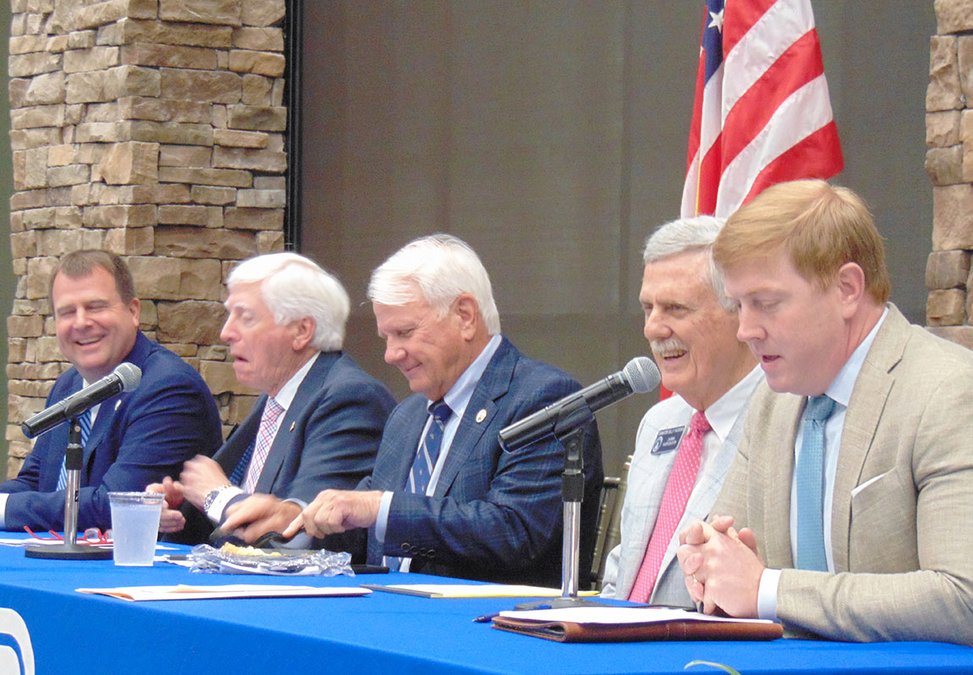
Sen. Blake Tillery, R-District 19, Vidalia, chairman of the Georgia Senate Appropriations Committee, acknowledged that monthly revenues have slowed but said that conservative spending practices leave the state government able to withstand some loss of revenue without spending cuts.
Georgia House Speaker Jon Burns, R-District 159, Newington, talked about, among other things, a new version of a law that could allow a state oversight commission to discipline and potentially remove district attorneys.
Other state lawmakers who took part in the Thursday, May 2, “Building a Better Bulloch Together” luncheon sponsored by Morris Bank were Sen. Billy Hickman, R-District 4, Statesboro, who chairs the Senate Higher Education Committee; Rep. Butch Parrish, R-District 158, Swainsboro, chair of the House Rules Committee and the Special Committee on Healthcare; and Rep. Lehman Franklin, R-District 160, Statesboro, who is still in his first term and does not yet chair a committee, but who Burns said “is going to be easy to promote.”
So, legislation having to do with health care, including changes to the Certificate of Need law for hospital expansions; and education – particularly Hickman’s focus on literacy – were other topics of the 2024 presentation. The luncheon was held in the Jack Hill Building at Ogeechee Technical College. Tillery was the one panel member whose district does not include any part of Bulloch County. But he and Hickman are heirs to different parts of the late Sen. Jack Hill’s political legacy, since Hickman represents District 4, which was Hill’s district, but after redistricting, Hill’s home county, Tattnall, is now in Tillery’s district, and Tillery chairs the Appropriations Committee, as Hill did for many years.
“It’s been an incredibly exciting time for Georgia since 2020,” said Tillery. But previously chairman of the Toombs County Commission, he said he remembered officials talking about what they would do “if we had money.”
“Well, over the past four years we’ve had money,” Tillery said. “That money’s starting to dry up; you’ll be starting to hear those stories pretty soon, too, but over the past we’ve seen our budget increase by 33 percent, roughly. That’s not something that as conservatives we sit up here and are going to brag about. … Well, why are we spending that much more money? Well, two reasons. One, Georgia is continuing to grow.”
Georgia added about 2 million people during the past decade, he noted.
“I mean, our per capita spending is still the 49th in the states,” Tillery said. “We’re never going to get below Alaska; Alaska pays you to be there. But we’re going to be 49th for as long as you continue to elect the conservative leadership that you have to my right.”
“The second reason is inflation,” he said. “I mean, it’s killing us. …”
“The next year’s budget we’ll not be able to be as friendly.” Tillery added.
He noted that in previous midyear amended budgets, the General Assembly typically added about $200 million “almost exclusively to education,” but that last year’s amended budget “added $1.5 billion in one category alone, infrastructure,” and more than $3 billion total.
“That will not be the case next year, mainly because what we saw this past month was negative revenue over the year before, again,” Tillery said.
Projected out for a year, the state will probably see a 4% to 6% revenue decline, he said, adding, “but again, because those leaders to my right have been so conservative in their budgeting, we’re going to be able to handle it.”
Literacy efforts
Although Hickman, a certified public accountant, might be expected to be involved with those numerical and monetary concerns, he said, he has made improving Georgia’s literacy rates, especially for children in elementary school, his special focus the past two years.
“In 2022, during the pandemic, in the state of Georgia only 32% of children in the fourth grade were reading on grade level. …,” Hickman said. “Prior to the pandemic, in 2019, it was 43.49%. That means 57% of children do not read on grade level … and quite honestly, those numbers do not get better so far. Work force development? How can we have a workforce developed if the people can’t read?”
Senate Bill 211, which he sponsored, created the Georgia Council on Literacy last year, and one of the council’s first meetings was held in Statesboro. Related legislation, House Bill 538, mandates the use of “science of reading” evidence-based approaches, including phonics instruction, and assessing students’ progress three times a year with “reading screeners” from a state-approved list.
“We’re going to test our children,” Hickman said. “We need to know where they’re at. We don’t need to wait until they get in fifth grade to find out they can’t read.”
Actual implementation of the screening program has been postponed by another year, he acknowledged.
Certificate of Need
Appointed by Burns during the 2023 session to chair a “Study Committee on Certificate of Need Modernization,” Parrish then became the primary sponsor of this year’s House Bill 1339. Certificates of Need, determining the size of health care facilities, such as by permitting a certain number of beds for hospitals, were originally established under a 1974 federal law. The federal law, intended to prevent unnecessary duplication of equipment and costs, was repealed in 1986, Parrish explained, but Georgia became one of a number of states that kept its own version of the law, changing it several times over the years.
“When we were having these committee meetings, some wanted to totally abolish Certificate of Need, and at the other end of it, some didn’t want to (change) anything,” Parrish said. “So what we tried to do is make an intelligent decision, listening to the facts … and try to come up with something that made sense, and that’s what we did.”
Under House Bill 1339, approved with bipartisan support, the basic permitting process remains in effect, but exemptions and exceptions have been introduced, he noted. For example, a hospital that has closed – as has happened with several of Georgia’s rural hospitals – but finds the means to reopen can now do so without having to go back through the Certificate of Need process “which would have taken years and many dollars to do,” Parrish said.
Beds for psychiatric and substance abuse in-patient programs will also be exempted, and rural hospitals can expand obstetric services more easily under certain conditions, he said.
John Roach, Morris Bank’s Bulloch County market president, prompted the legislators’ comments by reading topic questions directed to one or more of them.
Oversight of D.A.’s
Burns was asked to explain Senate Bill 332 on “Prosecutorial Oversight.” It re-authorizes a Prosecuting Attorneys Qualification Commission to investigate complaints against prosecutors, including elected district attorneys and county solicitors-general.
“It’s very clear (in) our state, not just in some high-profile cases, that D.A.’s around the state aren’t following the law. They’re picking and choosing which portions of the law they follow. So we knew that it was time, past time, to pass legislation that will now require D.A.’s to follow the law, simply put, to follow the Constitution of the United States and of Georgia, and the laws of Georgia. And I’ll say our local D.A. was supportive of our efforts. Some D.A.’s were not, across this state.”
He said, “Some of them are probably – I’ll just use this term, so we can all recognize it – some of them are commonly referred to as ‘woke D.A.’s.”
After saying, “There’s one in Atlanta that gets some notoriety; there’s one in Athens; there’s one in Columbus,” Burns added that the bill “has been in the works four years in the General Assembly” and is “not in reaction to a specific situation with any D.A. right now.”
Senate Bill 332, as signed into law by Gov. Brian Kemp, is a page and a half long. It removes a provision from an earlier version of the legislation, passed last year, that gave the Georgia Supreme Court final say in adopting standards for prosecutors, after those standards were to be drafted by the state-appointed commission with input from the Prosecuting Attorneys Council. The court in November declined to approve such standards, with justices stating that setting standards for prosecutors, who exercise executive power, “would likely be beyond the scope” of the court’s judiciary power.