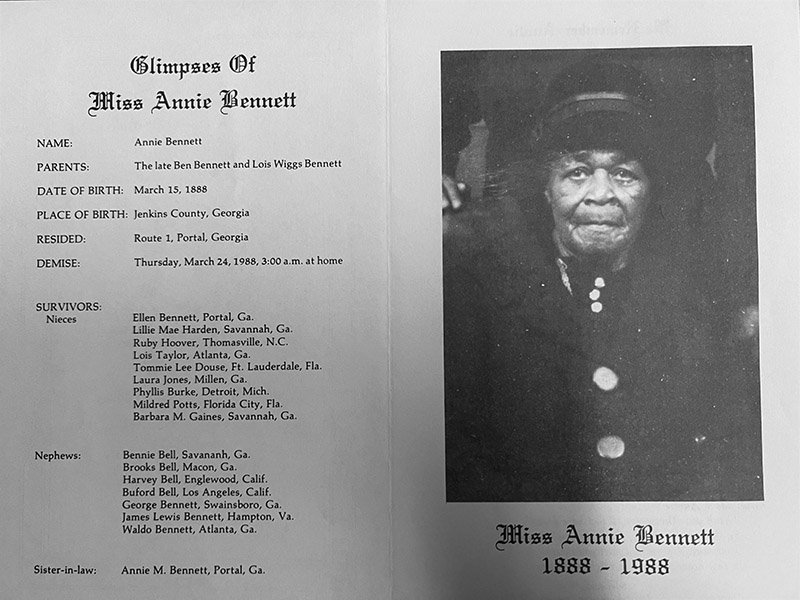
The Institute of Museum and Library Services, a federal agency, has awarded the Willow Hill Heritage and Renaissance Center $92,000 to continue the digitization of its collection of roughly 15,000 printed and written programs from African American funerals dating from the 1940s forward.
This is the second time the Willow Hill Center, based in the historic Willow Hill School near Portal in Bulloch County, has been awarded a grant through the IMLS. But the first IMLS grant the center received, in 2020, was from Coronavirus Aid, Relief and Economic Security (CARES) Act funding. That grant, for $109,420, helped equip Willow Hill’s campus and pavilion with broadband, Wi-Fi, computers and staff for open-air learning.
But the new two-year grant, expected to be funded beginning in July, comes from the regular program of Museum Grants for African American History and Culture. The $92,000 was one of 34 grants the IMLS awarded to as many museums and organizations. Together these grants total $6 million, and grants for more than $100,000 each required matching non-federal funds, which totaled $8,002,981 more, according to an IMLS news release June 15.
Dr. Alvin Jackson, president of the nonprofit Willow Hill Center’s board, compiled the collection of 15,000 or so programs over 35 years as a volunteer effort, said his daughter Dr. Nkenge Jackson-Flowers, now the African American Funeral Programs project coordinator.
“Funeral programs, which include biographical information on the deceased individual as well as order-of-service information, are a tool that genealogists use to fill in the some of the gaps for African Americans,” she told the Statesboro Herald. “Unless you’re famous, it’s the one place where your history is written down.”
So there are in many states growing collections of African American funeral programs, she said.
For years, Alvin Jackson collected thousands of funeral programs centered on Bulloch County, where he had grown up, and especially the Willow Hill and Portal areas. But word of what he was doing eventually attracted gifts of collected material from African American families who had moved to other states as part of the Great Migration.
The process of digitizing the programs to a searchable online database began as a non-thesis master’s degree project for Sarah Napier Tria when she was a Georgia Southern University public history grad student, in 2016-2017, under the guidance of Dr. Michael Van Wagenen, GS Public History Program coordinator.
After Tria graduated, several other students, including undergraduates from the university’s history and sociology departments, continued the work for shorter stints as Willow Hill summer interns or volunteers. Community volunteers have also contributed.
In 2021, the Digital Library of Georgia began harvesting the contents of the database, quarterly, from the Georgia Southern’s Digital Commons, and through this the collection also becomes accessible through the Digital Public Library of America. The collection, as far as it exists online, has been downloaded over 20,000 times and from places in 135 countries, Jackson-Flowers said.
About 20% done
But so far, just a few more than 2,700 of the 15,000 funeral programs have been digitized to Georgia Southern’s Digital Commons.
Adding more requires meticulous work, Jackson-Flowers explained. The programs range from printed bulletins several pages long with photographs to fragile, handwritten flyers from the mid-20th century, and in addition to scanning them in, human beings have to select and type in key words to enable searches of the database.
“When you can aggregate a large collection, then you can do a keywording search by area, you can do it by funeral home, you can do it by name,” she said. “What makes the database really superior is the number of reports that you can pull. So, if you want to know everyone that was buried at a particular cemetery, you can put in that key word.”
Jackson-Flowers, her mother Dr. Gayle Jackson – who is the Willow Hill Center’s development director – and Beth Burnett, digital scholarship librarian for the Georgia Southern University Libraries, wrote the grant proposal. The Zach Henderson Library’s Special Collections, the GS Public History Program, community members and the African American funeral homes in Bulloch County will all be “involved in making this collection a success,” said Jackson-Flowers.
Interns and manager
The grant will fund two internship positions for the two years, plus a part-time collections manager who is a Willow Hill Heritage and Renaissance Center staff member. Tiffany McCloy is already serving as the collections manager.
Van Wagenen and Dr. Brent Tharp, the Georgia Southern University Museum director, volunteer as project consultants, and Burnett and Special Collections Librarian Autumn Johnson also remain active supporters.
Besides making the collection accessible to researchers and the public, the project will provide paid internships for students preparing for careers as museum professionals.
“My students have always loved working with Willow Hill, not just for having accomplished an internship, but actually feeling like they’ve contributed and made a difference to an important cause in our community,” said Van Wagenen. “So it’s very personally enriching for the students as well, which makes the internship experience even better.”
A video entitled “Archival Silence: Closing the Gaps in American History in Bulloch County, Georgia,” highlighting this and related projects, appears on the center’s homepage at www.willowhillheritage.org.
Below the video portal, a “WHHRC African-American Funeral Programs” tab leads directly to the collection.