This week and next, the pencils meet the paper - and the fingertips the keys - as more than 4,500 Bulloch County students in third through eighth grades take the Georgia Milestones test for the first time.
Over time, Milestones will be a major departure from the Criterion Referenced Competency Tests it replaces. The new test brings new types of questions, which students are expected to answer in their own words. Eventually, Georgia Milestones testing also will be done exclusively online, in contrast to the all on-paper, all multiple-choice CRCTs.
But these features are being phased in. Only about a third of Georgia students are taking the test online this year. In Bulloch County, only the fourth and seventh graders, as well as students who need the test in an audible format, are testing online.
Meanwhile, the test questions and scoring are still in a trial phase. With results not expected back until the fall, this year's test cannot be used for student promotion decisions.
"We are telling the students that we will get the results back and that we will be using their results to determine how we move forward with their educational plans," said Brenda Kingery, testing coordinator for Bulloch County Schools.
A brochure the schools sent parents emphasized that the testing will serve important purposes even though it won't count for promotion. The tests are designed to give the schools feedback on how well they are working with the state-adopted standards for learning.
The test reports also should provide information on specific students' strengths and areas in which they need more instruction, Kingery said.
In future years, test scores that meet the state proficiency levels will be required for students to move up from the third, fifth and eighth grades, just as certain CRCT scores were required in these "gateway" grades.
But this year, there really is no gateway test for Georgia students.
Testing the test
Among the first-year Milestones questions are some "field-test" items designed to try out different testing approaches, Kingery said. A few norm-referenced items, which the test creators are administering to groups of students in other states, also are imbedded in the tests. Although the Milestones tests are made for Georgia, state officials wanted them to have national norms.
But "constructed response" items are a new type of question that will count in students' scores. On the English-language arts tests, these are short-answer or essay questions. On the math tests, these items ask students to explain their answers.
So far, the science and social studies tests do not include any constructed response questions.
"The majority of all the tests are still, right now, what you would call selective or multiple-choice, and this year, there are limited constructed response items, but as we move into this program, more of the constructed response will be included in the test," Kingery said.
Of 44 items that count on a language arts test, only four are constructed response questions, she said. That test also includes 16 items that will not count toward a student's score.
Of 73 items on a math test, only three are constructed response questions that count.
Preparations
"Teachers have been preparing students from day one," said Dr. Mary Felton, assistant superintendent for curriculum and instruction. "As a curriculum department, from the district level, we've been working with teachers to make sure that they prepare the students."
Although given at different times of the year, the end-of-course tests required for high school students also are considered part of the Georgia Milestones program. Training sessions, especially in math, were provided for teachers in third through 10th grades, Felton said.
For math, teachers learned a strategy called ACE. This means teaching students "to Answer, to Compute and then Explain," which fits the requirements of constructed response questions.
For English-language arts, social studies and science, the focus has been on "depth of knowledge." Classroom exercises are supposed to teach students to think critically about what they read and to respond in writing.
The school system also administered tests with similar question types, created by a company called WriteScore, to students twice this school year.
"I would say that there's no overemphasizing of testing," Felton said. "Our focus was emphasizing standards mastery, because with the change of the standards that we got from the state of Georgia, the requirements for students have changed."
If the schools teach the standards to mastery, students should be successful on the tests, she said.
A few schools also held academic pep rallies immediately before spring break, aimed in part at the testing.
Langston Chapel Middle School had a motivational speaker, De'Andre Davis, talk to students during its April 10 pep rally. That same day, the LCMS step team went to Mill Creek Elementary, rapping to motivate students there. Mill Creek's rally was for prekindergarten through fifth grade, not just those students in third grade and up now taking the tests. Its messages emphasized attendance, being on time, following directions and "doing your best, whether you are in class or taking a test or anything," said Mill Creek Principal Patrick Hill.
In regard to the tests, he said, the school wants to encourage students but not pressure them.
"Just like every year, we don't want to make it high pressure, but our teachers take it very seriously, and the students understand that, too," Hill said.
Makeup day
Tests for English-language arts and math continued through Thursday. Today will be a makeup day for students who missed tests earlier in the week. Tests in the other subjects will be administered Monday and Tuesday, with the rest of next week available for makeup tests.
Classroom instruction continues in nontesting hours. Most of the tests last about one hour. The longest is the writing section, considered part of English-language arts but given on a separate day, at 90 minutes, Kirkland said.
All Georgia school systems were required to test 30 percent of their students with the Internet-based version this year, and the fourth and seventh grades were chosen locally to avoid the usual gateway grades, said Monica Lanier, assistant superintendent for organizational effectiveness.
Two more grades will be tested electronically next year, and all are expected to take Web-based tests the third year, she said.
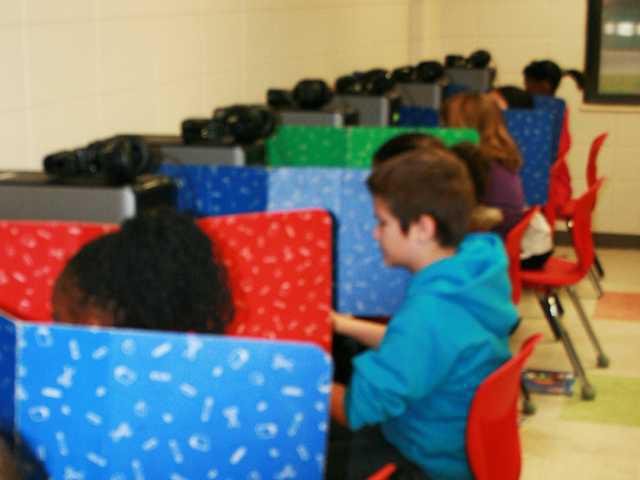
Besides using existing computer labs, schools have set up classrooms with additional computers as testing stations. At Mill Creek, besides three computer labs, Chromebook laptops are being used for wireless testing in one fourth-grade classroom and for some small groups.
"We haven't been used to doing online testing, but kind of having a hybrid of some classes doing paper-pencil and some doing online, it's been pretty smooth," Hill said Wednesday.
Al Hackle may be reached at (912) 489-9458.